
Author: Zinniia Manna, Maharashtra National Law University, Mumbai
To the Point
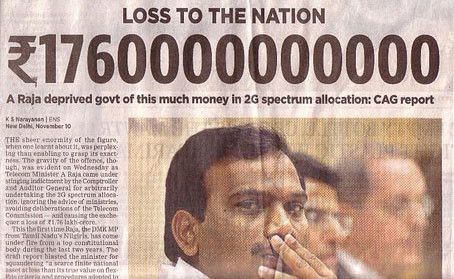
The 2G Spectrum Scam is considered one of India’s biggest corruption scandals because it exposed how political power and corporate interests can unfairly benefit a few at the cost of the entire nation. In 2008, valuable telecom spectrum licenses were distributed at extremely cheap prices based on a “first-come-first-served” system, even though demand was very high. The Comptroller and Auditor General of India (CAG) estimated that this caused a loss of almost ₹1.76 lakh crore to the public. The Supreme Court later stepped in and cancelled 122 of these licenses in 2012, saying that the allocation violated fairness and transparency.
However, in 2017, a Special CBI Court acquitted all the accused, including the then Telecom Minister A. Raja, because the evidence was not enough to prove a criminal conspiracy. This left many citizens confused. If there was no scam, then why did the nation suffer a huge financial loss and why did the Supreme Court cancel the licenses? The case shows a major gap between justice in words and justice in action. It revealed that India’s systems to detect and punish corruption still have many weaknesses. Today, the 2G case remains extremely important because it teaches that economic development must be supported by honest and strong institutions.
Abstract
The legal battle began when public interest groups challenged the manner in which the government distributed telecom spectrum. The petitioners argued that giving licenses at outdated 2001 prices in 2008, without a fair auction, violated the Constitution. They said that natural resources like radio spectrum belong to the public and the government must act as a trustee. If the government secretly helps only some companies, it violates Article 14 by acting unfairly and without reason.
The Supreme Court agreed with this view and restored transparency by cancelling all wrongly issued licenses. It declared auctions as the preferred method for distributing national resources, because they ensure equal opportunity and prevent corruption. But when the case went to trial, the prosecution could not prove direct bribery or exchange of money. The court said there was no clear evidence linking the policy decisions with illegal gains. This difference in outcomes shows that constitutional protection of fairness is strong, but criminal justice enforcement is weak. The case therefore reveals the need for major reforms in how India investigates economic crimes and ensures accountability.
Use of Legal Jargon
The 2G Spectrum Scam brought important legal ideas to the surface. The first one is Article 14 of the Constitution, which protects equality before the law. The Supreme Court held that government actions cannot be arbitrary or favour certain companies secretly. Even if a policy exists, it must be used fairly. This is called substantive equality, where the court checks whether the action truly protects the rights of all citizens.
Another important doctrine applied was the Public Trust Doctrine. It means natural resources are not private property of the government. The State is only a caretaker for the people. So, when spectrum was handed over cheaply, the State failed in its duty to protect the wealth of citizens. The Court made it clear that public welfare (Salus Populi Suprema Lex) must always come before private profits.
The case also involved Judicial Review, which allows courts to check if government decisions harm constitutional values. Although the government argued that resource allocation is a “policy decision,” the Court said that if a policy harms equality and public interest, the judiciary must step in.
However, criminal law requires strict proof. This is where the 2017 judgment highlighted challenges. Corruption today does not always involve visible bribe transactions. It involves regulatory capture, political influence and manipulated procedures, which are hard to establish in court. Therefore, the acquittal reflected a major gap in enforcement rather than the absence of wrongdoing.
The Proof
The effects of the 2G scam went far beyond legal judgments. Ordinary consumers faced network disruptions and the market suffered confusion due to the sudden cancellation of licenses. Investor confidence in India was badly shaken. Many foreign companies like Etisalat and Telenor lost money and exited India. This showed that corruption is not just a political issue, it directly affects the economy, employment and technological development.
The scam also revealed a major flaw in governance: important decisions were taken behind closed doors, without clear records. Investigating agencies struggled because documents were not properly maintained, meetings were informal and instructions were sometimes verbal. This made it difficult to prove who benefited and how. The Special CBI Court even remarked that the investigation lacked clarity and strong evidence.
People noticed that the powerful often escape legal punishment even when the wrongdoing is clear. This weakened public trust in the justice system. Media reports and Parliament discussions created huge pressure on the government. It led to a nationwide conversation about political corruption, influencing major movements like Anna Hazare’s India Against Corruption campaign.
This case also created change at the policy level. After the Supreme Court ruling, the government shifted to transparent auctions for spectrum. The revenue earned was much higher than before, proving that the earlier prices were unfairly low. The case showed that strong rules and systems are necessary for a fair market.
Contemporary Relevance
Even today, the 2G case is discussed as an example of how national resources can be misused if watchdog institutions are weak. It highlights the importance of strengthening the independence of regulators like TRAI, improving transparency in public allocation and reforming how political funding works. India’s economy today depends heavily on telecom and digital technology. So, ensuring fairness in resource distribution remains essential for the future. The case also encourages citizens to stay alert and demand accountability so that public wealth benefits everyone and not just a select few.
Case Laws
Ramana Dayaram Shetty v. International Airport Authority of India (1979)
This case laid the foundation for fairness in government decision-making. The Supreme Court held that the State cannot act in an arbitrary or secretive manner while giving public contracts. If the rules are suddenly changed or applied selectively to favour certain private parties, it violates Article 14 of the Constitution. In the 2G case, the government altered the cut-off dates without proper public notice and only a few companies were informed in advance. Using the principle from this judgment, the Supreme Court declared that the allocation of spectrum lacked transparency and equal opportunity.
Reliance Natural Resources Ltd. v. Reliance Industries Ltd. (2010)
This judgment reinforced the Public Trust Doctrine, recognising that natural resources belong to the people and not to the government in power. The State acts only as a trustee and must ensure resources are used for the common good. In the 2G controversy, valuable radio spectrum was given away at old, undervalued rates, which meant citizens did not receive the rightful economic benefit. Based on this decision, the Court observed that the government failed to protect public wealth while allocating spectrum.
Centre for Public Interest Litigation v. Union of India (2012)
This is the main case where the Supreme Court cancelled 122 telecom licenses issued in the 2008 allocation. The Court held that the first-come-first-served method was unconstitutional because it lacked fairness and discriminated in favour of a few companies. The Court stated that auctions are the most transparent way to distribute scarce national resources since they prevent corruption and ensure equal access. This ruling brought a major shift in India’s telecom policy and strengthened judicial oversight over economic governance.
International Comparison
South Korea’s Telecom Corruption Trials
In South Korea, similar telecom corruption led to criminal action against business heads and top political leaders. Their courts ensured swift punishment and strong accountability. This shows how decisive enforcement can rebuild public trust when national resources are misused.
Brazil’s Petrobras Reforms
Brazil’s major corruption scandal involving Petrobras triggered reforms in political funding and government contracts. The example demonstrates that corruption cases, if handled strongly, can lead to long-term improvements in governance and transparency.
United States – FCC Auctions
The United States follows an independent and transparent auction-based system for distributing spectrum. The FCC ensures that all bidders receive equal information and that rules cannot be manipulated. This model prevents favouritism and shows the value of strong institutional checks.
These examples show that strong anti-corruption frameworks must include effective investigation, punishment and transparent public policies.
Conclusion
The 2G Spectrum case remains a historic moment that exposes the risks when business and politics become too close. The Supreme Court played a big role in bringing fairness back into the system by cancelling the illegal licenses. But the later acquittals show that corruption can escape punishment when evidence is weak or systems are inefficient.
The case teaches us that India must upgrade how corruption is investigated and prosecuted. It also shows that transparent procedures like auctions are better than personal discretion in distributing public resources. For the future, India needs stronger regulators, clean political funding, faster justice and better whistleblower protection. Only then can the public trust the system completely.
Even though the scam is now more than a decade old, its lessons are still very relevant. The true success of the 2G case will only be seen when similar misuse of resources never happens again and fairness becomes a natural part of governance.
FAQs
Was the ₹1.76 lakh crore loss ever fully proven?
No, it was an estimate by CAG based on market value, but still showed major unfairness.
Why did the Supreme Court cancel licenses if no one was convicted?
Because the process itself violated equality and public interest, which is enough for judicial action in civil matters.
What major legal principle was applied?
The Public Trust Doctrine, government holds natural resources for the people.
Did the case improve India’s telecom sector?
Yes, later auctions earned much higher revenue and increased transparency.
Why does this case still matter today?
It highlights weaknesses in the justice system and the need for corruption-proof institutions.

