Author: Khushi Pursnani, Subodh Law College, Jaipur
To the Point
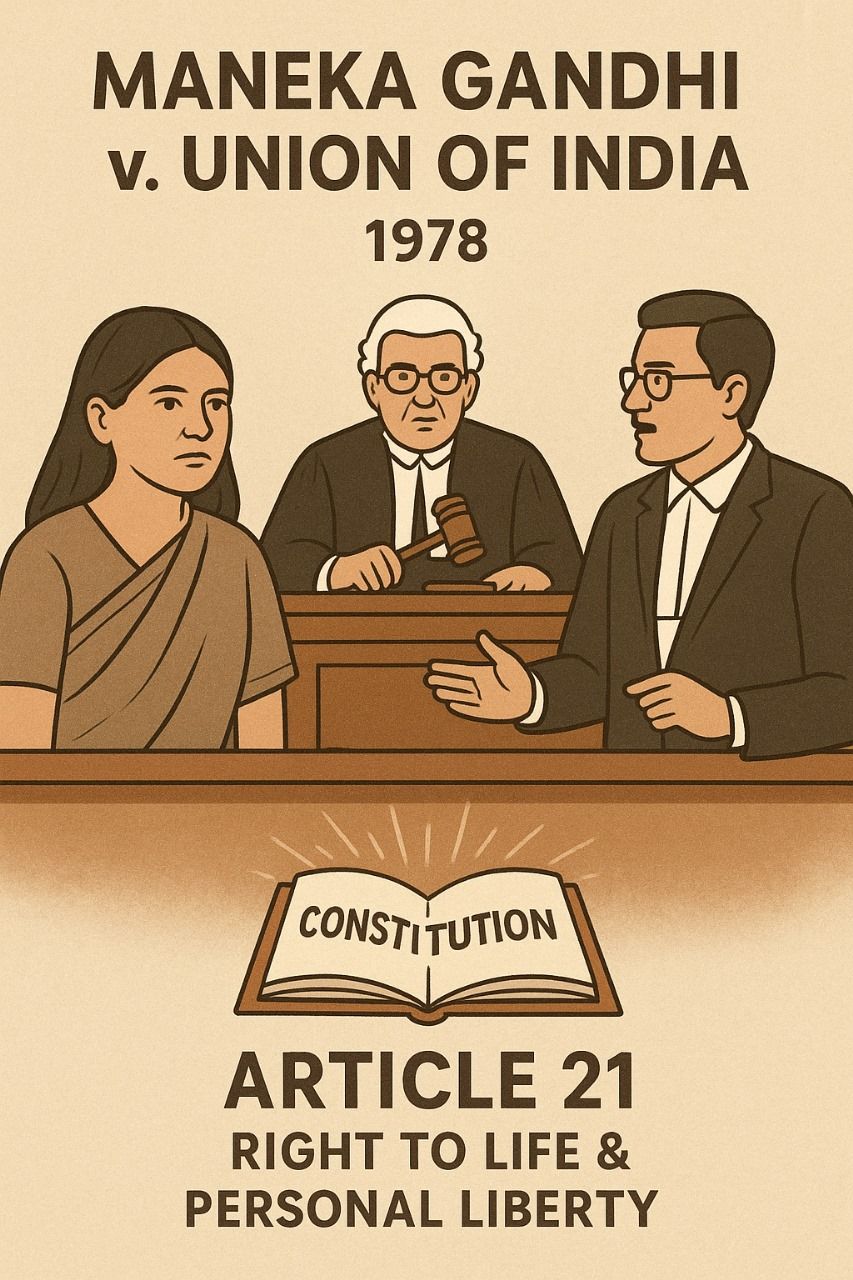
The landmark case of Maneka Gandhi v. Union of India (1978) changed how Article 21 of the Constitution of India is understood by determining that the right to life and personal liberty encompasses more than mere physical existence; it also includes the right to live with dignity. This decision broadened the interpretation of “procedure established by law” to signify a just, fair, and reasonable procedure, thus connecting Articles 14, 19, and 21 in a fundamental rights framework often referred to as the golden triangle.
Abstract
The landmark judgement redefined the concept of personal liberty and expanded its scope. The Supreme Court judicially incorporated the American doctrine of due process into Indian law. The decision led down Articles 14, 19, and 21, as the “Golden Triangle”, which is known as the foundation of constitutional jurisprudence in India.
Use of Legal Jargon
Article 21 – No person shall be deprived of his life or personal liberty except according to procedure established by law.
Principle of Natural Justice – Audi Alteram Partem (right to be heard).
Golden Triangle – It is a doctrine which established interrelation of Articles 14, 19, and 21.
Judicial Review – Power of courts to test the validity of State actions.
Due Process of Law – Though not expressly mentioned in the Constitution, was read into Article 21 after this case.
The Proof
Facts: Maneka Gandhi’s passport was impounded by the Government of India “in the public interest” under Section 10(3)(c) of the Passport Act, 1967, without furnishing her reasons.
Issue: Whether this seemingly random action infringed upon her basic rights as outlined in Articles 14, 19, and 21.
Judgment: The Supreme Court held that the procedure established by law must be “just, fair, and reasonable,” thereby reading due process into Article 21. The impugned order was thus constitutionally infirm.
Case Laws
1. A.K. Gopalan v. State of Madras– Earlier, the court had given a narrow interpretation of Article 21, holding that “procedure established by law” meant any law duly enacted, even if unjust.
2. Keshavananda Bharati v. State of Kerala– Established the Basic Structure Doctrine, which inspired the court to safeguard personal liberty from arbitrary State action.
3. Maneka Gandhi v. Union of India – Overruled A.K. Gopalan to the extent it gave a restrictive view of Article 21. The court held:
“Procedure established by law” must be just, fair, and reasonable.
Fundamental rights are not mutually exclusive but interconnected.
Freedom of movement under Article 19 and equality under Article 14 must be considered while interpreting Article 21.
4. Subsequent Influence –
Sunil Batra v. Delhi Administration – Right against cruel and inhuman treatment in prison.
Francis Coralie Mullin v. Administrator, Union Territory of Delhi – Right to live with dignity.
Olga Tellis v. Bombay Municipal Corporation – Right to livelihood.
Justice K.S. Puttaswamy v. Union of India – Right to Privacy.
Conclusion
The judgment in Maneka Gandhi v. Union of India transformed Article 21 from a restrictive guarantee into an expansive repository of human rights. It fortified constitutionalism against arbitrariness, paving the way for judicial activism in protecting civil liberties. This case continues to be a cornerstone of Indian constitutional law, inspiring subsequent jurisprudence on liberty, dignity, and fairness.
FAQS
Q1: Why is Maneka Gandhi v. Union of India considered a landmark case?
Because it expanded Article 21, introducing the principle that procedure must be just, fair, and reasonable, effectively importing due process into Indian law.
Q2: How did this case differ from A.K. Gopalan?
Unlike Gopalan, which allowed arbitrary laws as long as procedure was followed, Maneka Gandhi held that laws and procedures must meet tests of fairness and reasonableness.
Q3: What was the practical impact of this case?
It broadened the ambit of Article 21, influencing rulings on prisoners’ rights, livelihood, privacy, environment, and more.
Q4: Does this case still hold relevance today?
Yes, it laid the foundation for modern rights jurisprudence, including the recognition of the Right to Privacy in K.S. Puttaswamy v. Union of India (2017).