Author: Khushboo, Symbiosis International University.
To the Point
The Red Sea Crisis marks a crucial moment where regional conflicts have crossed borders and started to disrupt global trade. Ongoing threats to commercial shipping have revealed the weaknesses in international supply chains and highlighted the strategic importance of maritime chokepoints. The crisis extends beyond just security issues; it has become a matter of global economic stability, international legal standards, and geopolitical influence. By targeting trade routes, both non-state groups and governments are changing global trade politics through force instead of traditional diplomacy.
Abstract
The ongoing Red Sea Crisis represents a major shift in how regional conflicts affect global economic systems. What was once seen as a local security problem has turned into a wider disruption of maritime trade. This situation reveals the weakness of global supply chains and the way trade routes can be used as tools for power. Regional actors have carried out sustained attacks on commercial vessels operating in the Red Sea and the Bab-el-Mandeb Strait. They have changed key maritime points into means of economic and geopolitical influence. This article examines the crisis as a type of economic warfare. It looks at its impact on international trade politics, maritime security, and the legal rules that govern the seas. It also assesses the increasing militarization of commercial waterways and examines India’s response in the context of international maritime law, strategic independence, and global economic duty.
Legal Jargon
The Red Sea Crisis clearly involves key principles of international maritime law and the law about using force. According to the United Nations Convention on the Law of the Sea from 1982 (UNCLOS), the doctrine of freedom of navigation is a strong norm of modern maritime governance. Articles 87 and 90 affirm that all states have the right to navigate the high seas without illegal interference. Article 38 guarantees the right of transit passage through international straits like the Bab-el-Mandeb, which are essential for global trade.
Deliberate attacks on merchant ships are a clear violation of customary international law and can lead to state responsibility based on attribution and due diligence. When such acts are carried out by non-state actors with sustained intensity, they can be seen as quasi-belligerent acts, making it hard to distinguish between piracy and armed conflict at sea. In these cases, the affected states can invoke their inherent right of self-defense under Article 51 of the UN Charter, as long as they meet the conditions of necessity, proportionality, and immediacy.
The growing deployment of naval forces to protect commercial shipping also raises legal issues around maritime neutrality and civilian immunity, since merchant vessels are considered civilian objects under international humanitarian law unless they directly take part in hostilities. Excessive militarization of international waterways risks undermining the principle of peaceful uses of the seas and normalizing coercive practices that weaken the rule-based international maritime order.
The Proof
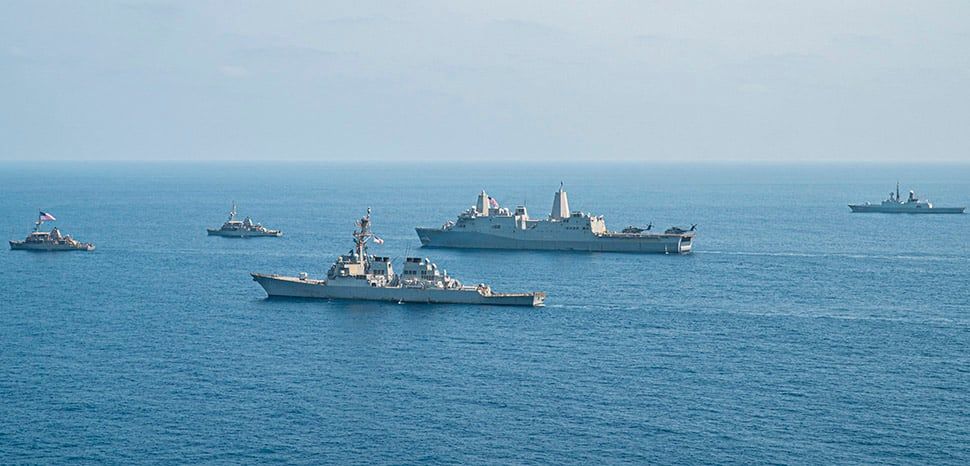
The Red Sea Crisis has resulted in clear and measurable disruptions to global maritime trade. Persistent security threats to commercial vessels have forced shipping companies to reroute ships via longer and costlier passages, increasing transit time and operational expenses. Additionally, heightened risk perception has led to a sharp rise in maritime insurance premiums, making navigation through the Red Sea economically burdensome. These factors have caused delays in the movement of essential commodities, including energy and food supplies, contributing to price volatility in international markets. The deployment of naval forces to secure trade routes has further intensified the militarisation of commercial waterways, increasing economic and strategic uncertainty. Collectively, these developments establish a direct nexus between regional maritime insecurity and global trade disruption, demonstrating that the Red Sea Crisis functions as a mechanism of economic coercion rather than a purely regional security issue.
Case Laws
1. Corfu Channel Case (United Kingdom v. Albania), ICJ, 1949
In the Corfu Channel Case, the International Court of Justice ruled that states must not knowingly let their territory be used for actions that threaten the rights of other states. The Court stressed the principle of freedom of navigation through international straits used for global transit. This case connects to the Red Sea Crisis, since the Bab-el-Mandeb Strait is an essential international strait for global trade. If a state fails to prevent hostile acts against commercial vessels under its control, it may face international responsibility for failing to meet due diligence obligations.
2. Oil Platforms Case (Islamic Republic of Iran v. United States of America), ICJ, 2003
In this case, the ICJ looked at whether attacks on oil platforms could be defended by the right of self-defense stated in Article 51 of the UN Charter. The Court made it clear that any use of force must meet the conditions of necessity and proportionality. This judgment is important for evaluating naval operations in the Red Sea. It restricts excessive militarization of trade routes and ensures that protective measures for shipping are legally justified and proportionate to the threat.
3. M/V Saiga (No. 2) Case, ITLOS, 1999
The International Tribunal for the Law of the Sea reaffirmed that interfering with merchant vessels on the high seas breaks the principle of freedom of navigation under UNCLOS. The Tribunal stated that actions taken against foreign vessels must strictly follow international law. This case backs the claim that attacks or illegal interference with commercial ships in the Red Sea go against UNCLOS and weaken the rule-based maritime order.
4. Artic sunrise Arbitration (Netherlands v. Russia), PCA, 2013
The tribunal decided that states must respect the rights of flag states and ensure that vessels can pass safely, even in politically sensitive situations. The ruling reinforces the duty to avoid arbitrary detention or interference with civilian vessels. It also emphasizes that coercive actions against commercial shipping in international waters are illegal.
Conclusion
The Red Sea Crisis shows how regional conflicts can significantly affect global trade by targeting important shipping routes. Attacks on commercial vessels disrupt supply chains and challenge the principles of freedom of navigation and the international maritime order. The economic and strategic effects, including higher shipping costs, increased insurance premiums, and market instability, reveal the global nature of what might seem like a regional security issue. While it is legal to deploy naval forces to protect commercial shipping, excessive military presence can increase risks and blur the lines between civilian commerce and armed conflict. For India, the crisis highlights the need to protect economic interests, ensure maritime readiness, and support international law. A cooperative and law-abiding global response is crucial to prevent economic coercion and maintain stability in international trade.
FAQS
Q1. Why is the Red Sea strategically important for global trade?
-It connects the Mediterranean Sea to the Indian Ocean through the Suez Canal. This makes it a critical route for energy and commercial shipments.
Q2. Is attacking commercial ships legal under international law?
-No. Such attacks break UNCLOS and customary international law and may count as piracy or armed attacks.
Q3. How does the Red Sea Crisis affect India?
-It raises shipping costs, threatens energy security, and disrupts trade routes that are vital to India’s economy.
Q4. Can states legally deploy navies to protect trade routes?
-Yes, under collective self defense and freedom of navigation principles, as long as the actions follow the rules of proportionality and necessity.
Q5. How does international law address attacks on commercial vessels in conflict zones?
-International law, as outlined by UNCLOS and customary rules, protects freedom of navigation. Attacks on merchant ships can be treated as piracy or armed attacks. States can respond in self-defense, making sure their actions are necessary, proportionate, and do not target civilians.