
Author: Manan Jhamb, Chandigarh University, Mohali
PROMISE OF A FRESH START
India’s Income Tax Act, 1961 was the creation of a bygone era, when ledgers were kept physically, assessments were done manually, and an economy was much simpler than today. In more than 64 years that basic law was amended so many times and grew so much that it eventually was over 47 chapters and 819 sections, a veritable maze compared to its original 298 sections. Taxpayers dreaded it. Many tax advisors have been charging exorbitant rates for figuring it out. For years it was a favorite topic of court fights. In fact, the law had turned into a dead letter.
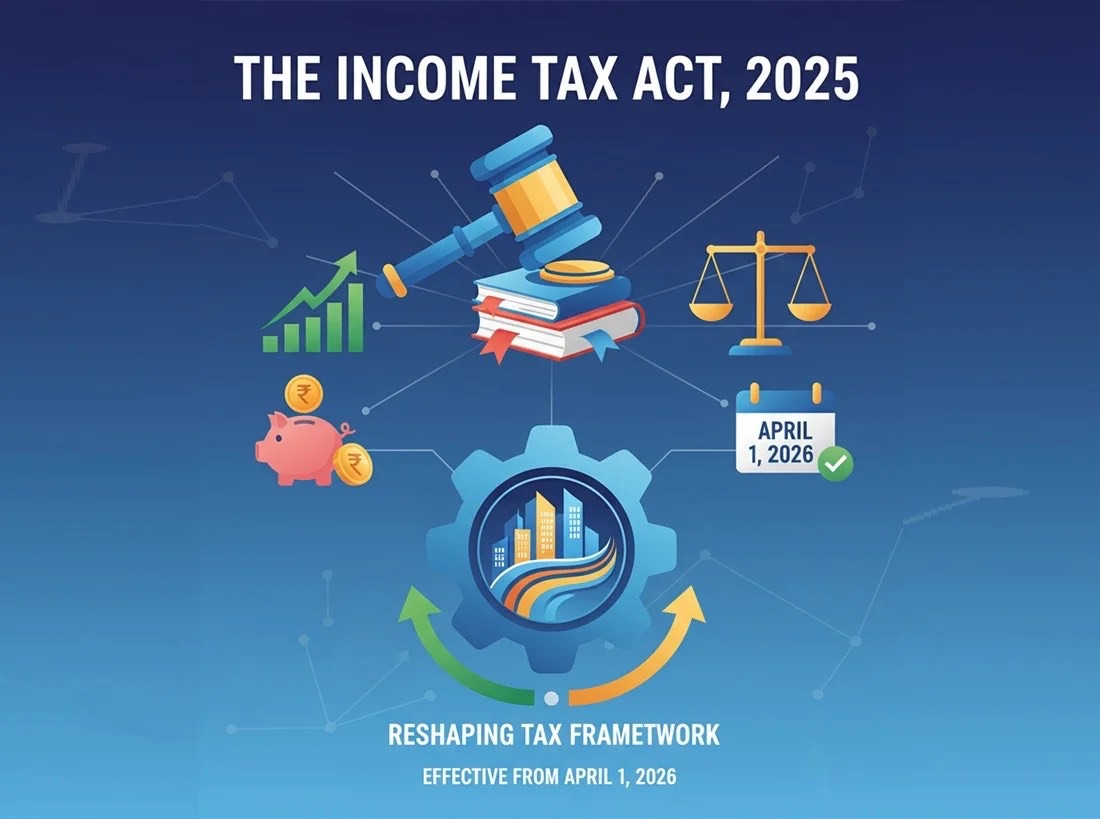
Income-Tax (No. 2) Bill 2025 was passed by Lok Sabha on 11 Aug 2025 and with Power of President, it was officially titled as Income-tax Act 2025, which is introduced with effect from 1 April 2026. The stated objective was rather simple: to render legislation more legible, minimize conflicts, and harmonize tax collection with the digital economy. It is to be assessed whether the mission was indeed fulfilled, but of course not without analyzing it with thought and due consideration, both for good and bad.
“ACCUMULATED COMPLEXITY” REPRESENTS THE SUM TOTAL OF THE PAST 64 YEARS OF LEARNING
An undistorted look at the need for the 2025 Act requires a straight confrontation of the failings of the Act of 1961 by the time it was past retirement age. The original law was ideal for a limited number of taxpayers and manual processing. It could not have foreseen the signing of the GST regime, the advent of the digital commerce, the kind of financial instruments which have become a routine these days and platform income in particular. Every Finance Act built on to previous ones; exception to exception, proviso to proviso.
“By 2025, the Act contained 819 sections, and the prevalence of rules, circulars and notifications made for a complicated sphere of compliance and much controversy with backlogs of years.”
A Select Committee review of the original draft incorporating feedback from comments and the public made 285 refinements that resulted in 32 significant changes to the text of the revised draft, issued in February 2025. The back and forth over that delay added months but — a more thought-out bill. What emerges is a reorganization of provisions into 536 sections over 23 chapters (still not a tokenistic reduction in raw volume, but an improvement in the organization, focus and presentation of the provisions).
WHAT HAPPENED IN TERMS OF CHANGES IN THE ARCHITECTURE OF REFORM?
Potential for Behavioral change. Language finally speaks to people Potential for behavioral change.
• First, there are changes in the way the language is expressed. The 1961 Act was well-known — or notorious — for the various phrases such as ‘notwithstanding anything contained to the contrary in any other provision of this Act. The 2025 Act dispenses with the throat clearing, and starts with more direct and contemporary language. Previously left as a kind of “legal appendix”, provisos and explanations have been incorporated in the main text, which makes each provision more “self-contained” and readable.
Most importantly, the concept of ‘Previous Year’ and ‘Assessment Year’, which is the reason for many tax deductions to be confusing for commoners, has been done away and replaced with one year tax (1 April to 31 March). This is done to bring tax provisions into Indian tax law in line with financial year and also Globally. Minute by minute – big psychological payoffs.
• A side-by-side comparison is included.

• Digital Governance, Built In
The 2025 Act isn’t just aware of the digital economy: its entire architecture is geared toward it. What used to be administrative directives for tomorrows forced face-to-face assessments, digital notices, electronic records and automated refund cycles are now found clearly in the statute. One chapter is devoted to non-profit organizations, an area which was formerly diffuse and poorly defined. The thousands of small businesses and independent workers who felt the burden of compliance, given the amount of money earned, benefit from increased thresholds in the presumptive taxation schemes.
• Taxpayer Protections Strengthened
On the protective side, the Act add notice obligations prior to enforcement measures, setting a bar to overzealous tax officers. Now, dispute resolution panels are required to issue directions, and include reasoning which can be provided in writing and is more likely to be challenged. Senior citizens can get the benefit from the merged Form 121 (replacing 15G & 15H), and a higher TDS threshold of Rs. A quarter lakh on interest income. Not flashy, but definitely real fixes to everyday grinds of compliance.
THE HARDER QUESTIONS: WHERE THE ACT FALLS SHORT
A critical examination requires more than a summative listing of the good effects. There are indeed weaknesses in the 2025 Act that should be addressed and examined, and appeals made on this basis are an acceptable argument.
• Cosmetic Simplicity vs. Substantive Reform
The criticism by tax practitioners and legal scholars that needs to be heeded the most is that the reform is in a large measure, more of a structural one than substantive. The tax rates, tax slabs, offences and penalties, and basic administration structure are unchanged. The new definition of ‘income’ contained in the new Act continues to refer back to the definition in the repealed 1961 Act, thereby creating a ‘semantic overlap’ which critics say will lead to court difficulty with interpreting the term. The addition of ‘irrespective of anything to the contrary’ for ‘notwithstanding anything contained to the contrary’ may be cosmetic, but not the true sign of a plain language revolution.
The bill contains the least substantial revisions to the taxation rules, “as fiscal laws naturally must, to be intelligible to the common taxpayer.
The apparently good idea was to make it easier for the average taxpayer to file her return without professional help, but this has not yet happened to the full extent. The legal field continues to be an “expert’s land” as they say. Although it is helpful to have fewer components making up the structural landscape, if there is no substance behind simplicity, compliance is merely carried around.
• The Dual-Regime Problem Remains
With the introduction of the new tax regime, there are now 2 parallel tax regimes for personal income under the old regime having deduction/exemptions and in the new tax regime with lower tax rates and lesser reliefs. This bifurcation is not addressed in the 2025 Act. The regime decision can still be made each year by the taxpayer, liability needs to be modelled for both regimes, and strategic decisions need to be made, which most individuals could not then undertake on their own. This architecture is found at a deeper level than any reduction or abstraction of the structure.
• Refund Rules Tightened
One change that has created a significant amount of concern is for the refund rules to be tightened. In the 1961 Act, refunds were available to taxpayers even if their returns were late. A 2025 rule is that refunds are not valid if they are not filed on time, although this is an administrative rule which, while sensible, will affect taxpayers missing the deadline for “good cause” due to illness, emergencies, or technological difficulties getting the refund. But it’s a retrograde development from a fairness standpoint — even if it’s an administrative one.
• The Real Near-Term Challenge: Transition Risk
Maybe the least talked about risk is transitional. The 1961 Act has been the ally of tax professionals, chartered accountants, company secretaries and the assessing officers for years. All the reference books, aid books and as many case law references and departmental circulars as possible are indexed to the old statute. Retraining doesn’t happen magically and it’s not free. In the transition period, any misinterpretations can cause the type of litigation that the Act was created to avoid. Education of taxpayers and education of officers is as vital as the bill itself is to the government’s responsibility.
A MEASURED VERDICT: NECESSARY BUT INCOMPLETE
The Income-tax Act, 2025 is indeed a law that needs to be introduced. The structural unsustainability of the 1961 Act, the rationalization of chapters, the merger of digital processes, the overlay of a common tax year, and the re-expression of the Act in a modern language, are all true successes which will make taxpayer compliance, at least for many, easier over time.
Yet, with honesty it must be stated that the Act is not the transformative simplification that its supporters billed it as being. It is a ‘building up’ within an old building, and not a new construction. The foundations – the two tax regimes, no rate changes, same offense structures – are unchanged. Litigation on the 1961 Act is far from done and, in effect, will need to be re-phased and re-numbered.
The final – and most telling – test of the 2025 Act will be in Parliament and in law journals. It will be at the thousands of offices of assessing officers, in the portal of small traders, in the scrutiny notices that reach the start-ups and in the court room where conflicts eventually end up. Laws are good only to the extent that they are enforced.
A bold and generally welcome move by India. Now, of course, it’s an invitation to do more — real substantive law simplification, to remove the complexity of the dual regimes and to make real investment in the human resources that enable any tax system to work. The 2025 Act is a start. It is not to be viewed as a goal.
The information provided in this article is for general information only and is not legal or tax advice. It is recommended that the reader seek the advice of a competent professional person with regard to their own situation.
FREQUENTLY ASKED QUESTIONS (FAQS)
Q1. What does income-tax Act, 2025 mean?
The new taxation law which is to be applied to India is the new Income-tax Act, 2025 since it has substituted the previous Income-tax Act, 1961. Effective as of 1 April 2026, it will presuppose simplification of taxation and its increased readability as well as adaptability of tax management towards the digital economy.
Q2. Why did there have to be a substitution of the Income-tax Act, 1961?
Response: It had become incredibly complicated, with numerous amendments, provisios and clarifications being added to it, a very complicated act after over sixty years. The act was increased up to 298 sections to 819 sections and became difficult to comply as a tax payer and gave rise to law suits.
Q3. What do you consider the greatest structural change of the 2025 Act be?
Musings: The most intriguing shift is that ideas of Previous Year and Assessment Year have been replaced with one tax year starting on 1 April to 31 March which are easier to understand.
Q4. Has the new Act decreased the amount of tax legislation?
Answer: Yes. The revised Income-tax Act, 2025, has 536 sections in 23 chapters in contrast to 819 sections and 47 chapters in the Income-tax Act, 1961 and hence is more organised.
Q5. Ok what the 2025 Act will add to digital governance?
Response: The Act inserts electronic in nature mechanisms in to the statutory text, the electronic notices, faceless assessments, electronic records and automated systems of refund provision.
Q6. What will the Act provide relief to small tax payers and businesses?
Response: The Act makes the thresholds in the apprehension of presumptive bonoanarism generated systems more challenging, streamlines the mechanism of obedience and the fortification of the digital administration, making the compliance burden investigated that of small enterprises and autonomous experts.
Q7. Which are some of the measures that have been taken to safeguard the taxpayers?
solution: The Act mandates the introduction of notice before certain actions can be implemented by the enforcers, sequence of the panels of dispute resolution and adding benefits to the senior citizens in terms of higher TDS limits and simplified declaration.
Q8. Does the Income-tax Act, 2025 change the tax rates or tax vats?
Answer: No. Simplification and reorganization of the structures is the main theme in the Act. The tax rates, tax slabs, penalties and the overall administration platform undergo minimum changes.
Q9. Is the issue of the dual tax regime sorted?
Response: No. Taxpayers have to choose as to whether to continue with the old regime of taxes with deductions and exemptions or to make a leap to the new regime with low tax rates but limited benefits. This intricacy is preserved with the 2025 Act.
Q10. What are the issues that are raised about provisions that are made in relation to refund?
Response: The new framework can deny tax payers that do not file the returns before the stipulated time a refund. This, which critics decry, will have a negative impact on those tax payers that are literally in need of aid like when they get sick or grow due to technical failure.
Q11. What are some of the challenges that can come in the shift towards the new Act?
Response: Tax professionals, government officials and taxpayers would be forced to alter to a different statutory model. The interpretation of the law, retraining and changes in references materials and reinterpretation of the legal precedents may entail short-term compliance and litigation difficulties.
Q12. Can the Income-tax Act, 2025 make the tax system of India as simple as possible?
Response: The Act will have a major enhancement in structure and language, and in addition, digitalization, but the core characteristics of tax rates, dual regimes, and essentials of administrative processes will remain the same. Thus it is thought that it will be a significant yet unaccomplished step towards making taxes easier.
Q13. Will the Income-tax Act, 2025 abate tax litigation?
Response: The Act should minimize controversies that come about due to vague writing and a lack of procedure. This kind of litigation can but go forward on substantive tax grounds and transitional interpretation issues.
Q14. What does the Act have to do with the senior citizens?
Response: Elder citizens get a consolidation of a declaration formness rather than 15G and 15H and more TDS 2.5 lakh on interests thus, it can be easy to comply.
Q15. The Income-tax Act, 2025 is faring well as well.
Response: The Act is a much needed and desirable reform in the tax structure of India. It should however be viewed as the initial move towards a broader reform movement than the age oldintricacies in the tax system.
