
Author: Priya Bharati , Gopal Narayan Singh University, Narayan School of Law
To the Point
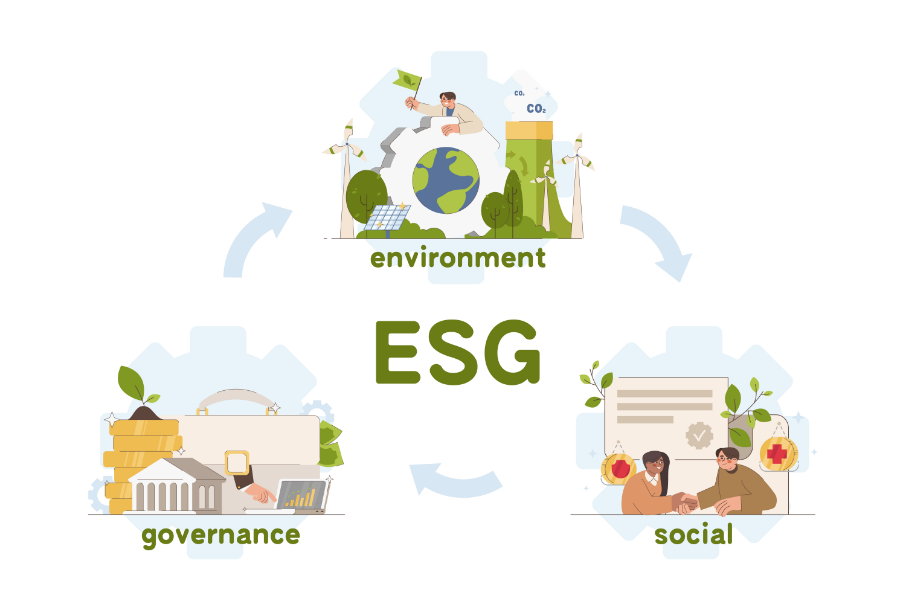
Environmental, Social and Governance (ESG) compliance has swiftly advanced from an aspirational corporate mantra to a legally enforceable standard of conduct. As climate change accelerates, social disparities widen, and governance failures produce headline scandals, authorities throughout the world are urging firms to embed ESG duties into their operational DNA.
The European Union, the United States, and India are setting out different but converging regulatory tracks, forcing companies to view ESG not as altruism but as a fiduciary responsibility.
Use of Legal Jargon
(a) Fiduciary Duty
The requirement that directors and officers work in the best long-term interests of the organisation, which many jurisdictions are now interpreting to include the management of ESG risks.
(b) Materiality
The threshold test (from securities law) as to whether ESG information is important enough to affect an investor’sdecision is subject to increased litigation in disclosure fraud cases.
(c) Non-Financial Reporting
Laws or regulations requiring a company to report its environmental effects, social metrics and governance structures in addition to its regular financial statements.
(d) Due Diligence
The legal standard of care requires firms to identify, prevent and mitigate harmful human rights and environmental impacts across their supply chains.
(e) Greenwashing
A tortious or dishonest misrepresentation of the firm’s ESG credentials to investors or customers, which can expose the corporation to responsibility under consumer protection and securities law.
(f) Stranded Assets
Assets that could suffer surprise write-downs due to climate-related regulatory changes are a notion now ingrained in prudent financial regulation.
(g) Stakeholder primacy
Doctrine evolution challenging the Friedman concept of pure shareholder primacy. Its identify the employees, communities and the environment as legally cognisable interests.
The Proof
The legislative infrastructure underlying the duty for ESG has evolved at a pace never seen before. In 2021, the Securities and Exchange Board of India (SEBI) launched the Business Responsibility and Sustainability Report (BRSR) framework in India, requiring the top 1,000 listed companies by market capitalisation to disclose ESG-aligned performance for the financial year 2022-23. This was a big shift from the erstwhile voluntary Business Responsibility Report (BRR) format.
The ‘S’ (Social) of ESG is operationalised by the Companies Act, 2013, through Section 135, which imposes a statutory responsibility of Corporate Social Responsibility (CSR) on corporations meeting the prescribed criteria of net worth, turnover or net profit. Section 135(7) provides for sanctions if companies do not spend the required 2% of average net profits on CSR activities or do not justify non-expenditure.
At an international level, the European Union’s Corporate Sustainability Reporting Directive (CSRD, 2023) broadened the reporting requirements to nearly 50,000 companies. The EU Corporate Sustainability Due Diligence Act requires companies to audit and remedy ESG impacts in their value chains. In the United States, 2022 saw the Securities
Abstract
This article discusses the legal issues of ESG (Environmental, Social and Governance) compliance and corporate accountability in today’s regulatory landscape. Assuming that ESG obligations are being removed from a regime of voluntary best practice to legally binding duties, the essay discusses the development of the statutory and regulatory frameworks in India, the European Union and the United States. It challenges the fundamental legal concepts—fiduciary duty, materiality, due diligence and greenwashing liability—on which ESG discussion turns.
The paper uses significant rulings and enforcement actions by regulators to illustrate that business non-compliance with ESG rules now results in substantial legal, reputational and financial penalties. The paper concludes with a discussion of doctrinal and institutional reforms needed to embed ESG accountability into corporate law on an ongoing basis. It contends that the future of a responsible company is not in discretionary
virtue but obligatory transparency, enforceable duties and judicially cognisable stakeholder rights.
Case Laws
(1) Client Earth v Shell plc (UK, 2023)
In a landmark environmental governance case, shareholder and environmental law NGO ClientEarth has filed a derivative litigation against the board of Shell plc before the High Court of England and Wales. The claimants argued that the board has breached a climate strategy compliance risk. Although the High Court ultimately declined permission to continue the derivative action, finding inadequate evidence of director bad faith at the authorisation stage, the case set a key precedent: climate strategy is fundamentally a matter of director duty. It led to ESG governance reform in key US-listed energy businesses and made institutional investors evaluate board climate competencies.
(2) Milieudefensie et al v. Royal Dutch Shell (Netherlands, 2021)
In a landmark decision, a district court in The Hague ordered Royal Dutch Shell N.V. to reduce its net global CO2 emissions by 45% by 2030 from 2019 levels. It also found Shell accountable for emissions (Scope 1 and 2).
The court referred to the general duty of care as embodied in the Dutch Civil Code (Article 6:162 BW) and to international soft law procedures, such as the UN Guiding Principles on Business and Human Rights (UNGPs). What is striking about this decision is its extraterritorial reach, and the admission by the court that corporate human rights and climate duties are legally justiciable, not aspirational. The case is now on appeal to the Hague Court of Appeal (2024).
(3) Indian Council for Enviro-Legal Action v. Union of India
This case of the Supreme Court of India, despite pre-ESG terminology, is a basic precedent for corporate environmental accountability. The court adopted the polluter pays principle and found that the industries are fully liable to pay for restoration of the environmental damage caused by them without any negligence.
The judgment also acknowledged that the right to a clean environment is an element of the right to life under Article 21 of the Constitution. It held that business organisations cannot externalise environmental costs onto communities and the state, a notion that continues to underpin ESG enforcement under Indian Environmental Law.
(4) West Virginia v. EPA (USA, 2022)
The United States Supreme Court’s ruling in this case—invoking the ‘Major Questions Doctrine’—constrained the Environmental Protection Agency’s authority to regulate power plant emissions under the Clean Air Act without explicit congressional authorisation.
While the decision curtailed federal regulatory reach, it simultaneously illuminated the importance of voluntary corporate ESG commitments and state-level climate legislation as regulatory substitutes for ESG compliance anchors and elevated the strategic value of credible voluntary corporate climate pledges and third-party compliance. ESG audits
(5) SEBI v. Roofit Industries Ltd (India)
SEBI has taken strong action against Roofit Industries for serious non-disclosure in the annual reports, including the manipulation of sustainability-related financial facts. The adjudicating officer held that selective non-disclosure of material information, including environmental compliance data, is an infringement of SEBI (Listing obligations and disclosure requirements) regulations 2015.
This decision is an early Indian precedent on greenwashing liability in the securities law arena, ruling that ESG disclosers are not merely cosmetic, but also substantive claims attracting the entire disciplinary apparatus of securities regulation.
Conclusion
The arc of ESG compliance is bending irrevocably towards legal enforceability. What started as the voluntary ethical posturing of enlightened capitalism has been transmuted — through legislative mandate, judicial interpretation, and investor pressure — into a corpus of hard duties with genuine legal repercussions. The ClientEarth and Shell litigations illustrate that directors who perceive ESG risks as externalities may be in breach of their fiduciary obligations. “The Milieudefensie ruling shows that courts will hold companies legally accountable for their environmental footprint across their value chain. India’s BRSR framework and CSR mandate mean ESG reporting is not a choice for reputational benefit, but a statutory duty.
Three theological revisions are now needed. First, the concept of materiality in disclosure law needs to be explicitly broadened to encompass ESG risks across all asset classes, not just within climate-specific regulatory regimes. Second, stakeholder rights – of employees, communities and environmental interests— need to be accorded greaterprocedural standing in corporate governance, beyond the tokenism of board-level ESG committees. Third, Indian law should incorporate supply chain due diligence responsibilities, modelled on the EU CS3D, holding domestic corporations accountable for ESG infractions in their global operations.
The twenty-first-century company cannot be an enclave of profit-seeking detached from the social and ecological systems that support it. ESG compliance, properly understood, is not a restraint on company freedom. It is the legal manifestation of corporate citizenship.
Frequently Asked Questions-
Q1. Are ESG standards mandated for companies in India?
Now onwards, the top 1,000 corporations (by market cap) have to report on ESG (BRSR). Companies meeting the specified financial criteria would be accountable for CSR obligations under Section 135 of the Companies Act, 2013. There is no mandatory ESG reporting for smaller unlisted companies yet, although SEBI and industry associations are pushing for voluntary adoption.
Q2. What is the difference between CSR compliance and ESG reporting?
The Companies Act 2013 (Companies Act) provides for compliance with CSR, which demands to spend 2% of average net earnings on defined social activities. ESG reporting is a broader disclosure regime which covers environmental performance, social metrics (labour rights, diversity, community impact) and governance criteria (board composition, anti-corruption). ESG reporting versus CSR figures
Q3. Is there any provision in India for investors or NGOs to sue a firm for non-compliance with ESG?
There is no express private remedy under Indian law for non-compliance with ESG. However, shareholders can file derivative lawsuits for breach of directors’ duty, environmental issues are assessed by the National Green Tribunal (NGT), and SEBI can impose penalties on listed companies for non-compliance with disclosure criteria. The PIL jurisdiction has been effectively used by High Courts and the Supreme Court in the past for environmental accountability.
Q4. What is “greenwashing”? What are the legal consequences of greenwashing?
Greenwashing is the false or fraudulent representation made by a firm regarding its environmental and sustainability performance. Possible legal repercussions include: Securities fraud liability (false statements made to investors), Consumer protection violations (false promises regarding products or advertising) and Regulatory sanctions by agencies such as SEBI (India) or SEC (USA). The Competition Commission of India (CCI) has the authority to examine greenwashing as an unfair trade practice.
Q5. What is the impact of the EU Corporate Sustainability Due Diligence Directive on Indian companies?
Large companies located in the EU will be required to conduct due diligence on the CS3D. The audits would be on Indian companies that are suppliers or subsidiaries of multinationals based in the EU. Companies that sell into the EU, or are part of EU supply chains, will need to prove they meet ESG requirements (particularly labour rights, environmental protection and governance) to continue to do business. This trend of extraterritoriality is encouraging Indian manufacturing and services enterprises to relocate to ESG.

