
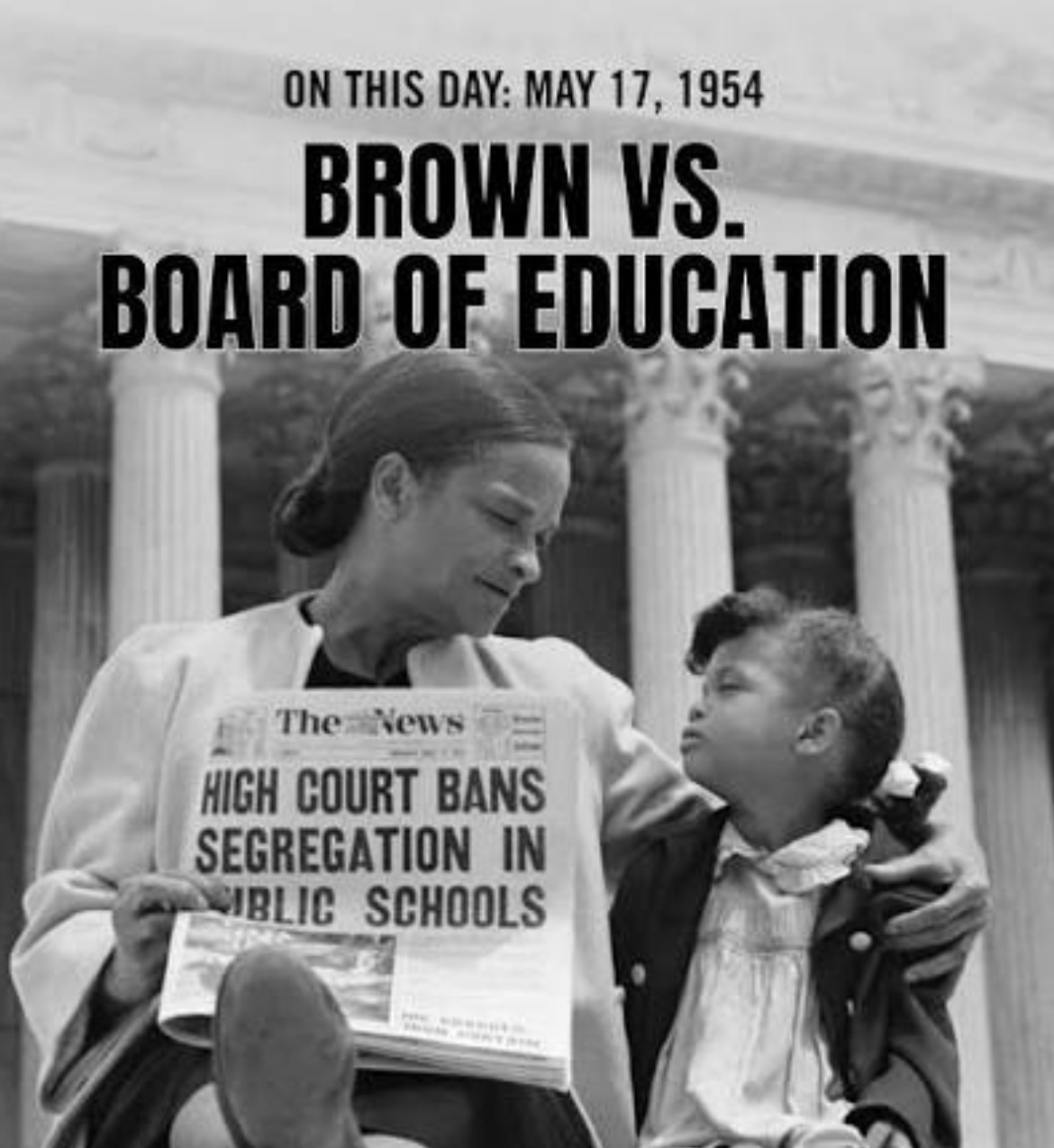
The Law Behind the most influential civil rights ruling in Supreme Court history in America
Author: Manan Jhamb, Chandigarh University
ABSTRACT
This paper reviews one of the iconic cases, that of Brown v. Board of Education of Topeka, 347 U.S.483 (1954), which knocked on the head the legal foundations of the separate but equal principles in learning institutions all over the United States of America. A unanimous decision by the Supreme Court, presided over by Chief Justice, Earl Warren, invalidated de jure racial segregation in the schools and ushered in a new age in constitutional law on the concept of equal protection. The factual history, legal reasoning, constitutional and long-standing implications of this case, which remains at the heart of the doctrine of civil rights jurisprudence and the meaning of equal protection under the Fourteenth Amendment will be explored.
TO THE POINT
Brown v. Board of Education de facto has overturned the doctrine of separate and equal from Plessy v. Ferguson. The Supreme Court ruled that the segregated education facilities are out of their very nature unequal and represent a violation of the Equal Protection Clause of the Fourteenth Amendment. The ruling by the court stipulated that all states must pull back and provide equal learning opportunities irrespective of a person’s race and that de facto segregation of black and white children themselves causes quantifiable psychological harm and a setback in their academic progress. The decision was the greatest extension of civil rights in the twentieth century and a launchpad to the larger Civil Rights Movement of the fifties and sixties.
THE FACTS AND THE CASE HISTORY
The cases were consolidated in five different states: Brown v. Board of Ed. (Kansas), Briggs v. Elliott (S.C.), Davis v. County School Board of Prince Edward Co. (Virginia), Bolling v. Sharpe (D.C.) and Gebhardt v. Bellevue Independent School District (Delaware). Both cases raised the issue of whether or not the state laws were constitutional, which required or permitted racial segregation in state schools.
The case began in Topeka, Kansas, when Oliver Brown, an African American parent, wanted to send his daughter Linda to an all-white elementary school instead of having to drive her to a separate black school that was at a long distance. Brown sued the school authorities for refusing to let him enter the school based on racial –classification, to challenge the constitutionality of the Kansas statute that permitted racial segregation in schools. This case did make its way to a three-judge panel of a district court that determined that segregated schools were substantially equal in physical plants and other resources, but would not rule in favor of an overturn of segregation. The plaintiff made its appeal directly to the Supreme Court which combined the case with four other cases that raised similar constitutional issues.
LAW AND CONSTITUTION TO BE IMPLEMENTED
The constitutional basis the ruling was based on was the Fourteenth Amendment, which was adopted in 1868, after the American Civil War. This is the first part of the Fourteenth Amendment: “No state shall deny to any person within its jurisdiction the equal protection of the laws. This Equal Protection Clause created a constitutional requirement that the government bodies receive similarly situated individuals equally and is not allowed to use classifications that unfairly discriminate without a significant purpose.
Before Brown, the Supreme Court had based itself on the doctrine of Plessy v. Ferguson, 163 U.S. 537 (1896), which held that the Constitution’s equal protection clause was not applicable to state action in public places like schools. With Plessy, laws that enforced racial segregation did not contravene the principles of equal protection as long as the facilities provided to different races were more or less equal in quality and resources. This doctrine was in effect for nearly 60 years, permitting the segregative practice in the field of transportation, public accommodations, schools and other places. Such a revisit would not be the first time that the Supreme Court had accepted the Plessy case in other graduate education cases, such as Sweatt v. Painter, 339 U.S. 629 (1950) and McLaurin v. Oklahoma State Regents, 339 U.S. 637 (1950): here the Court held that the state university programs had to accept U.S. African American students, but did not mean to revisit the broader separate but equal framework.
THE LAW AND THE ARGUMENTS THE COURT USED TO REACH ITS DECISION.
The petitioners presented a diverse constitutional case that was against racial segregation in schools. They claimed that, even though equivalent physical facilities were not being considered, the Equal Protection Clause proscribed state imposed racial classification and segregation. The petitioners also focused on the fact that even the process of segregation on its own caused constitutional injury by depriving African American students of equal education opportunities and negating the very human dignity as the foundations of human dignity.
The school boards defending the legitimacy of segregation laws pointed to the doctrine of separate but equal set forth in Plessy and that they had in no way demonstrated the inequality in facilities and education facilities. They did not think that there was invidious discrimination, but that segregation was custom and community based.
An extraordinary commentary was given in a unanimous opinion by Chief Justice Warren that not only boldly reimagines the jurisprudence of equal protection, but also the concept of equal protection more generally. The Court did that in terms of maintaining the Plessy model and said, “The Court does not recognize equality between separate educational institutions. The opinion underscored the fact that education is a core interest that is necessary to discharge citizenship duties and attain economic opportunity. The Court understood that segregation has certain psychological damage and stigmatization, especially detrimental to the growing minds, through the empirical studies presented in various litigation cases including the Doll Studies conducted by psychologists Kenneth and Mamie Clark, which showed that black children who had to undergo segregation had lower self-esteem and psychological damage.
The Court decided that there should be nothing like separate but equal doctrine in education and affirmed: Separate educational facilities are not equal. It was urged that segregation served to deny the children equal opportunity in education, and was a violation of equal protection. The case was subject to strict scrutiny standard of review under which the government must demonstrate a compelling state interest and that a specific racial classification is the least restrictive means of achieving the state interest. The Court did not find any legitimate governmental interest that would be used in defense of racial segregation in schools.
IMPLICATION – CONSTITUTIONALLY AND DOCTRINALLY
• Brown came up with some revolutionary principles of the constitution:
It rejected Separate but Equal – not only was the language of the Decision explicit in overturning Plessy, but the Court also declared that the tenet of separate but equal was not applicable in the context of education, a concept later extended to other areas of public accommodation, and ultimately, public life in general.
•Broader Standard in Challenges to Racial Classifications (resolving the tension between state interest and focus): The case added greater analysis of the specific racial belief arrangements, where race-based governmental classifications would lead to strict scrutiny in the first place and would therefore require a strong state interest and fit of focus of the classification to that interest.
•The Education as a Fundamental Recognition: The Court re-emphasized the education’s importance in a democratic society and continued to make the case that education was a fundamental matter, and one that is more worthy of constitutional protection.
•Acknowledgement of Psychological and Social Impact: It was a marked shift for the ruling in the constitutional analysis to consider social scientific evidence – it found that any psychology, scientifically measurable, caused by segregation violated equal protection guarantees.
Janich, Martin and Praed -2005: The judges established Mr. Affirmative Obligation to desegregate: The case established affirmative state duties to dismantle segregated systems, as opposed to merely facilitating equal resources, which changes the notions of equality in jurisprudence.
LEGAL TERMINOLOGY AND DOCTRINAL FRAMEWORK.
The ruling: whereby key principles of law are used as a basis for understanding and interpreting the current constitutional law without which it would be difficult to grasp the law. When segregation is mandated by law it is called the doctrine of de jure segregation, as opposed to de facto segregation which results from housing patterns and other individual actions. The degree of scrutiny given to each type of review falls into three categories in the jurisprudence of Equal Protection: rational basis review of economic classifications, intermediate scrutiny of gender classifications and strict scrutiny of race-based classifications. Strict scrutiny requires the government to show it has a compelling interest it’s trying to serve, and that it is doing so in a strictly limited way. Inherent inequality implies that we designate some classifications as stigmatizing, for which this would be true inherently, even if they seem to be evenly distributed. The doctrine of state action limits Fourteenth Amendment protections to state action as the Amendment only extends to state action and not individual discrimination. The doctrine of overruling allows the courts to topple precedent whereby a situation warrants a review of the law that has been formulated.
FACT: REASON AND FOUNDATIONS TO DECISION.
• The Court based its decision on numerous different bases of evidence:
In essence, the studies, the Clark Doll Studies, providing psychological evidences, had concluded that the segregation per se, brought psychological damages and low-self-perception to African American children raised in such environments.
• Comparative Educational Analysis: The expert testimony and documentary evidence showed that the segregated school systems violated the claim of equality in providing educational items, programs and amenities for African American students.
• Historical and Constitutional Analysis: The Court has given consideration to the history of the Fourteenth Amendment, determining that “the very purpose of the Amendment was to make all citizens equal, assure him his right to equal protection.
• Judicial Precedent Review: This case discussed previous Supreme Court cases in which it was implied segregation represented natural inequalities with respect to access to education, for instance, in cases as Sweatt v. Painter and McLaurin v. Oklahoma State Regents.
SUMMARY AND FINAL EFFECT.
Brown v. Board of Education is a turning point in the history of the American constitution and civil rights. The decision paved the way to a complete reformation of equality and the equal protection standards: equality does not only concern material factors but also covers equal dignity, opportunity and psychological welfare. In rejecting the separate but equal doctrine, the Court acknowledged that segregation brings great harm to the Constitution, regardless of whether the segregation is equal or unequal.
This ruling created a strong precedent of increased judicial doubt of the racial groupings and higher education as a core interest of society that must be traceable to the constitution. Although the path of the subsequent implementation of this constitutional ruling was an arduous and slow one, bringing plenty of opposition that had to be enforced by the Courts in shedding precedent groundbreaking cases such as Green v. County School Board, 391 U.S.430 (1968) and Swann v. Charlotte-Mecklenburg Board of Education, 402 U.S.1 (1971), the ruling remains untouched: the Government has no constitutional liberty in barring segregated education systems.
It is not as though Brown doesn’t make other contributions, however. The ruling gave the Constitution blueprint plans to end the segregation across all sectors of American society. Its focus on the evil of segregation and the “very essence of equal protection” has been used, to help shape the law in cases of affirmative action, voting rights, employment discrimination and “desegregation” of housing, and is the seminal case in current civil rights law. The case is clear evidence on how the court can play a healthy role in initiating changes for revolutionary social transformation acting with constitutional integrity, through insightful interpretation of the constitution and the recognition of empirical research concerning the issue of systemic inequality.
FREQUENTLY ASKED QUESTIONS
Q1. What was separate but equal doctrine and why was it important?
A separate yet equal doctrine, which was a case in Plessy v. Ferguson (1896), was that regulations which separated races by the government were not a violation of Equal Protection Clause in case the facilities were considerable equal between different races. Over nearly 60 years until Brown personally denied it, this doctrine was adhered to and used to justify most segregation in the United States. Plessy was a serious misunderstanding of the intent of the Fourteenth Amendment and promulgated the law of racial inferiority.
Q2: What were the impacts of the Clark Doll Studies on the Brown decision?
According to an experiment performed by psychologists Kenneth and Mamie Clark, African American children that were segregated had reduced self-esteem and psychological harm. Segregated children were seen to give preferences to white dolls and negative preferences to black dolls when given the choice of their favorite and least favorite. With this empirical data, the Supreme Court had scientific basis for understanding that segregation itself is the cause of quantifiable constitutional damage and that, seemingly regardless of equal resources, segregation is per se unequal.
Q3: Explain what “Strict Scrutiney” was and how this was applied to racial categories?
The most rigorous type of judicial review that can be applied to governmental action is the strict scrutiny. Based on the litigant burden, it must be shown by the government that a contested classification provides a compelling state interest and that the tools which are employed are “specific” in providing the interest. The over-classification by the government based on race leads to a very high level of scrutiny for fear of stigmatization and inferiority. Brown found the segregation to be subject to withering attack and that the state has no “compelling interest that can be asserted in favour of racial classifications in education.
Q4: How remain relevant Brown in the current constitutional law?
The putting down of constitutional brick walls: the refusal of the government to racialise or group its citizens in any way other than by way of justification; the concern with education as a fundamental interest; the definition of equality in terms of its ultimate effects and due to psychological injury. Brown is the constitutional grounding of civil rights doctrines in general. In modern times with voting rights, employment, housing, access to healthcare and affirmative action, all of the theoretical backgrounds of these areas offer a dedication to the theory of equal protection and the rejection of strict subordination in the form of legislation as illustrated by Brown.
Q5. What are some of the critiques of Browns?
Even as a king though, there’s been no mean-toned criticism for Brown. Some conservative scholars say that the ruling was more than the Court should have rendered and imposed its policies on education issues as far as it was concerned. Others say that the ‘relatively weak’ language in Brown II let become evident a huge opposition, and the inequity of education continued. Racial justice scholars note that, despite implementation of desegregation laws and orders, such law was rarely effective in inducing an educational equity or achieving the elimination of an achievement gap. Others adopting colorblindness criticize later diversity-based solutions which supposedly apply Brown. In addition, critics hold that Brown has talked about segregation, but has yet to address the inequalities of resources and inequalities of structure that segregation has aggravated and reinforced.

