
Author: Karuna Soni, K.G Shah Law School, SNDT University
LinkedIn Profile: https://www.linkedin.com/in/karuna-soni-047b15268?utm_source=share_via&utm_content=profile&utm_medium=member_ios
To the point
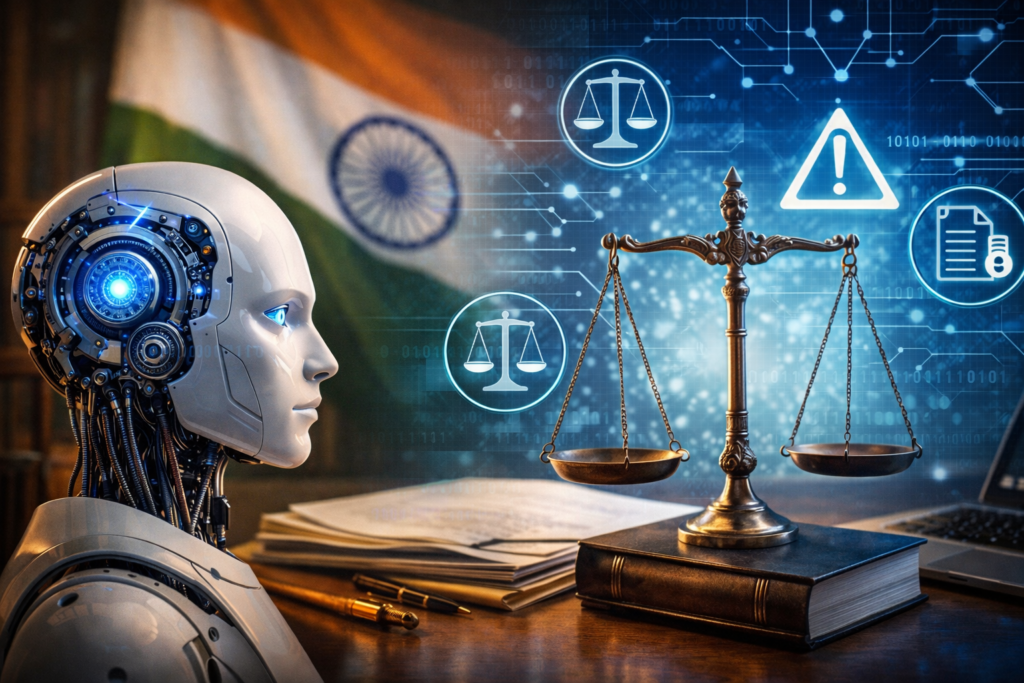
Rapid proliferation of AI into the realms of health care, autonomous logistics, and financial algorithms has left India’s civil liability system behind. In cases of damage caused by an autonomous agent, there exists a structural void within the legal regime. Classical tort laws rest upon human fault, foreseeability, and causation. AI disrupts that structure of causation by virtue of its ability to act emergently – i.e., unpredictably, beyond programming – leading to what is known as the “black box” problem. This article discusses how existing tort principles in India fail to assign liability to AI agents, highlights recent attempts at legislation in the area, and makes the case for creating a bespoke statutory solution using a combination of strict product liability and compulsory algorithmic insurance.
Use of Jargon
In order to thoroughly analyze machine-based torts, we need to be clear on some terminology:
Tortfeasor: A person or organization that has committed a civil wrong (i.e., a tort), causing injury/harm that gives rise to liability.
Black-Box Problem (Algorithmic Opaqueness): The practical inability of humans to discern the reasoning behind an AI’s decision making in a given scenario because of mathematical opaqueness of the process.
Novus Actus Interveniens: Any subsequent independent act that disrupts the chain of causation between the original act of negligence and the final injury, and thus exonerates the original wrongdoer from any form of liability.
Res Ipsa Loquitur: A legal concept of evidence meaning “the thing speaks for itself” where the fact of negligence is drawn from the very fact of the accident happening since the instrument used to inflict the damage is under the sole control of the defendant.
Strict Liability: A principle of liability whereby an individual is held liable for the outcome of a process or product irrespective of the presence of fault, intention, and/or negligence on his part.
Vicarious Liability: Secondary liability whereby the principal/employer is liable for the tortious acts committed by the agent/employee in the course of his employment.
The Proof
The adaptive character of Indian law in terms of dealing with potential risks due to AI is apparent through the following regulatory initiatives:
The Supreme Court Draft Regulations for Use of Artificial Intelligence in Courts (June 2026): Emphasizing the “human primacy” principle, Regulation 8 absolutely prohibits officials, lawyers, and other parties from relying on an AI’s algorithmic “hallucination” or “black box” approach as a defense in case of any mistakes made in filing or court proceedings. This regulation implies strict liability for humans in connection with court-approved AI.
The Information Technology (Intermediary Guidelines and Digital Media Ethics Code) Amendment Rules, 2026: Enacted in early 2026, these rules legalize the concept of “Synthetically Generated Information” (SGI) and create strict time windows for proactive content moderation (for example, a 2-hour mandate for taking down explicit deepfakes). These regulations transform the passive intermediary role into that of an active algorithmic output controller.
The Consumer Protection Act, 2019: According to Section 2(47), consumers who were hurt by algorithmic mistakes or misleading recommendations of AI should be actively suing through the “deficiency in service” and product liability provision.
Abstract
The Artificial Intelligence systems have a distinctive feature in comparison with other machines used in industries: self-adaptability. The present paper is dedicated to the concept of the “accountability gap” which arises under Indian tort law in the case when an AI system does a civil wrong. Traditionally, Indian courts have dealt with emerging torts on the basis of negligence or strict liability principles borrowed from English common law. However, due to the evolution of deep learning algorithms after deployment as a result of continuous data collection, it is impossible to set a clear boundary of human foreseeability.
The present paper analyzes the reasons why traditional negligence cannot apply to an autonomous actor and evaluates the inappropriateness of using AI as a “servant” in the context of vicarious liability. On the example of the Regulations for the Use of Artificial Intelligence in Courts, 2026 and statutory instruments such as the Consumer Protection Act, 2019, the present paper shows that currently India undergoes a shift toward a “strict human liability” benchmark. Finally, the present paper concludes with the suggestion of legislative solution.
Case Laws
M.C. Mehta v. Union of India (1987) 1 SCC 395
The Indian Supreme Court formulated the principle of Absolute Liability, breaking away from the exceptions that form part of the English doctrine of Rylands v. Fletcher. The Supreme Court ruled that any industry that indulges in an inherently dangerous or hazardous business is under an absolute and non-delegable obligation towards the community to make sure that no harm is caused. In the case of AI, the moment an un-audited autonomous vehicle or diagnostic algorithm for use in a healthcare setting is created by the developer, Indian courts have all the right to avoid the traditional tests of negligence and impose absolute liability.
Donoghue v. Stevenson [1932] AC 562
In this common law case which laid down the “Neighbour Principle” for establishing the tort of negligence, there needs to be duty of care, breach of duty and proximate damages. However, in the case of AI, the whole structure collapses. The moment an autonomous system with live sensors causes injury to someone by executing some kind of unexpected maneuver, the developer can always claim that the machine’s sudden behavioral change was an unpredictable act and therefore novus actus interveniens.
Anita Kushwaha v. Pushap Sudan (2016) 8 SCC 509
The right to access to justice has been unequivocally affirmed by the Supreme Court as an absolute element of the right to life guaranteed under Article 21 of the Constitution. The above mentioned case law lays down the foundation for the present debate on the Draft AI Regulations 2026. The access to justice of the litigants will be jeopardized due to structural technology issues where the litigants are liable for black-box problems of the State’s judicial AI system.
ANI Media Pvt Ltd v. OpenAI Inc & Anr [CS(COMM) 1028/2024]
The above case marks a very significant litigation before the Delhi High Court wherein the problems of data scraping, system hallucinations and accountability have come to light. It makes one understand the fact that when any generative system ingests huge, copyrighted databases and generates false or defamatory claims, then the platform operator cannot claim exemption from liability under Section 79 of the IT Act.
Conclusion
The core problem facing AI with respect to Indian tort law is the very fact that the system of tort law is built on redressing the failings of individuals, rather than systemic algorithmic problems. By removing the ability of the human actor from taking advantage of the “black-box defence” or “algorithmic hallucination” (as stated explicitly in the Draft AI Regulations 2026), India is moving towards strict liability.
However, to place the sole financial responsibility for algorithmic failings on the shoulders of the end-user alone would not be a viable approach. To fill this accountability vacuum, there needs to be a legislative step. What is needed in India is a clear legislative bridge: A scheme whereby the high-risk AI systems will be placed under the purview of strict liability for the developers, coupled with mandatory insurance for algorithms. In no other way can Indian law ensure that the victims of civil wrongs are protected, while the local AI industry blossoms.


