Author: Shivani Singh, Amity University, Patna
To the Point
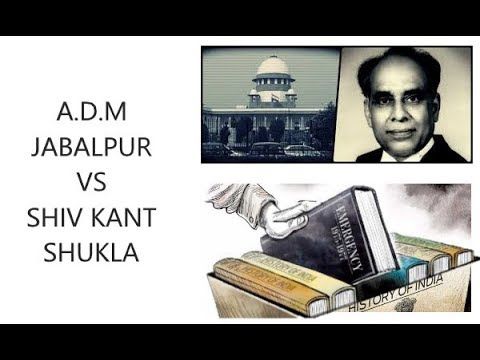
The ADM Jabalpur v. Shiv Kant Shukla case of 1976 popularly known as the Habeas Corpus Case is remembered as one of the darkest moments in Indian constitutional history. It came at a time when India’s democratic framework was tested during the Emergency proclaimed by Prime Minister Indira Gandhi.
The case focused on the suspension of fundamental rights as outlined in Article 359 of the Constitution, particularly the right to life and personal liberty ensured by Article 21.The Supreme Court, by a majority of 4:1, ruled that during the Emergency, citizens had no right to approach the court for enforcement of personal liberty.
The ruling essentially meant that a person could be detained by the government without legal recourse even if such detention was mala fide, arbitrary, or illegal. This judgment is widely criticized for being an instance of judicial surrender to executive power, with only Justice H.R. Khanna delivering a courageous dissent that upheld the sanctity of personal liberty as an inalienable human right.
Though later overruled in subsequent decisions, most notably in Justice K.S. Puttaswamy v. Union of India (2017), the ADM Jabalpur judgment remains an instructive precedent about the fragility of rights when unchecked executive authority collides with judicial complacency.
Use of Legal Jargon
To fully appreciate the impact of this case, it is crucial to understand the legal terminology and constitutional Provisions involved:
Habeas Corpus:It is a fundamental safeguard against unlawful Detention, compelling authorities to present the detained person before the court to justify the legality of the Detention.
Preventive Detention: A mechanism by which the state can detain individuals on the suspicion that they might commit an offense in the future, rather than for acts already committed.
Emergency Provisions (Articles 352–360):
Article 352: Authorizes the President to declare a national emergency in situations involving war, external attack, or internal armed rebellion.
Article 21: Protects every individual’s right to life and personal liberty, allowing deprivation of these rights only through a procedure established by law.
Judicial Review: This pertains to the power of the courts to evaluate whether the activities of the legislative or executive branches align with the Constitution.
Ratio Decidendi refers to the essential legal reasoning or principle that underlies and justifies a court’s judgment. In ADM Jabalpur, the ratio was that during an Emergency, the courts cannot entertain habeas corpus petitions as enforcement of Article 21 is suspended.
Obiter Dicta: Comments made by a judge that do not serve as binding precedent. Justice Khanna’s remarks about the supremacy of liberty, though part of his dissent, later became guiding principles.
This language framed the contours of the case and continues to dominate academic and judicial discourse surrounding it.
The Proof
Background
On June 25, 1975, Prime Minister Indira Gandhi announced a state of Emergency based on Article 352, citing “internal disturbance” as the reason. The fundamental rights outlined in Article 19 were put on hold, and an order was issued under Article 359, the right to move courts for enforcement of rights under Article 21 was also suspended.
Political leaders such as Jayaprakash Narayan, Morarji Desai, Atal Bihari Vajpayee, L.K. Advani and others were arrested under the Maintenance of Internal Security Act (MISA), 1971.Families and associates of detainees began filing habeas corpus petitions under Article 226 in various High Courts, challenging the legality of detentions.
Several High Courts (including Allahabad, Delhi, Karnataka, and Madhya Pradesh) ruled in favor of detainees, holding that even though rights were suspended, courts could still examine if detentions were mala fide, illegal, or without authority of law. The Union of India, alarmed by these judgments, appealed to the Supreme Court.
Issues Before the Court
1. Whether the writ of habeas corpus is maintainable during an Emergency when the right to life and liberty under Article 21 is suspended.
2. Whether detenues have any locus standi to challenge preventive detention orders.
3. Whether executive action during Emergency is completely immune from judicial scrutiny.
Arguments
Union of India (Appellants):
Claimed that the implementation of fundamental rights is halted under Article 359. Hence, no person has the right to move the court for habeas corpus.
Claimed that during Emergency, executive necessity takes precedence over individual liberty.
Insisted that preventive detention orders cannot be challenged even on grounds of mala fides.
Respondents (Detainees):
Contended that Article 21 is not the only source of right to life and liberty; these rights are inherent and flow from natural law.
Even if Article 21 is suspended, detentions can be challenged as ultra vires if not authorized by statute.
Emphasized that judicial review is part of the basic structure and cannot be ousted.
Judgment (Majority 4:1)
Majority Opinion (Justices A.N. Ray, M.H. Beg, Y.V. Chandrachud, P.N. Bhagwati):
It was determined that during the Emergency, individuals do not have the right to seek judicial intervention for the enforcement of Article 21.Asserted that the right to personal liberty is derived solely from the Constitution; if suspended, it ceases to exist temporarily.
Declared that executive detention orders cannot be questioned even if mala fide.
Ratio: Courts have no jurisdiction to entertain habeas corpus petitions during an Emergency.
Dissent (Justice H.R. Khanna)
Justice Khanna’s lone dissent became legendary:
He asserted that the right to life and liberty is not granted by the Constitution but is an inalienable human Right.
Even without Article 21, no authority has the power to deprive a person of liberty without lawful justification.
He warned that accepting the majority view would mean that during Emergency, the state could legally “take Away the life of a person without accountability.”
His dissent cost him the position of Chief Justice of India, as the government superseded him.
Justice Khanna’s dissent is celebrated as a beacon of constitutional morality, upholding that rule of law Cannot be suspended.
Abstract
The ADM Jabalpur ruling offers significant insights into constitutional law, democracy, and the function of the judiciary. The majority decision epitomized the failure of judicial review, demonstrating how fragile fundamental rights become when the judiciary aligns with the executive.
The Emergency context highlighted the tension between individual liberty and state security. Most individuals placed importance on the needs of the state, whereas Justice Khanna highlighted the fundamental nature of freedom.
The ruling was widely criticized domestically and internationally, being labeled a constitutional black mark. Eminent jurists like H.M. Seervai and Fali Nariman condemned the judgment, while scholars called it an instance of “constitutional abdication.”
Subsequent jurisprudence sought to undo the damage:
Maneka Gandhi v. Union of India (1978) expanded Article 21, holding that the procedure established by law must be just, fair, and reasonable.
K.S. Puttaswamy (2017) formally overruled ADM Jabalpur, affirming that life and liberty are non-negotiable rights even during crises.
Thus, ADM Jabalpur, though infamous, became the catalyst for strengthening constitutional safeguards and reaffirming that the judiciary is the guardian of liberty.
Case Laws
1. ADM Jabalpur v. Shiv Kant Shukla (1976) – Habeas corpus not maintainable during Emergency; majority upheld state supremacy, dissent preserved liberty.
2. A.K. Gopalan v. State of Madras (1950) – Narrow interpretation of Article 21, focusing on “procedure established by law.”
3. Smt. Indira Nehru Gandhi v. Raj Narain (1975) – Basic structure doctrine applied to strike down clauses protecting the Prime Minister’s election.
4. Maneka Gandhi v. Union of India (1978) – Expanded scope of Article 21, overruling Gopalan, making” procedure” subject to fairness and reasonableness.
5.Minerva Mills v. Union of India (1980) – Confirmed that judicial review is a core component of the basic structure and cannot be abolished.
6. Kehar Singh v. Union of India (1989) – Highlighted due process in clemency powers.
7. Justice K.S. Puttaswamy v. Union of India (2017) – Recognized privacy as a fundamental right and overruled ADM Jabalpur explicitly.
These cases together chart the evolution of Article 21 from its narrow beginnings to its current broad and rights-protective interpretation.
Conclusion
ADM Jabalpur v. Shivkant Shukla remains one of the most criticized and regretted decisions in India’s constitutional journey. During the Emergency of 1975–77, the Supreme Court ruled was called upon to answer whether the fundamental right to life and personal liberty under Article 21 could be suspended and whether the courts retained the power to issue writs of habeas corpus. By a 4:1 majority, the Court held that no person had the right to approach the judiciary for enforcement of fundamental rights during an Emergency once they were suspended. In effect, the judgment sanctioned the complete eclipse of personal liberty and gave unrestrained power to the executive, thereby undermining the very essence of constitutional democracy.
While the majority headed by Chief Justice A.N. Ray viewed the suspension of rights as constitutionally valid, Justice H.R. Khanna delivered a powerful dissent. He argued that the right to life and liberty is not a creation of the Constitution but flows from natural law and cannot be extinguished by any government or emergency proclamation. His opinion, though in the minority, has since been celebrated as a courageous assertion of judicial independence in the face of political pressure.
In retrospect, the case demonstrated how constitutional institutions can falter when confronted with authoritarianism. It revealed the dangers of majoritarian judicial reasoning when detached from constitutional values, and it highlighted the critical role of dissent in preserving democratic principles. The judgment has been extensively criticized by scholars, jurists, and even by the Supreme Court itself in later rulings. In Justice K.S. Puttaswamy v. Union of India (2017), the Court formally acknowledged that ADM Jabalpur was wrongly decided and that Justice Khanna’s dissent represented the correct constitutional position.
Ultimately, the Habeas Corpus Case stands as a cautionary tale of how fragile rights can become if the judiciary surrenders its role as guardian of liberty. Its legacy is twofold: on the one hand, it reflects a grave judicial abdication during the Emergency.
FAQS
Q1. What is the ADM Jabalpur case also known as?
It is popularly known as the Habeas Corpus Case, as it dealt with the suspension of the writ of habeas corpus during the Emergency.
Q2. What was the context of the case?
The situation developed during the Emergency period from 1975 to 1977, when the government halted the enforcement of basic rights, such as the right to life and personal liberty as stated in Article 21.Several political leaders and citizens detained under the Maintenance of Internal Security Act (MISA) challenged their detention through habeas corpus petitions.
Q3. What was the legal issue before the Court?
Whether, during the suspension of fundamental rights under Article 359(1), a citizen could approach the High Courts or the Supreme Court for a writ of habeas corpus against unlawful detention.
Q4. What did the Supreme Court decide?
With a 4:1 majority, the Court decided that:
When Article 21 is suspended, no person has the right to move a court for enforcement of personal liberty.
The government’s detention orders, even if arbitrary or mala fide, could not be judicially challenged during the Emergency.
Q5. Who were the judges, and what opinions did they express?
Majority (against personal liberty): Chief Justice A.N. Ray, Justice M.H. Beg, Justice Y.V. Chandrachud, Justice P.N. Bhagwati.
Dissent: Justice H.R. Khanna, who held that the right to life and liberty is inherent and cannot be suspended, even during an Emergency.
Q6. Why is Justice H.R. Khanna’s dissent important?
Justice Khanna highlighted that life and liberty are fundamental rights that are not bestowed by the Constitution.His dissent is regarded as a landmark defense of individual freedom and judicial independence. It also cost him his elevation as Chief Justice.
Q7. What was the impact of the judgment?
It legitimized mass detentions and curtailed judicial oversight during the Emergency.
It is widely criticized as a dark chapter in Indian constitutional history, showing the judiciary’s failure to safeguard fundamental rights.
Q8. Was ADM Jabalpur ever overruled?
Yes. In the case of K.S. Puttaswamy v. Union of India (2017), which addressed the Right to Privacy, a nine-judge bench expressly overturned ADM Jabalpur, characterizing it as “seriously flawed.”
Q9. Why is this case still studied today?
To understand the tension between State security and individual rights.
As a warning against the judiciary subordination to the executive branch.
As a celebration of dissenting voices like Justice Khanna’s, which uphold constitutional morality.
Q10. What constitutional provisions were central to this case?
Article 21: Protection of life and personal liberty.
Article 359(1): Authority of the President to halt the ability to approach courts for the protection of fundamental rights during a state of Emergency.
Q11.How did this case reflect on the judiciary’s role during the Emergency?
The majority ruling showed judicial deference to executive power. The dissent, however, is seen as a shining example of judicial courage. The case remains a benchmark for evaluating the judiciary’s independence under political pressure.
Q12. What was the public and academic reaction to the judgment?
The decision was strongly criticized by jurists, scholars, and civil rights activists. It was perceived as the judiciary abandoning its duty as the “guardian of fundamental rights.”
Q13. Did the 44th Constitutional Amendment (1978) alter the legal status following the Emergency?
Yes. The 44th Amendment made significant changes, ensuring that certain rights, including Articles 20 and 21, cannot be suspended even during an Emergency. This was a direct response to the ADM Jabalpur ruling.
Q14. How is Justice Khanna remembered in Indian constitutional history?
Justice H.R. Khanna is remembered as the lone dissenter who defended civil liberties. His stand is celebrated as a moral victory, symbolizing the principle that the Constitution protects citizens against the State, even in times of crisis.
Q15. How does ADM Jabalpur connect to the Right to Privacy judgment (Puttaswamy, 2017)?
The Supreme Court in Puttaswamy expressly disapproved of ADM Jabalpur, affirming that fundamental rights like privacy, liberty, and dignity are intrinsic and cannot be suspended by executive decree.
Q16. What lessons does the case teach law students and policymakers?
The fragility of rights if the judiciary fails to act independently. The importance of dissent in safeguarding constitutional values. The need for vigilance in times of national crisis to prevent executive overreach.
References
ADM Jabalpur v. Shivkant Shukla, AIR 1976 SC 1207.
A.K. Gopalan v. State of Madras, AIR 1950 SC 27.
Smt. Indira Nehru Gandhi v. Raj Narain, 1975 Supp SCC 1.
Maneka Gandhi v. Union of India, AIR 1978 SC 597.
Minerva Mills Ltd. V. Union of India, AIR 1980 SC 1789.
Kehar Singh v. Union of India, AIR 1989 SC 653.
Justice K.S. Puttaswamy v. Union of India, (2017) 10 SCC 1.