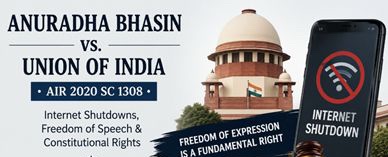
Author: Garvita Kathuria, Maharaja Agrasen Institute of Management Studies
LinkedIn Profile: https://www.linkedin.com/in/garvita-kathuria-883797344?utm_source=share&utm_campaign=share_via&utm_content=profile&utm_medium=ios_app
ABSTRACT
This article critically examines Anuradha Bhasin v. Union of India, (2020) 3 SCC 637, where the Supreme Court of India reviewed the constitutionality of the extensive internet and communications blackout imposed in Jammu & Kashmir after the revocation of the region’s special status under Article 370 in August 2019. The legal issues addressed included the scope of freedom of speech and expression under Article 19(1)(a), the right to conduct trade or profession under Article 19(1)(g), the legality of indefinite internet suspensions, the constitutional limits of Section 144 CrPC, and the standards for judicial review related to executive orders on national security. The Court found that fundamental rights under Article 19 can be exercised through the internet, that indefinite internet suspension is unconstitutional, that Section 144 CrPC orders must have a time limit and be periodically reviewed, and that all restriction orders must be made public for judicial scrutiny. The judgment is based on the proportionality doctrine discussed in Modern Dental College v. State of Madhya Pradesh and the privacy rights established in K.S. Puttaswamy v. Union of India. It represents a major step in India’s developing digital rights law, outlining the constitutional framework for internet governance. Nonetheless, the judgment’s reluctance to declare internet access an independent right under Article 21 and its tendency to delegate the proportionality assessment to the executive present significant limitations. The article concludes that, despite these shortcomings, Anuradha Bhasin is a crucial precedent for addressing digital freedoms in India.
Keywords: Anuradha Bhasin, Internet Shutdowns, Digital Rights, Freedom of Speech, Article 19, Section 144 CrPC, National Security.
TO THE POINT
On 5 August 2019, after Jammu & Kashmir’s special status under Article 370 was revoked and the region was reorganised into two Union Territories, the Government placed severe restrictions across the area. These included almost complete suspension of internet and telecommunications services under Section 144 CrPC and the Temporary Suspension of Telecom Services Rules, 2017. The restrictions lasted for a long time, and the official orders were not made public. In response to these measures, Anuradha Bhasin, Executive Editor of the Kashmir Times, and Ghulam Nabi Azad filed writ petitions in the Supreme Court under Article 32. They argued that the restrictions violated the freedoms protected under Articles 19(1)(a) and 19(1)(g), harmed press freedom, and did not meet the standards of transparency, reasonableness, or the rule of law. In a significant ruling on 10 January 2020, a three-judge bench made up of Justice N.V. Ramana, Justice R. Subhash Reddy, and Justice B.R. Gavai stated that freedom of speech and expression, along with the right to conduct trade or profession, can be exercised through the internet. This brought internet activities under the protection of fundamental rights. The Court also declared that an indefinite suspension of internet services is unconstitutional, that all restrictions must be reasonable, and that the Government must publish and periodically review such orders. This ruling is considered a landmark decision in Indian digital rights law, affirming constitutional protections in the digital space and reinforcing accountability, transparency, and judicial review principles.
USE OF LEGAL JARGON
Freedom of Speech and Expression under Article 19(1)(a)
The Supreme Court determined that Article 19(1)(a) protects freedom of speech and expression through all modern communication platforms, including the internet. Since the internet is essential for sharing information, journalism, and political discussion, restrictions on internet access directly impact this fundamental right.
Freedom to Practice Trade or Profession under Article 19(1)(g)
The Court recognised that internet access is crucial for many modern professions and businesses. The shutdown in Jammu & Kashmir significantly impacted journalists, traders, and other professionals, affecting the rights guaranteed under Article 19(1)(g).
Reasonable Restrictions and the Framework of Articles 19(2)–19(6)
While fundamental rights under Article 19 are not absolute, any restrictions based on public order or national security must be reasonable. The Court stressed that the State must justify restrictions and prove they are necessary and proportionate.
Doctrine of Proportionality
A major contribution of the judgment was applying the proportionality doctrine. The Court stated that restrictions must aim for a legitimate purpose, be logically connected to that purpose, be the least restrictive option available, and balance public interest with individual rights. Indefinite and blanket internet shutdowns probably do not meet this standard.
Judicial Review and the Rule of Law
The Court confirmed that actions taken by the executive under Section 144 CrPC and the Telecom Suspension Rules are open to judicial review. It emphasised that restriction orders must be public so that affected individuals can challenge their legality in court.
Procedural Safeguards, Constitutional Morality, and Digital Rights
The judgment highlighted the importance of procedural safeguards like publicising orders, periodic reviews, and demonstrating necessity. Although the Court did not recognise internet access as a separate fundamental right under Article 21, it established the internet as a constitutionally protected medium for exercising fundamental freedoms, laying the groundwork for future digital rights law.
THE PROOF
The case of Anuradha Bhasin v. Union of India arose from the restrictions placed in Jammu and Kashmir following the constitutional changes on 5 August 2019, when Article 370 was revoked and the State reorganised into two Union Territories. Anticipating unrest, the administration applied restrictions under Section 144 CrPC and suspended internet and communication services under the Temporary Suspension of Telecom Services Rules, 2017, creating a prolonged communication blackout. Anuradha Bhasin, Executive Editor of Kashmir Times, and Ghulam Nabi Azad challenged these measures in the Supreme Court, claiming that the indefinite internet shutdown violated freedoms protected under Articles 19(1)(a) and 19(1)(g), undermined press freedom and political involvement, and did not meet the standards of transparency, legality, and proportionality. The key issues before the Court included whether fundamental rights extend to the internet, whether indefinite internet shutdowns are constitutionally acceptable, whether Section 144 CrPC can justify widespread and prolonged restrictions, and the extent of judicial review concerning national security matters.
The Supreme Court ruled that the rights to freedom of speech and expression and to practise any profession or trade through the internet are protected under Articles 19(1)(a) and 19(1)(g). It stated that indefinite suspension of internet services is unconstitutional, asserting that such restrictions must be temporary, necessary, and reviewed periodically. The Court further stated that Section 144 CrPC cannot be applied repeatedly or indefinitely without proper justification and that all restriction orders must be made public to allow for public challenge and judicial scrutiny. Although the judgment faced criticism for not classifying internet access as a separate fundamental right under Article 21 and for largely leaving the proportionality assessment to the executive, it remains a landmark ruling that affirms digital rights, enhances governmental accountability, and establishes that restrictions on internet access must meet constitutional standards and undergo meaningful judicial review.
CASE LAWS
1. Romesh Thappar v. State of Madras, AIR 1950 SC 124
The Supreme Court ruled that freedom of speech and expression includes the right to share ideas and cannot be limited based on reasons outside Article 19(2). This case established that restrictions on a communication medium also restrict free speech itself, a principle later applied to the internet in Anuradha Bhasin.
2. Bennett Coleman & Co. v. Union of India, (1972) 2 SCC 788
The Court decided that limitations on newspaper circulation and publication directly impact freedom of speech and the press. It recognised that restricting the medium of dissemination effectively diminishes the right itself, a principle extended to internet communication in Anuradha Bhasin.
3. Shreya Singhal v. Union of India, (2015) 5 SCC 1
The Court invalidated Section 66A of the Information Technology Act and confirmed that free speech protections apply to online expression. The ruling established that internet speech has constitutional protection and that restrictions must comply with Article 19(2).
4. People’s Union for Civil Liberties v. Union of India, (1997) 1 SCC 301
In this case about telephone tapping, the Court acknowledged the right to privacy in communications and highlighted the need for procedural safeguards in executive actions affecting telecommunications. These principles shaped the Court’s approach to internet suspension orders in Anuradha Bhasin.
5. Modern Dental College v. State of Madhya Pradesh, (2016) 7 SCC 353
This decision formally embraced the doctrine of proportionality in Indian constitutional law. The four-part proportionality test became the standard used in Anuradha Bhasin to evaluate the validity of internet shutdowns and restrictions on fundamental rights.
6. K.S. Puttaswamy v. Union of India, (2017) 10 SCC 1
The nine-judge bench acknowledged privacy as a fundamental right under Article 21 and highlighted the protection of digital and informational privacy. Its proportionality framework and rights-based approach strongly influenced the reasoning in Anuradha Bhasin.
CONCLUSION
Anuradha Bhasin v. Union of India is significant in Indian constitutional law because it confirms that fundamental rights under Articles 19(1)(a) and 19(1)(g) can be exercised online. It also states that any restrictions on digital access must meet the proportionality test. The Supreme Court improved constitutional protections by requiring the publication and periodic review of internet suspension orders. The Court also reaffirmed that judicial review is available even for issues related to national security. However, some critics argue that the judgment failed to recognize internet access as its own right under Article 21. They also point out that it left the proportionality assessment mainly to the executive authorities involved. Despite these shortcomings, the decision changed India’s digital rights landscape by including the internet in the constitutional protection of fundamental freedoms. It also created a legal path to challenge arbitrary internet shutdowns. The focus on transparency and accountability in government actions continues to shape discussions about digital governance. As technology, artificial intelligence, and data-driven administration increasingly influence modern governance, the core message of the judgment remains crucial: constitutional protections apply in the digital realm, and any limitations on online freedoms must be lawful, proportional, and subject to judicial review.
FREQUENTLY ASKED QUESTIONS (FAQs)
1. What was the main issue in Anuradha Bhasin v. Union of India?
The main issue was whether the extensive internet and communication shutdown in Jammu & Kashmir, after the revocation of Article 370’s special status in August 2019, was constitutional. Other questions included whether the fundamental rights under Article 19 apply to the internet, whether indefinite suspensions are lawful, and what standard of judicial review applies to orders based on national security.
2. Did the Supreme Court declare internet access a fundamental right?
The Court did not declare internet access as a separate fundamental right. Instead, it ruled that exercising fundamental rights under Articles 19(1)(a) (free speech) and 19(1)(g) (trade and profession) through the internet is constitutionally protected. Any restrictions on internet access that limit these rights must meet the conditions outlined in the Constitution.
3. What is the proportionality test applied in the case?
The Court used a four-stage proportionality test based on cases like Modern Dental College v. State of Madhya Pradesh and K.S. Puttaswamy v. Union of India: (i) the measure must have a legitimate goal; (ii) there should be a clear connection between the measure and the goal; (iii) the measure must be the least intrusive way to achieve the goal; and (iv) the benefits of the measure must outweigh the costs of restricting rights.
4. How does the judgment affect internet shutdowns in India?
The judgment states that indefinite internet suspensions are unconstitutional. All suspension orders need to be published, reviewed regularly, and proportionate to the identified threat. Section 144 CrPC orders must be time-limited and cannot be renewed automatically. These rulings give citizens and courts a legal basis to contest arbitrary shutdowns, although enforcing these rules has proved challenging in practice.
5. What role did Article 19 play in the decision?
Article 19 was key to the decision. The Court ruled that Articles 19(1)(a) and 19(1)(g) can be exercised through the internet. Any restrictions on internet access that limit free speech or the right to earn a living must pass the tests of reasonableness and proportionality outlined in Articles 19(2) and 19(6). Article 19 thus provided the main constitutional framework for judging the legality of the shutdown.
6. Why is the case considered a landmark judgment?
This case is considered landmark for several reasons: it is the first clear Supreme Court ruling on the constitutional status of internet access in India; it introduced the proportionality doctrine into the examination of fundamental rights; it set enforceable procedural standards for suspension orders; and it reaffirmed strong judicial oversight of government actions in national security and digital governance.