Author: Astha Keshri, B. A LL.B, Sister Nivedita University
To the Point
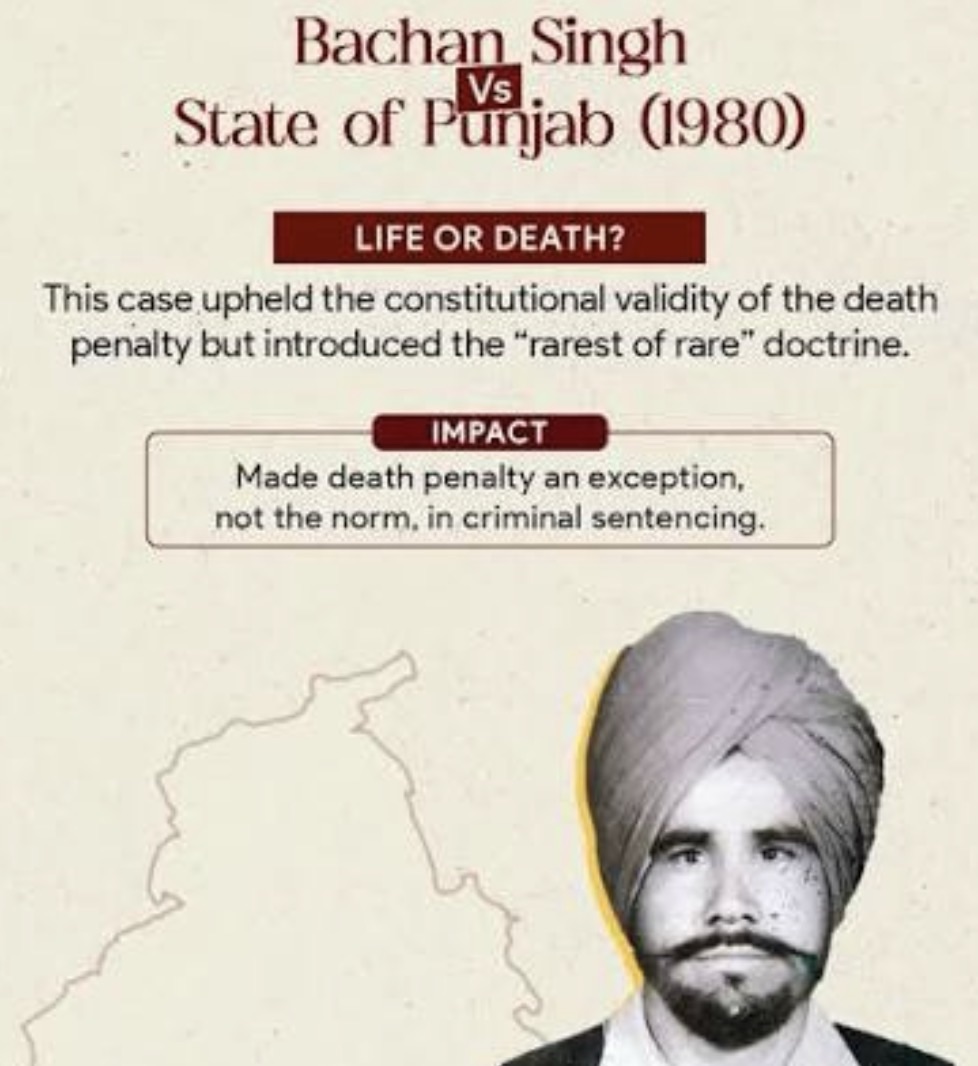
The Supreme Court’s decision in Bachan Singh v. State of Punjab (1980) is one of the most significant judgments in Indian criminal jurisprudence. The case addressed the constitutional validity of the death penalty under Section 302 of the Indian Penal Code and Section 354(3) of the Code of Criminal Procedure, 1973. The Court upheld the constitutionality of capital punishment but ruled that it should be imposed only in the “rarest of rare” cases where life imprisonment is unquestionably inadequate. This judgment continues to guide Indian courts in determining when the death penalty may be awarded.
Use of Legal Jargon
Before examining the case, it is important to understand certain legal terms used in the judgment:
Capital Punishment: A sentence of death imposed by a court of law.
Constitutional Validity: The conformity of a law with the provisions of the Constitution.
Judicial Discretion: The authority of judges to make decisions based on the circumstances of a particular case.
Mitigating Circumstances: Factors that reduce the severity of punishment.
Aggravating Circumstances: Factors that increase the seriousness of an offence.
Article 14: Guarantees equality before the law.
Article 19: Protects certain fundamental freedoms.
Article 21: Guarantees the right to life and personal liberty except according to procedure established by law.
Rarest of Rare Doctrine: A principle that limits the use of the death penalty to exceptional cases involving extreme culpability.
The Proof
Facts of the Case
Bachan Singh was convicted of murder and sentenced to death. Having previously been convicted of another murder, he became involved in a violent incident resulting in multiple deaths. The Sessions Court awarded the death sentence, which was upheld by the High Court. Bachan Singh challenged the constitutional validity of the death penalty before the Supreme Court.
Issues Before the Court
1. Whether the death penalty prescribed under Section 302 IPC violated Articles 14, 19, and 21 of the Constitution.
2. Whether Section 354(3) of the Code of Criminal Procedure, which requires special reasons for imposing the death sentence, was constitutionally valid.
3. Under what circumstances should capital punishment be imposed.
Judgment
A Constitution Bench of the Supreme Court, by a majority of 4:1, upheld the constitutional validity of the death penalty. The Court held that capital punishment does not violate Articles 14, 19, or 21 when imposed through a fair, just, and reasonable procedure established by law.
The Court emphasized that life imprisonment is the normal rule and death sentence is the exception. Judges must carefully consider both aggravating and mitigating circumstances before awarding capital punishment.
The Court introduced the famous “rarest of rare” doctrine, stating that the death penalty should be imposed only when the alternative option of life imprisonment is unquestionably foreclosed.
Significance of the Judgment
The judgment transformed India’s sentencing policy by restricting the use of capital punishment. It established safeguards against arbitrary sentencing and ensured that courts consider the circumstances of both the crime and the offender.
The decision continues to influence criminal justice administration and remains the leading authority on death penalty jurisprudence in India.
Abstract
The decision in Bachan Singh v. State of Punjab (1980) represents a landmark development in Indian constitutional and criminal law. The Supreme Court examined the legality of capital punishment in light of fundamental rights guaranteed under the Constitution. While affirming the validity of the death penalty, the Court limited its application through the “rarest of rare” doctrine. This principle balances society’s interest in punishing heinous crimes with the constitutional commitment to protecting human dignity and life. The judgment remains a cornerstone of Indian sentencing jurisprudence and continues to guide courts in capital punishment cases.
Case Laws
1. Bachan Singh v. State of Punjab, AIR 1980 SC 898
The Supreme Court upheld the constitutional validity of the death penalty and established the “rarest of rare” doctrine.
2. Machhi Singh v. State of Punjab, AIR 1983 SC 957
The Court further clarified the principles laid down in Bachan Singh and identified categories of cases where the death penalty may be justified, such as exceptionally brutal murders and crimes that shock the collective conscience of society.
3. Jagmohan Singh v. State of Uttar Pradesh, AIR 1973 SC 947
The Court earlier upheld the constitutional validity of capital punishment and laid the groundwork for later decisions.
4. Santosh Kumar Satishbhushan Bariyar v. State of Maharashtra, (2009) 6 SCC 498
The Supreme Court stressed the need for careful application of the “rarest of rare” doctrine and warned against arbitrary sentencing.
5. Shankar Kisanrao Khade v. State of Maharashtra, (2013) 5 SCC 546
The Court revisited death penalty jurisprudence and highlighted inconsistencies in sentencing practices.
Conclusion
Bachan Singh v. State of Punjab remains one of the most influential decisions in Indian legal history. The Supreme Court successfully balanced the constitutional right to life with the State’s power to punish grave offences. By introducing the “rarest of rare” doctrine, the Court ensured that capital punishment would be reserved only for exceptional cases. The judgment continues to serve as a guiding precedent for courts and reflects the judiciary’s commitment to fairness, proportionality, and constitutional values in criminal sentencing.
FAQ
1. Why is Bachan Singh v. State of Punjab considered a landmark case?
It established the “rarest of rare” doctrine and upheld the constitutional validity of the death penalty in India.
2. What is the “rarest of rare” doctrine?
It is a legal principle stating that the death penalty should be imposed only in exceptional cases where life imprisonment is clearly inadequate.
3. Which constitutional provisions were examined in this case?
The Supreme Court examined Articles 14, 19, and 21 of the Constitution of India.
4. Did the Supreme Court abolish the death penalty in this case?
No. The Court upheld its constitutionality but significantly restricted its use.
5. Why is the judgment still relevant today?
Indian courts continue to rely on this decision while deciding cases involving capital punishment and sentencing policy.