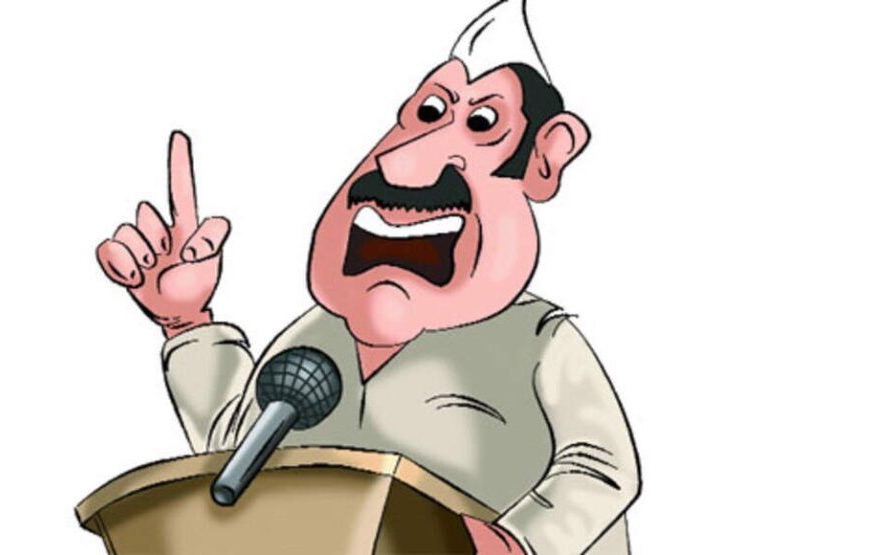
THREAT TO DEMOCRACY AND THE RULE OF LAW
Author: Sai Smruti Kiran, Centurion University of Technology and Management
TO THE POINT
India is the world’s largest democracy.
Yet, a troubling situation has developed.People who break the law are now taking part in politics.This growing trend, known as the criminalization of politics, is a serious issue because it goes against the basic principles of democracy.The rules meant to govern the law arebeing replaced by the pursuit of money and power.Democracy relies on leaders who are responsible and committed to the well-being of the
public.However, more and more political parties are linked to criminal activities.Because of this, instead of focusing on improving public welfare, politics in the country has become a profitable business.The criminalization of politics means that people with a criminal backgroundare entering politics.While criminal law is meant to punish those who break the law, politics often gives them a chance to gain legitimacy and protection.The criminalization of politics in India is not a coincidencebut the result of deep-rooted problems in the system.The presence of criminal charges against political leaders weakens public trust and harms
democratic institutions.This issue also involves corruption.It happens intwo ways: criminals run for office and become lawmakers, or politicians misuse their position to engage in illegal activities.Today, criminalization is a reality in Indian politics.Voters, political parties, and the law enforcement agencies all
share responsibility for this.When criminals enter politics, crime andviolence are closely connected.Although there have been many judicial observations and recommendations from different committees, the problem continues.As Abraham Lincoln said, democracy belongs to the people, is run by them, and is for their benefit.The structure of a nation’s politics determines its future.Political criminalization has become a lasting feature of Indian politics.Parliament needs to take strong steps toreduce this threat.Fair elections are essential for a pure democracy.Only through collective efforts and institutional commitment can India safeguard its
democratic future and remain true to the supremacy of the Constitution.
ABSTRACT
The criminalization of politics in India is not just a legal issue; it is amoral crisis that threatens the very foundation of democracy.
Democracy must serve as the basis of society.The relationship between politics and criminal activities must be broken so that citizens do notlose faith in their government.India needs reforms, strong political will,and an awakened public that rejects lawbreakers becoming lawmakers.This article examines the causes, judicial
frameworks, implications, and recommendations aimed atdecriminalizing Indian politics.The criminalization of politics is one of the most serious threats to India’s democratic system and the rule of law.
LEGAL JARGONS
RULE OF LAW: No one is above the law.
CONSTITUTIONAL MORALITY: Governance mustfollow constitutional values. FREE AND FAIR ELECTION: An election that is conducted impartially.
ELECTORAL INTEGRITY: Honesty and fairness in the electoral process. PUBLIC TRUST DOCTRINE:Public offices are held for the benefit of citizens. NATURAL JUSTICE: Fairness in decision-making.
CONSTITUTIONAL SUPREMACY: The Constitutionis the highest law. ELECTORAL MALPRACTICE: Illegal practices in elections.
CORRUPT PRACTICE: Electoral offenses under the Representation ofthe People Act.
TO PROOF
The rule of law, good governance, and democracy are all at risk due tothe criminalization of politics.
Despite judicial decisions such as Union of India v.Association for Democratic Reforms, Lily Thomas v.Union of India, and Public Interest Foundation v.Union of India, the problem continues because criminal cases are delayed and electoral changes are not enough.Protecting the integrity of India’s democratic system depends on a strong legal system,quick justice, greater transparency, and informed voting.Only whenpeople of integrity and responsibility hold public office can a true democracy flourish.
CASE LAW
MANOJ NARULA V.
UNION OF INDIA 2014
Although the court could not ban such nominations, the Prime Minister and Chief Ministers have a constitutional duty to protect constitutionalmorality and avoid nominating individuals with serious criminal histories.
INDIRA NEHRUGANDHI V. RAJ NARAIN 1975
This case is a turning point in Indian constitutional and political history.
It led to the declaration of the Emergency in 1975 and brought upimportant issues about the Constitution’s structure, judicial independence, and the limits of parliamentary authority.
KULDIP NAYAR V.
UNION OF INDIA 2006
This is a significant constitutional law case often referred to as the “Rajya Sabha case.” It addressed important questions about the federalstructure, the basic structure doctrine, and the principle of electoral secrecy.
RESURGENCE INDIA V.
ELECTION COMMISSION OF INDIA 2014
This case is a landmark judgment on electoral transparency.
It reinforced the right of citizens to know about candidates andempowered Returning Officers to reject nomination papers with incomplete information.
FAQs
What is meant by criminalization of politics?
Criminalization of politics refers to the increasing involvement of peoplewith criminal histories or ongoing criminal charges in elections and public office.
It also involves using political influence to affect judicialprocesses and criminal investigations. Why is the criminalization considered a threat to democracy?
It goes against the values of free and fair elections, weakens the rule oflaw, damages public trust in
democratic institutions, and promotes corruption by allowing people withserious criminal records to hold public office.
Which law governs the disqualification of candidates with acriminal conviction in India? The Representation of the People Act, 1951.