Author: Shreya Gupta, Dharmashastra National Law School
TO THE POINT
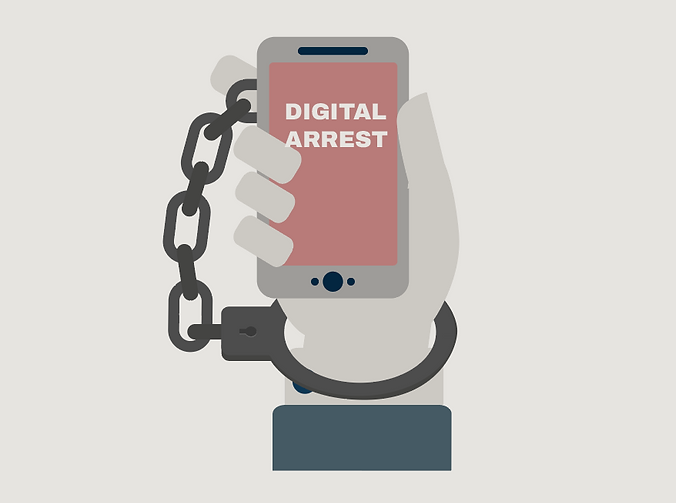
The Digital Arrest Scam is an emerging type of cyber fraud in which fraudsters deceitfully pose as a police or court institution in order to illegitimately force victims to believe they are arrested via digital channels. Scammers, relying on a fear of punishment for a crime and overall ignorance of procedural knowledge, devise an imaginary legal provision called “digital arrest” which they use for extortion purposes. The Digital Arrest Scam lacks any legal basis in Indian jurisprudence, since the arrest is a coercive state act strictly regulated for implementation in line with statutes and provisions of the Constitution. It is, therefore, presumably illegal, fake, or fraudulent if one assumes the capability to execute an arrest through video calls, messaging, or emails. Digital-based scams, therefore, have been a grave abuse of the perception engendered through the criminal justice system, which may amount to cheating, impersonation, intimidation, and cyber fraud.
In addition to the financial damage, this fraud causes mental anguish, denies individual freedom as a result of compulsive isolation, and damages public confidence in honest law enforcement agencies. This fraud is a potential harbinger of the dark dangers posed by the escalation of cybercrime, in which the rule of law itself becomes a tool for fraud. The increase in digital arrest scams, particularly the sophistication shown, points to the imperative need for legal knowledge, more robust cyber policing, and judicial classification of this fraud as a new form of cybercrime.
ABSTRACT
The growing digitisation of the governance and banking systems, as well as the police forces of India, has unintentionally contributed to the growth of cyber frauds that rely on the public’s trust in the state’s authority. One of the emerging threats to the public in this regard is that of the Digital Arrest Scam, where the fraudsters deceive the public by masquerading as police officers and/or officials of investigative agencies/judicial authorities and coerce the public illegally to believe that they have been arrested for grave crimes against the state. This paper will discuss the definition of the digital arrest scam phenomenon and will go on to cover the mode of operation of the digital scam and the constitutional and judicial precedents that emerge concerning the prevalence of the digital scams of arrests in India and the constitutional issues that arise in the realm of the digital scams of arrests.
USE OF LEGAL JARGON
The Digital Arrest Scam can be defined as an act which is marked by the fraudulent impersonation of ‘public servants’, together with misleading as well as intimidatory intentions, hence inviting both substantive and procedural criminal liability as provided for in Indian law. The Digital Arrest Scam involves mens rea ab initio, where the intentions for the act are present from the very start. This involves deceiving others by claiming lawful authority that one does not actually have, hence involving the state’s power in a colourable exercise of sovereign power* where civilians act on the powers of the state.
In criminal terms, the labelling of a victim as under ‘digital arrest’ can itself be deemed cheating under Section 415 of the Indian Penal Code, since it contains an element of deception and duping the victim into parting with their property. The protracted incarceration of victims through threats and mental duress can also be deemed wrongful restraint and criminal intimidation, in view of the hampering of the free exercise of liberty on the part of the victim. The preparation of fake files, court orders, and identity cards constitutes forgery, and the use of forged documents as genuine is also considered forgery.
Under cyber law, the practice of pretending to be a law enforcement agency through the use of electronic communication services is classified as “cheating by personation using computer resources” and is a specific offence in the Information Technology Act of 2000. The scam is also fraught with several challenges regarding jurisdiction, the admissibility of electronic evidence, and the requirements of Section 65B of the Indian Evidence Act of 1872. On the constitutional front, digital arrest scams amount to a serious violation of the right to individual liberty guaranteed under Article 21, as well as the procedural guarantee against arbitrary arrests under Article 22. The scam, therefore, does not amount to just an economic crime, but a profound assault upon the processes constituting rule-of-law governance in the digital era.
THE PROOF
The extent of digital arrest scam instances being prevalent is evident by the fact that complaints are being recorded in Cyber Crime Cells in several states, with each complaint containing similar modalities of impersonation, intimidation, and undue financial extortions. The fact of digital arrest being impossible receives official support in repeated public notifications issued by respective law enforcement agencies and the government, stating that no arrest is possible in the digital format. Further, objective evidence exists in the digital trail often left behind in the aftermath of digital arrest scam instances, such as spoofed telephone numbers, forged electronic documents in the likeness of official notifications or judicial mandates, video calls recorded with instances of impostors in the likeness of police personnel, and finally, bank and UPI transactions of forced financial handouts. Such digital evidence, when attested to in accordance with Section 65B of the Indian Evidence Act, 1872, is deemed valid evidence of the offence itself and the intention behind it. Taken together, this recurrence of fact elements across cases reflects that the digital arrest scam is indeed not an isolated case but part of a systemic, organised cyber-enabled fraud.
CASE LAWS
Hridaya Ranjan Prasad Verma v. State of Bihar (2000) – The Supreme Court held that the offence of cheating under Section 420 of the Indian Penal Code requires the intent to be dishonest from the very inception of the transaction. Moreover, mere breach of promise to contract does not amount to an offence Fit for punishment in a criminal court. The essence of cheating is the ingredient of mens rea.
State of Gujarat vs. Mohanlal Jitamalji Porwal (1987) – The Supreme Court stated that economic offences are serious crimes that have a large impact on society. They expressed that these crimes undermine the confidence of the general public in public institutions and governance. This is largely because there is no element of violence in an economic offence. A strict policy needs to be followed in relation to economic crimes.
CBI vs Ramalinga Raju (2017) – White-collar crimes are committed after meticulous planning and deliberation. These crimes result in massive economic loss and damage to economic institutions. What is required in such cases is deterrence sentencing. Economic offenders cannot be likened to common criminals.
CONCLUSION
The Digital Arrest Scam is a disquieting blend of cyber fraud and abuse of authority.” In the Digital Arrest Scam, the fraudsters not only deprive the victim of money but also affect the confidence of the public in the criminal justice system with the help of an invented process that has no basis in reality. The lack of knowledge of the laws about the process of arrests makes the occurrence of such scams commonplace. Stopping the threat will therefore call for a coordinated effort that aims at strengthening the enforcement of cyber laws and acknowledging digital arrest scams as a separate crime at the judicial level and improving technological security, and educating the public.
FAQS
QUESTION 1: WHAT MAKES THE NOTION OF ‘DIGITAL ARREST’ UNTENABLE IN INDIAN CRIMINAL LAW?
The notion of digital arrest is legally unviable as arrest in Indian law needs to be strictly in accordance with the procedure prescribed under the Code of Criminal Procedure, 1973. Arrest must be accompanied by physical custody and control by the legal authority, as ensured under Articles 21 and 22 of the Constitution of India. None of the laws in India discuss video calls, emails, or messaging services in the context of effecting an arrest.
QUESTION 2: HOW IS A DIGITAL/ARREST SCAM AN INFRINGEMENT OF THE BASIC RIGHTS PROVIDED FOR IN THE INDIAN CONSTITUTION?
The digital arrest scam violates the ”right to liberty” guaranteed by Article 21 of the Constitution by unfairly limiting the liberty of the citizen through intimidation and coercion. The scam will also contravene Article 22 of the same constitution that provides the right to freedom from arbitrary arrest and detention. The scam will usurp the powers of the state since the scammers will pretend to be the state and therefore will exercise state powers without the authority of the law.
QUESTION 3: WHAT IS THE CRIMINAL LIABILITY FOR IMPERSONATION OF LAW ENFORCEMENT AGENCIES IN DIGITAL ARREST SCAMS?
The act of mimicry/impersonation of the police officials invites liability under Section 170 of the IPC, along with the charge of cheating under Sections 415 and 420 IPC. If the digital documents and the orders from the courts are fake, then sections 468 and 471 IPC are also applicable. Further, the act of deception through electronic communication invites the liability of cheating by personation as stated in Section 66D of the Information Technology Act of 2000. Moreover, the criminal conspiracy is a harsh reality if several culprits are involved.
QUESTION 4: WHAT SHOULD A VICTIM DO WHEN THEY COME ACROSS A DIGITAL ARREST SCAM?
It is recommended that, as a victim, one needs to cut all forms of communication and not transfer any money as well as any information. All the cybercrime evidence available in terms of voice recordings, messages, and transaction details ought to be saved in line with the technical requirements of any case for evidence. This ought to be done immediately on the cybercrime portal and at the local police.