Author: Vidhi Pravinbhai Pandya, Anand Law College, Anand
To the Point
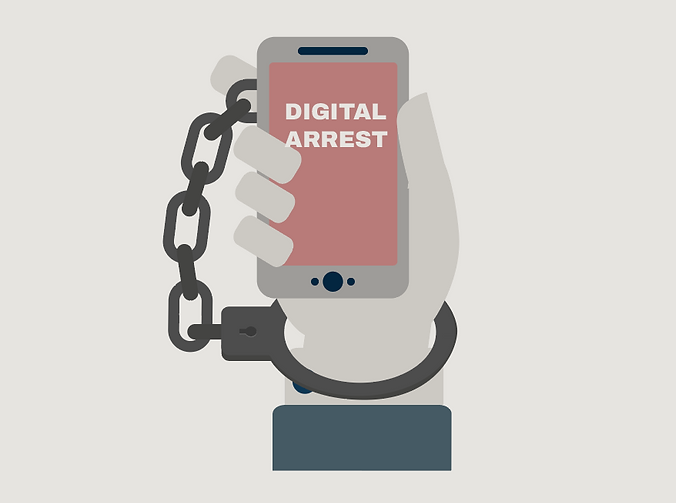
The rapid digitalisation of governance, banking, and communication in India has transformed how crimes are committed and investigated. While technology has enhanced efficiency and accessibility, it has simultaneously facilitated the rise of sophisticated cybercrimes, particularly online scams and the alarming phenomenon of digital arrests. Fraudsters impersonate police officers, CBI officials, or enforcement agencies through video calls, fake documents, and spoofed phone numbers, coercing victims into transferring money under the false threat of arrest or prosecution.
Despite India’s expanding cyber infrastructure and increasing internet penetration, the legal and institutional framework governing cyber policing remains fragmented and reactive. Existing laws such as the Information Technology Act, 2000, the Bharatiya Nyaya Sanhita, 2023, and the Bharatiya Nagarik Suraksha Sanhita, 2023 inadequately address the unique nature of digital arrests and cross-border cyber fraud. This article critically examines the legal gaps in India’s cyber policing framework, analyses relevant case laws, and proposes reforms to strengthen cybercrime prevention, investigation, and victim protection in the digital age.
Abstract
The proliferation of online scams and the emergence of “digital arrests” represent a new frontier of cybercrime in India. Criminals increasingly exploit technological vulnerabilities, jurisdictional limitations, and low digital literacy to impersonate law enforcement agencies and extort money from unsuspecting citizens. While Indian cyber laws have evolved over time, they remain insufficient to effectively address technologically sophisticated frauds that operate across territorial and national boundaries.
This article explores the concept of digital arrests, the modus operandi of online scam networks, and the shortcomings of India’s cyber policing framework. By analysing statutory provisions, judicial pronouncements, and enforcement challenges, the article highlights systemic gaps in investigation, jurisdiction, and victim redressal mechanisms. It concludes by recommending legal, institutional, and technological reforms aimed at strengthening cyber policing and safeguarding citizens’ digital rights in an increasingly connected society.
Use of Legal Jargon
The phenomenon of digital arrests exposes fundamental deficiencies in India’s cybercrime jurisprudence and enforcement architecture. Cyber frauds involving impersonation of public servants directly implicate offences under the Bharatiya Nyaya Sanhita, 2023, including cheating, criminal intimidation, identity theft, and personation. Simultaneously, such acts constitute contraventions under the Information Technology Act, 2000, particularly offences relating to identity theft, cheating by personation using computer resources, and unauthorised access to electronic systems.
However, the procedural mechanisms under the Bharatiya Nagarik Suraksha Sanhita, 2023, remain territorially constrained and ill-suited to address crimes executed in virtual spaces without physical presence. Jurisdictional ambiguities, evidentiary challenges concerning electronic records, and the transnational character of cybercrime networks further complicate investigation and prosecution. These limitations undermine the deterrent effect of cyber laws and necessitate a recalibration of India’s cyber policing framework to align with constitutional guarantees of personal liberty, due process, and access to justice.
The Proof
India has witnessed an exponential rise in cybercrime incidents over the past decade, with online financial frauds and impersonation scams constituting a significant proportion of reported cases. Digital arrest scams typically involve fraudsters posing as officials from law enforcement agencies such as the CBI, ED, or local police, accusing victims of involvement in money laundering, narcotics trafficking, or other serious offences. Victims are coerced through video calls, fake arrest warrants, and fabricated case details into transferring funds to “secure accounts” to avoid arrest.
Legally, the concept of arrest under Indian law is grounded in physical custody and procedural safeguards. An arrest must comply with statutory requirements, including lawful authority, communication of grounds of arrest, and production before a magistrate. Digital arrests, by contrast, bypass these safeguards entirely, creating a legal paradox where citizens are deprived of liberty and property without any lawful process.
Although offences related to cheating, impersonation, and cyber fraud are criminalised under existing statutes, enforcement agencies face significant obstacles. Cybercrime investigations require technical expertise, real-time coordination with financial institutions, and cross-border cooperation, which remain inadequately institutionalised. Furthermore, the absence of a dedicated legal definition or recognition of digital arrest frauds limits prosecutorial clarity and public awareness, allowing such scams to flourish in a regulatory vacuum.
Legal Framework Governing Cyber Policing in India
Information Technology Act, 2000
The Information Technology Act, 2000, serves as the primary legislation addressing cyber offences in India. Sections dealing with identity theft, cheating by personation using computer resources, and unauthorised access provide a statutory basis for prosecuting online scam operators. However, the Act was enacted at a time when cybercrime was relatively nascent and does not adequately contemplate complex frauds involving video impersonation, deepfakes, and coordinated international networks.
Bharatiya Nyaya Sanhita, 2023
The Bharatiya Nyaya Sanhita criminalises cheating, impersonation, criminal intimidation, and forgery, all of which are central to digital arrest scams. Nonetheless, these provisions remain technologically neutral and do not account for the aggravated nature of offences committed through digital platforms, nor do they provide enhanced penalties or investigative powers tailored to cybercrime.
Bharatiya Nagarik Suraksha Sanhita, 2023
Procedural law continues to emphasise territorial jurisdiction and physical investigation. Cyber offences, however, often span multiple states or countries, resulting in delays, jurisdictional conflicts, and fragmented investigations. The lack of specialised cyber procedural norms undermines effective enforcement and victim redressal.
Case Laws
1. State of Tamil Nadu v. Suhas Katti (2004)
This landmark case marked one of India’s first cybercrime convictions, recognising the evidentiary value of electronic records. While the case established judicial willingness to address cyber offences, it also revealed the dependence of successful prosecution on technical expertise and prompt investigation.
2. Shreya Singhal v. Union of India (2015)
Although primarily concerning freedom of speech, this case underscored the importance of balancing state regulation of digital spaces with constitutional rights. The judgment highlights that cyber policing must operate within the bounds of legality, proportionality, and due process.
3. Anvar P.V. v. P.K. Basheer (2014)
The Supreme Court clarified the admissibility of electronic evidence, emphasising compliance with procedural safeguards. In cyber fraud cases, failure to properly authenticate digital evidence often results in acquittals, exposing enforcement gaps.
4. Internet and Mobile Association of India v. RBI (2020)
The Court acknowledged the growing importance of digital financial systems and the need for regulatory clarity. The judgment indirectly reflects the judiciary’s recognition of evolving digital risks, including online financial frauds.
Challenges in India’s Cyber Policing Framework
Jurisdictional Limitations
Cybercrimes transcend physical boundaries, while policing remains territorially bound. Determining jurisdiction often delays registration of FIRs and investigation.
Lack of Technical Capacity
Many police stations lack trained cyber forensic personnel and infrastructure, leading to ineffective investigation and low conviction rates.
Delayed Reporting and Awareness
Victims often hesitate to report digital arrest scams due to fear, stigma, or lack of awareness, allowing perpetrators to evade accountability.
Cross-Border Enforcement Issues
A significant number of scam operations originate outside India, complicating extradition, evidence collection, and prosecution.
Impact on Fundamental Rights
Digital arrest scams directly violate Article 21 of the Constitution by depriving individuals of liberty and property without due process. The psychological trauma inflicted on victims, particularly senior citizens, further underscores the human rights dimension of cyber fraud. Ineffective cyber policing erodes public trust in law enforcement and digital governance initiatives.
Suggested Reforms
Statutory Recognition of Digital Arrest Fraud
Explicit legal recognition of digital arrest scams as a distinct offence would enhance clarity and deterrence.
Specialised Cyber Policing Units
Establishing dedicated cybercrime units with nationwide jurisdiction and technical expertise is essential.
Procedural Reforms
Amendments to procedural law should facilitate swift investigation, inter-state coordination, and digital evidence handling.
Public Awareness and Digital Literacy
Nationwide campaigns are necessary to educate citizens about cyber frauds and lawful arrest procedures.
International Cooperation
Strengthening treaties and cooperation mechanisms for cross-border cybercrime enforcement is imperative.
Conclusion
Digital arrests and online scams represent a serious challenge to India’s legal and policing framework in the digital era. While existing laws criminalise various aspects of cyber fraud, they fall short of addressing the unique technological, procedural, and jurisdictional complexities involved. The absence of specialised statutory recognition, coupled with enforcement limitations, undermines effective deterrence and victim protection.
To safeguard constitutional rights and public trust, India must adopt a proactive and adaptive approach to cyber policing. Legal reforms, institutional strengthening, technological investment, and public awareness must converge to create a robust framework capable of addressing evolving cyber threats. Only through such comprehensive measures can India ensure that digital progress does not come at the cost of justice and personal liberty.
FAQS
1. What is a digital arrest?
A digital arrest refers to fraudulent acts where criminals impersonate law enforcement officials online and coerce victims into transferring money under false threats of arrest.
2. Are digital arrests legally valid?
No. Indian law recognises only lawful arrests carried out through prescribed legal procedures. Digital arrests have no legal validity.
3. Which laws apply to online scams in India?
Online scams are primarily governed by the IT Act, 2000, Bharatiya Nyaya Sanhita, 2023, and Bharatiya Nagarik Suraksha Sanhita, 2023.
4. Why is cyber policing difficult in India?
Challenges include lack of technical expertise, jurisdictional limitations, cross-border nature of crimes, and low digital awareness.
5. What reforms are needed to combat digital arrest scams?
Legal recognition of such scams, specialised cyber units, procedural reforms, international cooperation, and public awareness initiatives are crucial.