Author: Kashish Srivastava, Lloyd Law College
To the point
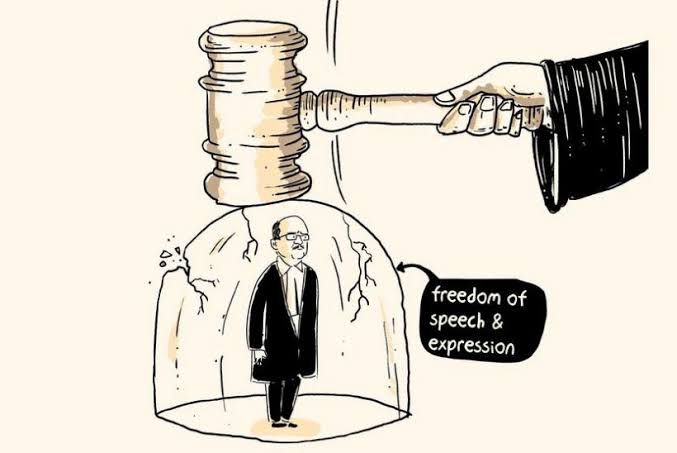
Social media platforms are the modernised ways for enabling people to connect with on global level. However, the best use of social media is to facilitate free expression which should be balanced by curbing hate speech and incitement to violence. This article evaluates the legal complications in regulation of speech and expression on social media, and the approach to such regulations.
Use of Legal Jargon
• First Amendment: The US Constitution’s First Amendment guards freedom of religion and expression against government interference. The amendment was ratified in 1791 and prevents Congress from having a national religion, imposing limitations on religious practices, or curtailing speech, the press, assembly, or petitions to the government.
• Content Moderation: This process involves reviewing the user generated content on online platform and ensure that it complies with guidelines and policies of the platform.
• Prior Restraint: It refers to government censorship that prohibits speech or expression before it is actually conveyed.
• Hate Speech: speech that expresses hate or encourages violence or hatred against protected groups.
• Platform Liability: It refers to the legal responsibility of online platforms for the content and actions of their users.
The Proof
• While the U.S. government is constitutionally limited in terms of censoring speech; private platforms have tremendous flexibility permissively and respectfully to engage in content moderation and enforcement based upon their own terms of service.
• Recent legislative proposals such as Kids Online Safety Act (KOSA) and California’s SB 976 have largely been divisive in resolving the balance of protecting minors while advancing First Amendment protections.
• The European Union’s Digital Services Act (DSA) requires platforms to remove “illegal content” such as hate speech, but the vagueness of social media content, differing member state definitions and requirements results in inconsistent implementation and oversight.
• Countries around the globe impose stricter regulation, or outright bans of specific online speech, often using justifications rooted in matters of national security or concerning public order.
Abstract
The proliferation of social media has transformed the world of free speech and expression, presenting novel legal concerns regarding the rights and liabilities of users as well as the social media sites themselves. Although the First Amendment constrains government censorship in the U.S., private platforms have a lot of room to moderate content. Legislative and regulatory reactions are diverse: the U.S. struggles with state and federal bills aimed at addressing online harms, the EU applies wide content take-down mandates, and other countries apply even more stringent controls. The problem is balancing the protection of open expression with the protection of individuals and groups from harm.
Case Laws
United States
1. NetChoice v. Bonta (2025): NetChoice v. Bonta is a court case on California’s “Protecting Our Kids from Social Media Addiction Act” (SB 976) and the California Age-Appropriate Design Code Act (CAADCA), which protects children online. The case is a complaint brought by NetChoice, an association representing the tech industry, against California Attorney General Rob Bonta, claiming that such laws violate the First Amendment and other constitutional protections.
2. Packingham v. North Carolina (2017): In Packingham v. North Carolina, the United States Supreme Court found an unconstitutional law from North Carolina which made it illegal for registered sex offenders from using social media. The law prohibited those on the sex offender registry from visiting websites that allowed minors to register. The court held this prohibition violated the First Amendment because it was not narrowly tailored to protect the state’s interest in protecting children, and broadly restricted the free speech rights of a large class of people.
European Union
Digital Services Act (2022/2024): Okay, so it’s not technically a court case, but this regulation’s shaking things up. Platforms now gotta yank illegal stuff down fast—like really fast—or else. Plus, there’s a whole pile of fresh rules they’ve gotta follow. Some folks are freaking out that this could go way too far and end up muzzling people who aren’t even breaking the law. Kind of a double-edged sword, honestly.
International
Global Cases of Press Freedom: States like Pakistan have employed legislation such as the Prevention of Electronic Crimes Act to arrest critical journalists, illustrating how speech control is employed to silence opposition.
Conclusion
The law of free expression on social media is characterized by an underlying tension: platforms have to weigh the right to free expression against the need to avoid harm. Constitutional protections in the United States restrict government censorship, but private platforms have considerable control over moderation. In the EU and elsewhere, regulatory regimes such as the DSA add complexity, as ambiguous definitions of “hate speech” and “illegal content” have the potential for inconsistent and overbroad censorship. Ultimately, the task for legislatures, courts, and platforms is to create sensitive, open, and rights-enforcing methods of content moderation that balance free expression and the security of online communities.
FAQS
Q: Do users of social media possess First Amendment rights on private sites?
A: The United States’ First Amendment only limits government action, not corporations. Social media companies do not have a statutory obligation to enforce First Amendment norms, although their moderation practices are frequently contentious in the free speech debate17.
Q: How do platforms determine and regulate “harmful content”?
A: Definitions differ across platforms and jurisdictions. In the EU, the DSA mandates taking down “illegal content,” such as hate speech, but the absence of common definitions causes problems for enforcement. In the U.S., platforms establish their own rules, which can be stricter than constitutional norms.
Q: Are there international variations in governing speech on social media?
A: Yes. The U.S. tilts toward constitutional free speech protections, whereas the EU requires tougher content moderation. Others, like Pakistan, employ speech laws to silence opposition, demonstrating a broad range of regulatory efforts.
Q: May platforms be held accountable for user content?
A: Within the U.S., Section 230 of the Communications Decency Act typically protects platforms from liability for content created by users, although this immunity is currently the subject of ongoing legislative controversy. The EU’s DSA establishes new regimes of compliance and liability for platforms.