
Author: Vidhi P. Pandya, Anand Law, College Anand
To the Point
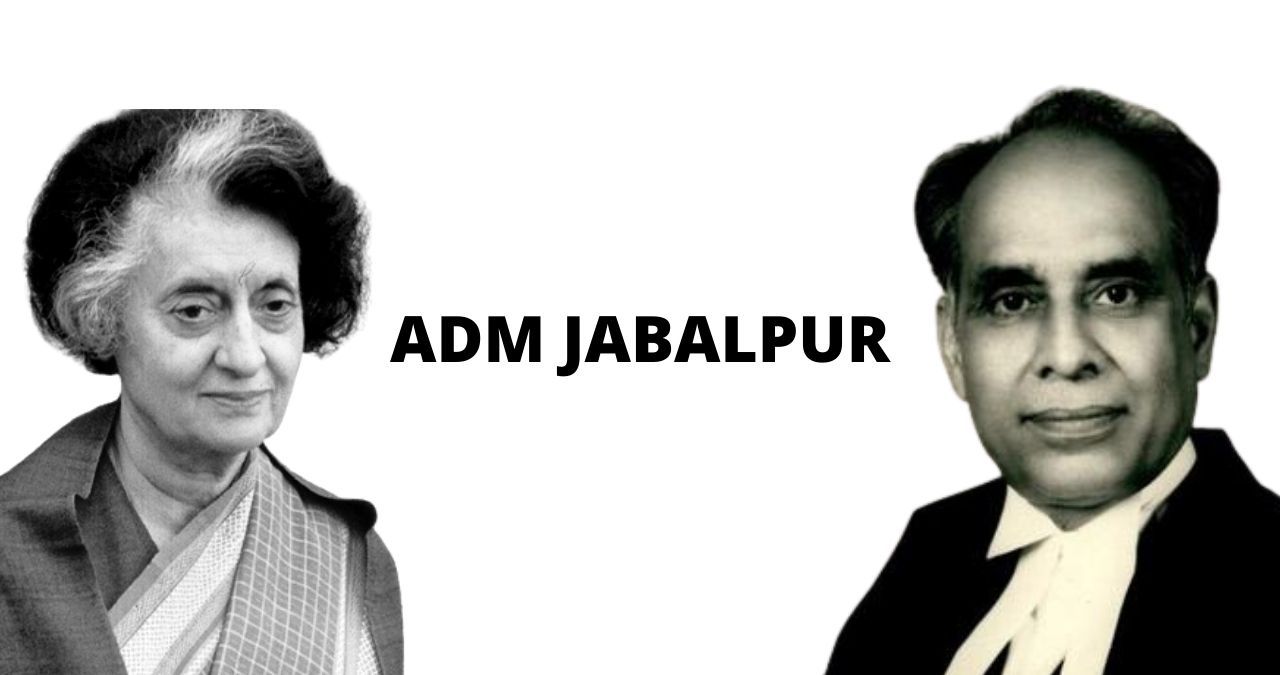
In Indian constitutional history, the Supreme Court of India’s ruling in ADM Jabalpur v. Shivkant Shukla (1976) is among the most contentious and criticised rulings. The case, which was heard during the Internal Emergency (1975–1977), dealt with a significant constitutional issue: may the ability to seek judicial remedies through habeas corpus be suspended during an emergency, especially in situations involving unlawful detention? The Supreme Court ruled, by a majority of 4:1, that no one had locus standi to petition any court for the enforcement of the right to personal liberty under Article 21 during the declaration of emergency under Article 352 and the suspension of fundamental rights enforcement under Article 359.
This ruling essentially subordinated constitutional rights to the demands of emergency governance, leaving individual liberty at the whim of administrative discretion. Since then, the decision has been heavily criticised for forsaking the judiciary’s responsibility as the defender of fundamental rights and legitimising arbitrary state action. The ADM Jabalpur case, its constitutional justification, its effects on civil freedoms, and its ultimate overturning are all critically examined in this article. The article aims to demonstrate how the ruling constitutes a constitutional failure and why it continues to serve as a warning for Indian democracy through doctrinal analysis and a study of case law.
Abstract
The ADM Jabalpur case represents a dark chapter in the constitutional jurisprudence of India, where the Supreme Court prioritized executive authority over individual liberty during the Emergency period. This article undertakes a constitutional critique of the judgment, focusing on the suspension of the writ of habeas corpus and the denial of judicial remedies for illegal detention. It examines the interpretation of Articles 21, 32, 226, and 359 of the Constitution and evaluates the reasoning adopted by the majority in contrast with Justice H.R. Khanna’s historic dissent.
By analyzing the legal, moral, and constitutional dimensions of the decision, this article argues that ADM Jabalpur undermined the basic structure of the Constitution by negating the rule of law and judicial review. The article further explores the long-term impact of the judgment, its repudiation in later cases, and its relevance in contemporary constitutional discourse. Ultimately, it emphasizes the necessity of safeguarding fundamental rights even during emergencies to preserve constitutional democracy.
Use of legal jargon
The ADM Jabalpur judgment raises profound constitutional questions concerning the scope of Article 21, the enforceability of fundamental rights during emergencies, and the doctrine of rule of law. The writ of habeas corpus, regarded as a bulwark against arbitrary detention, derives its authority from Articles 32 and 226 of the Constitution. Article 359 empowers the President to suspend the right to move courts for enforcement of specified fundamental rights during an emergency, but not the rights themselves.
In ADM Jabalpur, the majority interpreted Article 359 expansively to hold that during the suspension of Article 21, no remedy existed against unlawful detention, even if such detention violated statutory or natural law principles. This approach effectively subordinated constitutional supremacy to executive fiat and diluted the doctrine of judicial review. The judgment also conflicted with the principle of audi alteram partem and the concept of inherent natural rights, which predate constitutional recognition.
Justice Khanna’s dissent, grounded in constitutional morality and natural law theory, asserted that the right to life and personal liberty is not the creation of the Constitution but is inherent in human existence. His opinion underscored that even in the absence of Article 21, the State could not deprive a person of life or liberty without authority of law. This dissent later became the cornerstone for the restoration of constitutional values in subsequent jurisprudence
The Proof
The factual backdrop of ADM Jabalpur lies in the declaration of National Emergency in June 1975, following political unrest and judicial challenges to the Prime Minister’s election. During this period, thousands of individuals were detained under preventive detention laws such as the Maintenance of Internal Security Act (MISA). Several detainees approached High Courts through writ petitions challenging their detention as mala fide, illegal, or ultra vires.
While some High Courts upheld the detainees’ right to judicial review despite the Emergency, the Union of India appealed to the Supreme Court. The core issue before the Court was whether any writ petition under Article 226 was maintainable for enforcement of the right to personal liberty during the suspension of Article 21.
The majority held that since Article 21 was suspended, no person could seek relief against illegal detention, even if it violated statutory provisions. This reasoning ignored the distinction between suspension of enforcement and suspension of the right itself. It also disregarded the principle that executive action must have legal authority, thereby allowing detention without accountability.
The judgment revealed a positivist approach to constitutional interpretation, prioritizing textual literalism over constitutional values. In doing so, the Court failed to act as a check on executive excesses, resulting in widespread human rights violations. The absence of judicial oversight during the Emergency demonstrated how constitutional safeguards could be rendered ineffective if not interpreted purposively.
Case Law
1.ADM Jabalpur v. Shivkant Shukla (1976)
In this landmark case, the Supreme Court held that during the Emergency, no person had the right to move any court for enforcement of the right to personal liberty under Article 21. The majority judgment by Chief Justice A.N. Ray and Justices Beg, Chandrachud, and Bhagwati concluded that Article 359 barred judicial remedies even in cases of illegal detention.
Justice H.R. Khanna dissented, asserting that the rule of law could not be suspended and that the right to life and liberty existed independently of Article 21. His dissent is widely regarded as one of the finest judicial opinions in Indian history and later formed the basis for the judgment’s repudiation.
2.Maneka Gandhi v. Union of India (1978)
Although decided after the Emergency, Maneka Gandhi significantly expanded the interpretation of Article 21 by linking it with Articles 14 and 19. The Court held that any law depriving personal liberty must be just, fair, and reasonable. This judgment implicitly rejected the narrow interpretation adopted in ADM Jabalpur and restored substantive due process into Indian constitutional law.
3. K.S. Puttaswamy v. Union of India (2017)
In the Puttaswamy case, a nine-judge bench explicitly overruled ADM Jabalpur, holding that the judgment was erroneous and inconsistent with constitutional principles. The Court recognized the right to privacy as a fundamental right under Article 21 and affirmed that fundamental rights cannot be suspended in a manner that destroys their essence.
The Court acknowledged Justice Khanna’s dissent and declared that ADM Jabalpur failed to uphold the rule of law and constitutional morality.
Conclusion
The ADM Jabalpur judgment represents a constitutional aberration where the Supreme Court abdicated its role as the protector of fundamental rights. By denying citizens the right to challenge unlawful detention, the Court legitimized executive arbitrariness and undermined democratic values. The judgment exposed the fragility of constitutional safeguards when interpreted without regard to underlying principles of justice, liberty, and human dignity.
The eventual overruling of ADM Jabalpur signifies the resilience of the Indian Constitution and the judiciary’s capacity for self-correction. It reinforces the idea that fundamental rights are not mere legal privileges but essential components of human existence that cannot be extinguished even during emergencies.
The case serves as a reminder that constitutional courts must remain vigilant, especially in times of crisis. The protection of habeas corpus and personal liberty is indispensable to the survival of constitutional democracy. ADM Jabalpur thus stands not as a precedent to be followed, but as a lesson to be remembered.
FAQS
1. What was the main issue in ADM Jabalpur case?
The main issue was whether a person could approach the courts for enforcement of the right to personal liberty during the Emergency when Article 21 was suspended.
2. Why is ADM Jabalpur considered a controversial judgment?
It is criticized for allowing the suspension of habeas corpus and denying judicial remedies against illegal detention, thereby legitimizing executive excesses.
3. Who gave the dissenting opinion in ADM Jabalpur?
Justice H.R. Khanna gave the dissenting opinion, emphasizing that the right to life and liberty exists independently of the Constitution.
4. Has ADM Jabalpur been overruled?
Yes, it was expressly overruled by the Supreme Court in K.S. Puttaswamy v. Union of India (2017).
5. What is the relevance of ADM Jabalpur today?
The case serves as a cautionary tale highlighting the importance of judicial independence, rule of law, and protection of fundamental rights, even during emergencies.
