Author: Yash Bundela, SAGE University Indore
To the Point
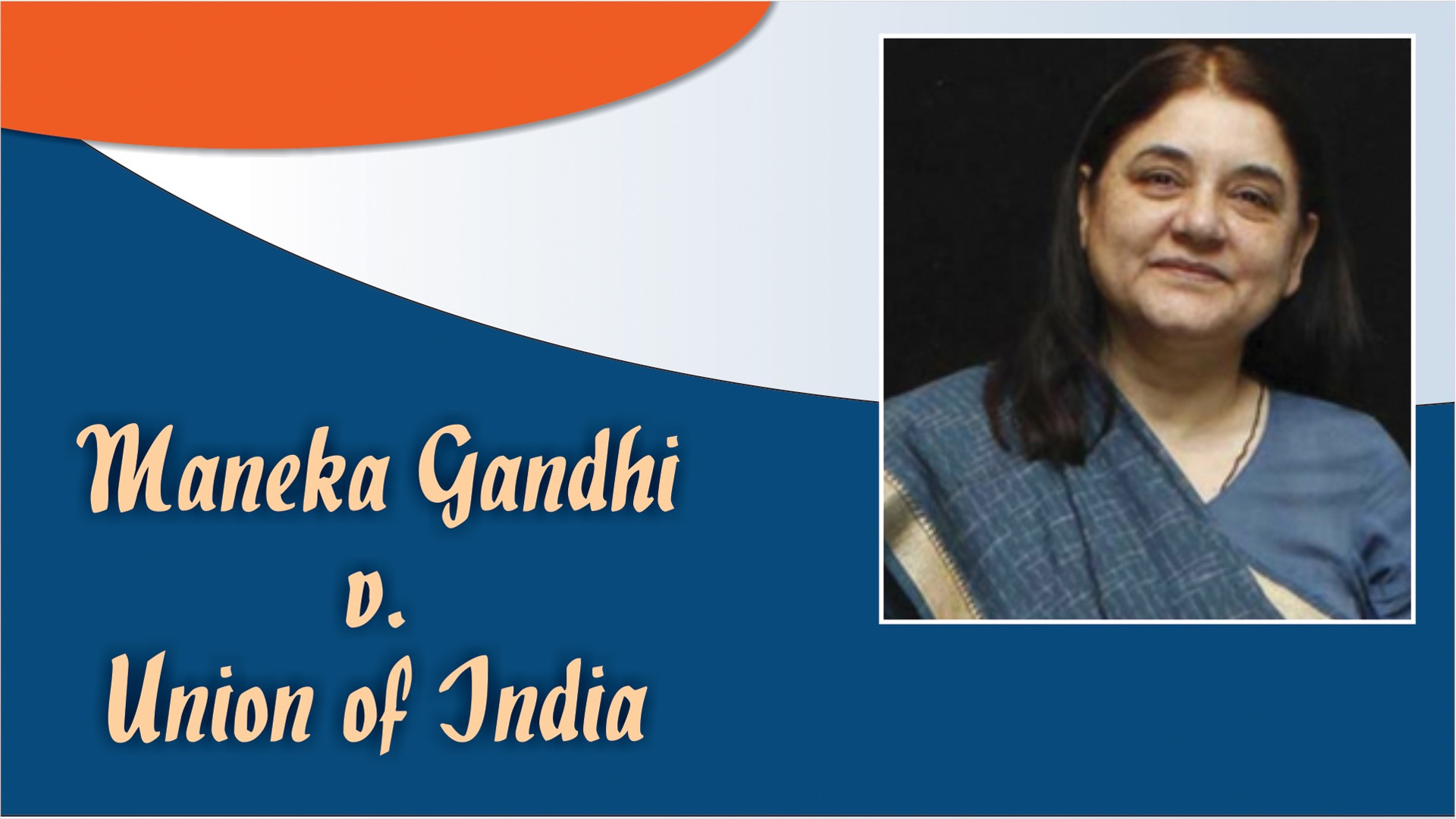
The case law Maneka Gandhi vs. Union of India AIR 1978 SC 597, was a landmark case in Indian legal field. It is a type of writ petition, the case expanded the scope of Article 21 (Right to life) and also established the rule of golden triangle i.e. Article 14 (Right to equality), Article 19 (Right to freedom) and Article 21 (Right to life and personal liberty). The case judgement and decision established a broad relationship between Article 14, 19 & 21 and also Shows an interdependence of these three main constitutional Article. Besides of this integration the state exhibit the procedure must be fair, just and reasonable, under the law and match with the Rule of golden triangle.
Use of legal Jargon
The case of Maneka Gandhi vs Union of India have involved the various Articles & provision of Indian Constitution such as, Article 14 Right to equality, this Article established the concept All are equal before the law, means all the citizens of India must be treated equally in every procedure.
Article 19 stands for Right to freedom from this Article the following sub points involved Article 19(1)(a).
Right to freedom of speech & expression and Article 19(1)(g) Right to carry any profession and carry any business under this article the facts also includes the infringement of right to travel in country.
Article 21 gives us a right to life & personal liberty, that case was primarily depends on the violation of right to travel but later court relied on it to ensure legal fairness and reasonableness.
Passport Act, 1967 Sec. 10(3)© involves directly in the case. The section of Act empower the passport authority to impound, cancel and revoke the passport of any person.It is deemed to protect the sovereignty of nation and other countries also. Along with this provision the case also involve procedural fairness, state’s arbitrary action, due process of law etc.
The Proof
The case arises when the personal passport of Maneka Gandhi was impounded by the government under Passport Act 1967. And the same was done in public interest. The passport was seized on the ground that she has violated the security of India.
Maneka Gandhi challenged the action in the court and argued against the government that violation of her fundamental rights such as Article 19 and Article 21 of Indian Constitution as well as violation of her Right to travel. And also the action is arbitrary and against principle of Natural Justice.
In same matter the Union (State) Responded that the Act done in public interest and it is necessary to maintain National security.
The court listen the both parties arguments and relied that the suspension of passport by Passport Authority is Arbitrary because they don’t have any valid reason behind its action and the Supreme court declared in its judgement their action restricting an individual personal liberty, violation of Right to travel, Arbitrary action of state and Article 21 also. The court passed a golden triangle concept that Article 14, 19 & 21 are interconnected by each other and in the case court must satisfy the All three Fundamental Rights.
Abstract
The case of Maneka Gandhi vs. Union of India was a landmark case in Indian law. The case not only resolve the issue but also expanded the interpretation of fundamental rights such as Article 14, 19, 21. Through its judgement not only Article 14, 19, 21 interpreted but also established the concept of golden triangle between these three Articles along with procedural fairness, reasonable restriction and arbitrary action. The Article Aims to examine the case and shows its legal value and impact on our legal system and constitution’s interpretation, along with Government’s limitedness over individual’s fundamental Rights.
Case laws
– A.K. Gopalan vs. State of Madras (1950)- The case of Ak Gopalan involved a issue of preventive detention. The Supreme Court of India interpret Article 21 the very Narrow. And held that in Our country there is Procedure established by law follow instead of due Process of law.
– Justice K. S. Puttaswami vs. Union of India (2017)- In this case the Supreme Court of India held that the Right to Privacy As a Part of Fundamental Right and the Case also Relied on Maneka Gandhi vs. Union of India case because, it follows the Golden triangle Rule and Substantive Due Process.
– Olga tellis vs. Bombay Municipal Corporation (1985)-The Court Ruled that the Right to livelihood is an essential Part of Article 21 of “Right to life” And Constitution is not only give a Right of life but also Earn for their livelihood.
– Mohini Jain vs. State of Karnataka (1992)-In this case a Petitioner filed a case against Capitation fee taken by the Medical college. So Supreme held that Right to Education is a Part of Fundamental Right under Article 21.
Conclusion
The case of Maneka Gandhi vs Union of India marked a landmark decision in Indian legal & constitutional history. The case not only Address the issue of Maneka Gandhi but expanded the interpretations of various constitutional Provisions such as Article 14, 19 & 21. That Safeguard human Dignity and Personal liberty.And make our constitutional value better for future ones.
The case established the interdependence and interconnection among the various Articles (Provisions) of Indian Constitution. Thus the case and its Ruling Supports and influence a lot of cases on its Bases. The Maneka gandhi case Plays a Pivot Role to Shape and strengthen Indian Judicial System.
FAQs
①. Which Provisions and Articles of Indian Constitution served in case of Maneka Gandhi vs U.O.I.?
— Article 14, 19, & 21 of Indian Constitution.
②. Which Principle we got by its Judgement?
— The core type of Principle we get by its Judgement Such as, Principle of Golden triangle, expansion of Article 21, & Substantive Due Process of law.
③ Is it have a future Relevant for other Cases?
-Yes, It is Considered very Relevant for other case, it also used by Indian Judiciary for the decision of other cases.