Author: Riya S. Rane, Hindi Vidya Prachar Samiti’s College of Law
To the Point
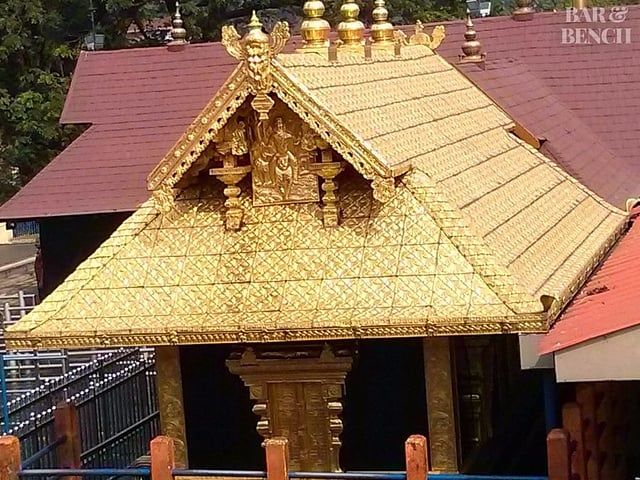
The Supreme Court of India, in the landmark judgment of Indian Young Lawyers Association vs. The State of Kerala, addressed the constitutionality of the exclusionary practice barring women of menstruating age (approximately 10 to 50 years) from entering the Sabarimala Temple. In a 4:1 majority verdict, the Court declared the practice unconstitutional, ruling that biological factors cannot be a ground for discrimination in matters of faith and worship. The judgment emphasized that “devotion cannot be subjected to the rigidity and stereotypes of gender”.
Use of Legal Jargon
The judgment is replete with significant legal terminology essential to constitutional jurisprudence:
Ultra Vires: The Court held that Rule 3(b) of the Kerala Hindu Places of Public Worship (Authorisation of Entry) Rules, 1965, was ultra vires (beyond the powers of) the parent Act of 1965, as it violated the prohibition against discrimination based on sex.
Res Judicata: Arguments regarding the binding nature of a previous Kerala High Court judgment (S. Mahendran) were raised, with respondents claiming the issue was res judicata (a matter already judged). However, the Supreme Court heard the matter as a public interest litigation involving fundamental rights.
Essential Religious Practice: A core test applied was whether the exclusion of women was an “essential religious practice” of the Hindu religion. The Court determined it was not, as it was not an unalterable core belief.
Religious Denomination: The Court examined whether the devotees of Lord Ayyappa constituted a separate “religious denomination” under Article 26. It concluded they did not, as they lacked a distinct name, common organization, and system of beliefs distinct from the general Hindu religion.
Constitutional Morality: The judgment heavily relied on “constitutional morality,” asserting that public morality in Article 25 must yield to the fundamental values of dignity, liberty, and equality enshrined in the Constitution.
Naishtika Brahmachari: The deity, Lord Ayyappa, is described as a Naishtika Brahmachari (eternal celibate), a factual premise used by respondents to justify the exclusion.
The Proof
The judgment provides a detailed analysis of why the exclusionary practice could not stand constitutional scrutiny:
Violation of Article 25: The Court held that Article 25(1) guarantees the right to practice religion to “all persons,” which includes women. The right to worship is available to men and women equally. The practice of exclusion denies women their right to worship and practice their faith.
Not a Religious Denomination: The Court found that devotees of Lord Ayyappa do not form a separate religious denomination under Article 26. They are Hindus who worship Lord Ayyappa, and the temple is a public place of worship. Without the status of a denomination, the temple cannot claim the protection of Article 26 to manage its own affairs in a way that derogates from fundamental rights.
Biological Discrimination: The Court ruled that exclusion based on physiological factors like menstruation amounts to discrimination based on sex, violating Article 15(1). The stigma associated with menstruation was deemed to have no place in a constitutional order.
Rule 3(b) Invalidated: Rule 3(b) of the 1965 Rules, which permitted the exclusion of women based on custom, was declared ultra vires Section 3 of the 1965 Act. Section 3 mandates that places of public worship be open to all sections and classes of Hindus.
Constitutional Morality: The Court asserted that “morality” in Article 25 refers to constitutional morality. Therefore, religious practices cannot violate the fundamental principles of dignity and equality.
Abstract
The case of Indian Young Lawyers Association vs. The State of Kerala (2018) challenged the centuries-old custom of prohibiting women aged 10 to 50 from entering the Sabarimala Temple in Kerala. The petitioners argued that this practice violated the fundamental rights to equality, non-discrimination, and freedom of religion guaranteed by the Indian Constitution. The respondents defended the practice as an essential part of the temple’s tradition, citing the celibate nature of the deity, Lord Ayyappa. The Supreme Court faced the critical task of balancing the freedom of religion of a group against the individual right to equality and dignity. The majority judgment struck down the exclusionary practice, holding that “patriarchy in religion cannot be permitted to trump over the element of pure devotion”. The verdict represents a significant moment in Indian constitutional law, reinforcing the supremacy of constitutional values over customary religious practices.
Case Laws
The judgment extensively referenced pivotal case laws to substantiate its reasoning:
The Commissioner, Hindu Religious Endowments, Madras v. Shri Lakshmindra Thirtha Swaminar of Sri Shirur Mutt (Shirur Mutt Case): Cited to define “essential religious practices” and “religious denomination.” The Court reiterated that what constitutes an essential part of a religion is primarily ascertained with reference to the doctrines of that religion itself.
S.P. Mittal v. Union of India: Used to determine the tests for a “religious denomination.” The Court affirmed that a denomination must have a common faith, common organization, and a distinctive name.
S. Mahendran v. The Secretary, Travancore Devaswom Board: The previous Kerala High Court judgment that had upheld the ban was analyzed and effectively overruled. The Supreme Court noted that the High Court had treated the practice as a usage rather than an essential religious custom.
Sri Venkataramana Devaru v. State of Mysore: Cited to explain the harmonious construction between Article 25(2)(b) and Article 26(b), holding that the right of a denomination to manage its affairs is subject to laws throwing open public Hindu religious institutions to all classes of Hindus.
N. Adithayan v. Travancore Devaswom Board: Referenced to support the view that any custom or usage violating human rights and dignity cannot be countenanced by the law.
Conclusion
The Supreme Court’s verdict in the Sabarimala case is a resounding affirmation of the principles of dignity, liberty, and equality. By lifting the ban on women’s entry, the Court dismantled a practice rooted in the notion that women are “lesser” or “impure” due to biological processes. The majority held that the practice of exclusion was not an essential religious practice and that the devotees did not constitute a separate religious denomination entitled to exclude women.
The judgment establishes that “constitutional morality” must guide the interpretation of religious freedom, ensuring that practices derogatory to women are not shielded under the guise of faith. However, it is crucial to note the dissenting opinion of Justice Indu Malhotra, who argued that judicial review of religious practices should be limited and that courts should not impose their rationality on matters of deep religious sentiment. Despite the dissent, the majority ruling stands as the law of the land, asserting that the “Constitution should not become an instrument for the perpetuation of patriarchy”.
FAQS
Q: What was the primary reason for the ban on women entering Sabarimala?
A: The ban was based on the belief that the deity, Lord Ayyappa, is a Naishtika Brahmachari (eternal celibate), and the presence of women of menstruating age (10-50) would disturb his celibacy and austerity.
Q: Did the Supreme Court find the Sabarimala devotees to be a separate religious denomination?
A: No. The Court ruled that they do not constitute a separate religious denomination under Article 26 because they do not have a distinct name, a common organization, or a system of beliefs distinct from the general Hindu religion.
Q: What is the significance of “Rule 3(b)” mentioned in the judgment?
A: Rule 3(b) of the Kerala Hindu Places of Public Worship (Authorisation of Entry) Rules, 1965, allowed for the exclusion of women based on custom. The Supreme Court struck this rule down as ultra vires (beyond the scope of) the parent Act and unconstitutional.
Q: What was the dissenting view?
A: Justice Indu Malhotra dissented, arguing that issues of deep religious faith should not be interfered with by courts unless they are pernicious. She held that the devotees constitute a religious denomination and that the Court should not impose its morality on religious practices.
Q: Does Article 17 (Abolition of Untouchability) apply to this case?
A: Opinions varied. Justice Chandrachud (concurring) argued that Article 17 applies to social exclusion based on notions of purity and impurity, including menstrual discrimination. However, Justice Indu Malhotra in her dissent stated that Article 17 pertains specifically to caste-based untouchability and does not apply to women as a class.