Author: Tanishka shakya, Symbiosis Law School
Abstract
The doctrine of separation of powers forms a foundational principle of constitutional democracies, designed to prevent the union of authority by distributing governmental functions among distinct organs of the state. This doctrine is not strictly applied in India but it is carried out in a functional division with the checks and balances. The relationships between the judiciary and the executive have attracted a lot of attention, both in the media and the literature, in the last couple of years, especially with regard to the appointment of judges, the extent of judicial review and the executive decision making. Such developments have raised a question whether the constitutional balance is declining or simply adapting to the modern issues of governance. This article takes the neutral and analytical stance in reviewing the judiciary-executive relationship in India and places the recent developments in the framework of constitutional provisions and judicial precedents and realities of democracy. It contends that instead of indicating the breakdown, the present stage is a continuation of constitutional conversation that entails reciprocal respect, restraint and institutional maturity.
To the Point
Flexible Framework: India has a functional separation of powers rather than strict institutional isolation.
The Balancing Act: As partners in governance, the Executive and Judicial branches are charged with preventing abuses while respecting constitutional boundaries.
Natural Friction: Modern controversies, including concerning judicial appointment, are part of the institutional and not constitutional breakdown.
The Human Factor: The efficiency of governance, the protection of human rights, and public trust in democratic institutions are all directly impacted by these institutional connections.
The Way Forward: Constitutional morality, mutual respect, moderation, and adherence to democratic standards are essential to constitutional stability.
Use of Legal Jargon
This article interacts with the core constitutional ideas such as Separation of powers, Judicial independence, Executive discretion, Checks and Balances, Judicial review, Basic structure doctrine, Constitutional morality, Institutional comity, Rule of law, Delegated legislation and Constitutional accountability.
The Proof
Separation of Powers: Rigidity to Functional Balance.
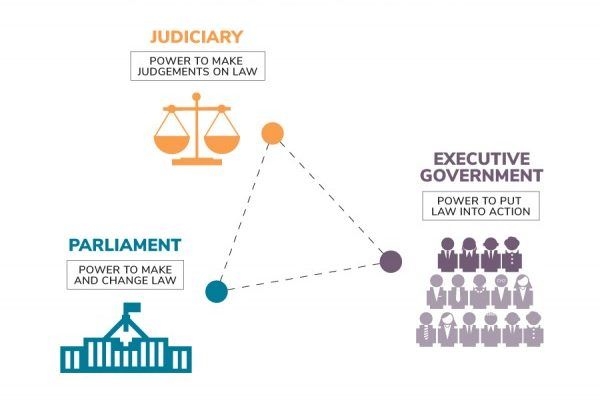
According to Montesquieu, the classical doctrine of separation of powers is based on strict and watertight division of Legislature makes laws, Executive implement laws and Judiciary interprets laws. This kind of rigidity was deemed necessary to avoid tyranny by consolidation of power.
But, the framers of the Indian Constitution not only avoided this model, but did so deliberately. The complexity of the democracy then meant that it required flexible rather than restricted. Accordingly, the Indian constitutional structure assumes an effective division of powers, as each organ has its primary role to execute and has somewhat overlapping jurisdiction to provide effective governance.
Despite the fact that the Constitution does not directly enshrine the doctrine, this spirit is underlying a number of provisions. Article 50 guides the State in parting the judiciary with the executive in the provision of services to the people, which is the further strengthening of the judiciary on the grassroots level. Articles 121 and 211 forbid the review of legislatures on the actions of judges, other than when it comes to impeachment, as it would protect the integrity of the judiciary and its dignity. Articles 122 and 212 on the other hand limit judicial review of the legislative process, and safeguard the independence of the legislative action.
Put all of this together, there is a constitutional design, which is balancing independence and interdependence, in such a way that no organ becomes supreme and each is answerable under its constitutional boundaries.
2. Judicial Independence and Executive Discretion: It is all about Institutional Tension.
The friction between the judicial and the executive in the institution must be viewed in a human and functional manner existing as a power struggle. Every institution has a specific constitutional personality based on the duties of the institution.
The executive being the vehicle of governance operates under the political imperative, administrative necessity and the expectation of the people. It focuses on efficiency, the implementation of policies and the timely decision making. Judicial interference, especially by review or supervision, can at times be viewed as a necessary restriction to shift government.
Judiciary on the other hand, acts as a constitutional conscience of the State. Speed is not its main responsibility, but legality, that all action of the State should be in conformity to constitutional values, fundamental rights, and the rule of law. Judiciary autonomy allows courts to rightly challenge authority without any fear or favour particularly when there is a risk of constitutional over-step in executive discretion.
This contradiction of administrative efficiency and constitutional accountability is bound to cause tension. However, it is not a constitutional failure. Instead, it is indicative of checks and balances of a healthy democracy where power is subjected to constant testing, justification and restraint.
3. The Basic Structure Doctrine and Judicial Review.
In India, the supremacy of the constitution is based on judicial review. It grants courts the power to review legislative and executive activities with regard to their constitutionality. This authority is not an act of judicial supremacy, but of a means to defend the rule of law, such that the governance is subordinated to the Constitution.
Legitimacy of judicial review is also enhanced by the doctrine of Basic Structure which imposes that there are some foundational elements, including separation of powers, judicial independence and constitutional morality, which cannot be changed even through a constitutional amendment. This doctrine changes the judicial review into a protector of constitutional identity instead of the tool of interpretation.
Current legal rulings confirm that judiciary actions are not aimed at taking over government, but guarding against undermining constitutional principles, particularly where the executive branch of government poses dangers to democratic ideals or the federal equilibrium.
4. Contemporary Areas of Institutional Interaction (2024-2025).
This is the case of both courtship and appointments. The most obvious point of judiciary and the executive interaction is judicial appointments. The Collegium System, which has undergone a judicial interpretation to avert political interference in judicial appointments, is an attempt to maintain the independence of the judiciary. The executive, in its turn, promotes more transparency and institutional responsibility.
Towards the end of 2024 and early 2025, the Supreme Court again stated that the executive may not be capable of indefinitely postponing or arbitrarily executing collegium suggestions. Such decisions highlight the concept of institutional courtship, i.e. institutional respect amongst the constitutional organs, but restate the idea that administrative discretion may not supersede constitutional duties.
a) Executive Accountability and Judicial Review.
Judicial review still serves as a constitutional check to executive inaction no less than action. In 2025 in the case of Governor of Tamil Nadu, the Supreme Court stated that a refusal to give consent to legislation of a State over an extended period was a constitutional impropriety. The Court made it clear that the purpose of the legislature cannot be overcome by silence or time on the part of the executives.
This decision makes the constitution more responsible and accountable, making discretionary powers to be handled in good faith and within reasonable time.
b) Rule of Law and Environmental Governance.
In Vanashakti v. Union of India, 2025. The Supreme Court turned down the ex post facto environmental clearances. Although the executive offered such clearances on developmental reasons, the judiciary stressed that rule of law is incapable of condoning the factualisation of illegality.
Notably, the Court did not replace its policy preferences. Rather, it strengthened procedural discipline, whereby, delegated laws and executive regulations are put to work within constitutional and legislative guidelines.
c) Public Trust, transparency and post-retirement appointments.
This is because appointment of retired judges to executive or quasi-executive positions even though this is constitutionally acceptable, has cast a shadow concerning perceptions of impartiality and destruction of confidence by the people. These issues are concerned with constitutional morality which requires both legal adherence as well as ethical restraint of constitutional actors.
In April 2025, the judges of the Supreme Court unanimously decided to publicly release their assets, another voluntary measure to strengthen the institution of transparency and credibility. This action shows a changing judicial spirit where independence has to be coupled with the trust of the people.
5. Dialogue, not Institutional Conflict, Constitutional.
The modern day correlation between the executive and the judiciary can only be viewed as a constitutional dialogue rather than a confrontation. The Constitution holds the power to check and balance and through institutional comity, power is held accountable, flexible, and morally grounded through judiciary review.
Instead of being indicative of the failure of the separation of powers, the current trends depict the Constitution as dynamic, adjusting to the contemporary needs of governance without failing to follow the spirit of its formation. This is the dynamism of balance that is at the core of the constitutional democracy of India.
Case Laws
Ram Jawaya Kapur v. State of Punjab (1955): This case established that India’s separation of powers is functional rather than strict rigidity.
Kesavananda Bharati v. State of Kerala (1973): The separation of powers was acknowledged as a part of the Basic Structure of the Constitution
Indira Nehru Gandhi v. Raj Narain (1975): Judicial review was strengthened as a check on executive overreach.
State of Tamil Nadu v. Governor of Tamil Nadu (2025): Clarified that governors cannot refuse to give their consent forever and must act on the Council of Ministers’ assistance and advice.
Waqf (Amendment) Act Challenges (2025): Ongoing processes that strike a balance between constitutional protections of property rights and religious freedom and executive reform attempts.
Conclusion
The analysis of the doctrine of separation of powers in the Indian constitutional system indicates that institutional tension between the executive and judiciary system is not new and is not necessarily effective. The Constitution of India consciously follows a pattern of functional separation, since it is understood that the highest rigidity is unwise in a multifaceted and changing democracy. The experiences discussed in this article, including the appointment of judges and the lack of action by the executive team, the governance of the environment, and the benefits of retirement, indicate that friction can be a consequence of conflicting duties in the constitution rather than open hostility.
Judicial intervention in the executive performing in the judicial review is not an endeavour to exercise governance, but rather a means to ensure constitutional accountability and practice democracy. Meanwhile, executive issues of efficiency, transparency, and policy implementation are valid governance priorities. It is not the issue of claiming superiority, but rather the issue of constitutional moderation by exercising restraint and respect towards one another.
Recent events show that the executive and the judiciary are in a constant constitutional discussion and not a breakage of separation of powers. The cases about delayed gubernatorial approval and environmental conformity are a reassertion of the judiciary as a constitutional protector, and also demonstrates a need to hold executive accountable to constitutional convention. On the same note, strategies directed to improve transparency at the judiciary are geared towards improving the trust of the people.
The strength of the doctrine of separation of powers in India, after all, will rest on the presence of constitutional morality, comity of institutional and accountability. The sustainability of the Indian democracy will be pegged on the capacity of its constitutional organs to withstand the limits of authority, as well as positively interact with each other in the name of the rule of law, as the governance issues will grow more intricate.
FAQS
Q1. Does total institutional isolation result from the separation of powers?
No. In India, separation of powers is functional, not absolute. The Constitution allows limited overlap between the legislature, executive, and judiciary to ensure cooperation and effective governance.
Q2. Does judicial involvement necessarily indicate overreach?
No. Judicial involvement becomes overreach only when courts interfere in policy matters without constitutional justification. When courts act to protect fundamental rights or uphold constitutional values, such involvement is legitimate.
Q3. What makes judicial appointment delays contentious?
Delays are contentious because they affect the functioning and efficiency of courts and raise concerns about transparency, accountability, and institutional independence in the appointment process.
Q4. Can disputes between the judiciary and the executive branch undermine democracy?
Not necessarily. Healthy disagreement is part of constitutional governance. However, persistent conflict without mutual respect can weaken public trust and institutional stability.
Q5. What keeps the two organs in balance?
The balance is maintained through constitutional provisions, checks and balances, judicial restraint, executive accountability, and mutual respect for institutional boundaries.