
Author: Prince Raj, K.K. University
ABSTRACT
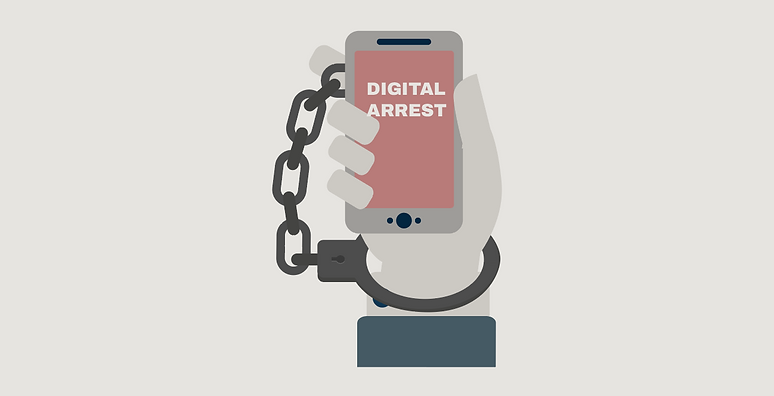
Digital Arrest has emerged as one of the most disturbing forms of cyber-enabled fraud in India. Unlike traditional arrest ordered by law, a digital arrest is a fraudulent act whereby cyber crooks represent themselves as police officers, government officials, law enforcement bodies, or judges and mentally pressure victims into thinking they’re under inquiry or detained. Perpetrators build a situation of anxiety, urgency, and legal terror – making victims stay connected over video calls and give money under the guise of verification or conformity to the law.
India’s rapid digitalization, combined with the increase in internet penetration and inadequate cyber awareness, has really accelerated the growth of these crimes. Victims lose both their financial resources and suffer from severe emotional pain, reputational damage, and psychological shock. The legal issue lies in that there is no expression ‘digital arrest’ in any Indian statue. However, the conducts involved attract certain laws under the Information Technology Act, 2000, the Bharatiya Nyaya Sanhita, 2023 (BNS), and associated cybercrime legislations.
To the point
Digital arrest is a highly complex cybercrime plan by which fraudsters manipulate individuals by deceitfully saying that they’re involved in some very serious crime like money laundering, drug dealing, financial fraud, or funding terrorist activities. The scammers usually present themselves as police officers, CBI, Enforcement Directorate, RBI, customs authority personnel, or even members of the judiciary itself.
Victims get told that a package sent to them includes prohibited items or that their bank account is related to criminal transactions. So as to build credibility, the scammers show fabricated ID cards, manufactured arrest warrants, very authentic-looking documents, and forged government stamps. The victim is then directed to be accessible at all times on a video call and is intimidated with a probable arrest if they hang up.
Legally, no law enforcement body in India is allowed to make a lawful arrest simply through a video call or requesting money for verification reasons. Hence, digital arrest is primarily mental confinement achieved through deception and coercion rather than actual detention.
Legal Jargon
Digital arrest fraud really draws in many different parts of criminal law, cyber law, and constitutional law. Although the actual word itself isn’t defined in any statute, the activities involved trigger lots of other legal offenses.
A. Cheating by pretend to be someone else :
Under the Bharatiya Nyaya Sanhita, 2023, impersonating a public official or government worker so as to trick another person is considered cheating by personation. Scammers falsely tell people they’re police officers, ED officials, customs authorities, or judges – all so they can get some sort of unfair financial benefit.
B. Criminal Intimidation
The threats used during digital arrest scams actually fit under the concept of criminal intimidation. Victims are often threatened with imprisonment, arrest, media exposure, or even legal proceedings – so that they act against their free will.
C. Extortion
When money is obtained through placing someone in fear of some kind of legal consequences or harming their reputation, it may actually be considered extortion. The victim gives over funds unwillingly because of coercion brought on by some pretty convincing fraudulent threats.
D. Identity Theft and Cyber Fraud
Section 66C of the Information Technology Act, 2000 makes identity theft involving electronic credentials a punishable offense, while Section 66D specifically deals with cheating by pretending to be someone using computer systems and communication devices. These laws are quite often cited in cyber fraud court cases.
E. Electronic Evidence
The Bharatiya Sakshya Adhiniyam, 2023 acknowledges electronic documents as actually admissible as evidence. Screenshots, phone recordings, transaction receipts, emails, WhatsApp messages, and even video recordings might just become very important pieces of evidence throughout an investigation and prosecution process.
F. Constitutional Safeguards
Digital arrest scams really go against some pretty key constitutional protections mentioned in Articles 20, 21, and 22 of the Indian Constitution. These provisions safeguard our personal freedom, due process, and our protection from the government taking some kind of arbitrary action. Scammers really take advantage of the public’s lack of knowledge about these constitutional rights to create this totally false impression of lawful authority.
As a result, digital arrest is not just some technological crime – it’s also a very serious breach of one’s own dignity, autonomy, and freedom. The point where cyber law and constitutional law intersect makes the subject quite significant indeed in modern legal discussions.
The Proof: Why Digital Arrest is a Serious Legal Threat
The full extent of digital arrest scams’ severity is shown through rising cybercrime statistics and countless real-life instances all over India. Your financial losses will usually amount to tens of thousands to even millions of rupees – whilst victims endure long-lasting psychological trauma. It’s much more than your regular cheating act since it really does create a condition of mental confinement and extreme fear itself.
Case Study 1: Malti Verma (Agra)
One of the most heartbreaking incidents involved a school teacher called Malti Verma. Fraudsters supposedly got in touch with her while pretending to be law enforcement officials – and falsely told her that her daughter was arrested on charges of prostitution. They demanded money for her release. The emotional shock and reported psychological pressure really did result in a severe case of distress, eventually causing a fatal heart attack. This particular case shows just how digital arrest scams can cause outcomes extending way beyond financial loss itself.
Case Study 2: Delhi Retired Engineer
Another highly discussed incident was when a retired engineer from Delhi was put under prolonged video surveillance by people claiming to be law enforcement officers. Under constant intimidation and threat of arrest itself, he transferred roughly ₹10 crore into accounts controlled by the fraudsters. The case highlights just how effective the use of psychological manipulation is by cybercriminals quite well.
Case Study 3: Indore Woman
A 65-year-old lady from Indore was allegedly held under a kind of ‘digital house arrest’ for several days. She was threatened with prosecution for money laundering and terrorism-related crimes unless she followed instructions. Eventually, she transferred about ₹46 lakh before finding out the whole thing was totally fake.
Legal Significance
These cases clearly show that digital arrest really is a very complex combination of impersonation, intimidation, extortion, and cyber deception itself. Different from traditional forms of fraud, the criminals really do create an illusion of being part of the law and exploit victims’ trust in our government institutions. The psychological aspect of the crime really does make its effect a lot worse itself.
The increase in these sorts of incidents has made law enforcement agencies, courts, financial institutions, and policymakers develop a lot more sophisticated responses indeed. Greater cyber awareness, stronger investigation methods, and public education initiatives are really seen as very necessary tools indeed for fighting this emerging threat itself.
Latest Case Laws
The fresh legal pronouncements in 2025 make it clear:
Digital arrest fraud is on the rise and courts see it as a serious form of cybercrime. In response, there have been calls for tougher laws and more public education.
State of Telangana v. Unknown Cyber Fraud Syndicate (2025)
Investigations by the Telangana Cyber Crime Police have revealed fraudsters carrying out digital arrests on a grand scale with possible links to call centres overseas. It was pointed out by judges that the fraudulent action of pretending to be police via digital means amounts to a serious form of cyber fraud which needs to be dealt with firmly.
Delhi High Court on Digital Arrest Scams (2025)
The Delhi High Court has said that no investigating agency can ask for money to be transferred through a video call for verification.
If someone receives such a call, they should verify the facts from the police or at least from official sources before taking any further action: this was suggested by the court.
Conclusion
The term “virtual arrest” may be new however it factors to an antique problem: criminals pretending to be police. What’s different now is that these fraudsters are using technology not just to scare people into thinking they’re under arrest when they’re not (a trick known as ‘digital’ or ‘video’ fraud), but also to steal their money.
Despite a lack of any formal recognition of this phenomenon— for example as a separate criminal offence— there’s no doubt its consequences can be far-reaching; and potentially very serious indeed.
FAQs
Q1. What is Digital Arrest?
– A cyber fraud where criminals falsely claim a person is under investigation or arrest to extract money or information.
Q2. Is Digital Arrest recognized under Indian law?
– No. The term has no statutory definition but the underlying acts are punishable offences.
Q3. Can police arrest someone through a video call?
– No. Arrest procedures must comply with legal and constitutional requirements.
Q4. Are electronic records admissible in court?
– Yes. Electronic evidence is admissible subject to statutory requirements.


