Author: Amulya Kagadal, Sri Siddappa kambali Law college, Dharwad
To the Point
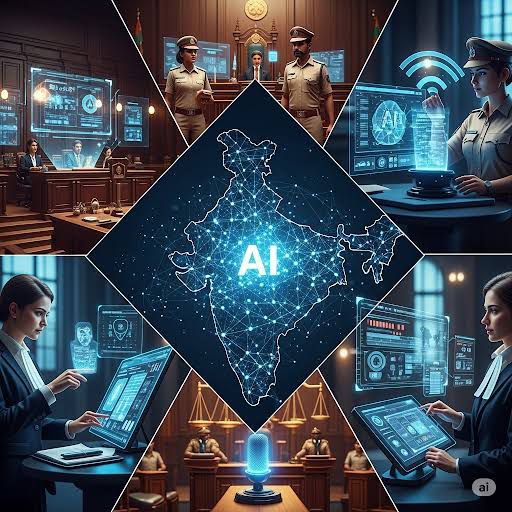
It is a real force transubstantiating diligence each over the world, and the legal profession is no exception. In India, where the courts are weighed down with more than 4.5 crore backlogged cases as of the year 2025, the application of AI tools has the potential to redefine justice delivery.
The Supreme Court’s SUPACE platform ( Supreme Court Portal for Assistance in Court effectiveness) is a corner in bringing AI into judicial operations. It provides judges with smart research support, determines pertinent precedents, and saves time spent on handling complicated case files. Outside the courts, AI-based services in e-discovery, legal analytics, contract review, prediction of case outcomes, and client management are gradually becoming a part of Indian legal practice.
However, the embrace of AI in the legal domain is not free from issues. Ethical issues such as algorithmic bias, unexplainability, and possible contravention of due process rights threaten the constitutional ideals in Articles 14, 19, and 21 of the Constitution of India Also, the non- regulated operation of AI could compromise the substance of judicial independence..
This article discusses the intersection of technology and jurisprudence and how AI could be employed as an aiding tool and not a substitute for human judgment. It traverses constitutional protection, legislative structures, and historical case judgments, along with prescribing a blueprint to reconcile innovation and the timeless values of natural justice.
Use of Legal Jargon
In this article, applicable legal terminology and Latin maxims have been employed:
Audi Alteram Partem : No bone should be judged unheard
Rate Decidendi – it is essential rule of law on which a judicial decision rests.
Obiter Dicta – Remarks of a judge not constituting part of the ruling.
Per Incuriam – Judgement pronounced in ignorance of law.
Res Integra – Issue of unravished question of law.
Due Process – Treatment under the law in a fair manner.
Algorithmic Bias – Systematic tilt in AI responses as a result of defective training data.
Judicial Discretion – Judge’s power to determine a case grounded on justice and law.
Procedural Fairness – Compliance with fair trial rights.
Data Fiduciary – Organism in charge of processing particular data
The Proof
1. Constitutional Provisions
Article 14 – Equality before law; protection against discriminatory AI decisions.
Article 21 – Right to life and personal liberty; includes privacy and fair trial.
Composition 39A – AI as a support tool for fair justice and accessible legal aid for all.
2. Statutory Provisions
Indian Evidence Act, 1872 – Sections 65A & 65B on electronic evidence.
Law of Civil Procedure, 1908 – Provisions enabling video conferencing (Order XVIII).
Section 273 of the Criminal Procedure Code, 1973 addresses the handling of electronic evidence.
3. Recent Legislative Developments
Digital Personal Data Protection Act, 2023 – Regulates AI’s handling of personal data.
E-Courts Project Phase III (2023) – Focus on AI integration in case management.
4. Government & Institutional Reports
Supreme Court’s SUPACE Project (2021) – AI-assisted research for judges.
Abstract
Artificial Intelligence can revolutionise the Indian judicial system by enhancing speed, accuracy, and accessibility of justice delivery. With courts bogged down with humongous backlogs and procedural inefficiencies, AI-based tools like SUPACE can revolutionise case management, legal research, and even drafting of routine judicial orders.
But the use of AI in judicial operations poses salient constitutional, ethical, and procedural issues. From the threat of algorithmic prejudice to issues of judicial responsibility in verdicts based on AI inputs, the inclusion of the technology into the law needs to be precariously balanced. Though foreign jurisdictions such as the United States, United Kingdom, and Singapore have tested AI in different legal roles, India has to derive its own jurisprudential protections.
This paper discusses the statutory provision, constitutional requirements, and judicial statements concerning AI in the Indian legal framework. This discusses milestone Indian and comparative case laws, recognizes gaps in regulation, and offers a roadmap for the proper adoption of AI. In the end, the aim is to have AI as an aid—streamlining judicial efficiency while maintaining natural justice principles.
Case Laws
1. State of Maharashtra v. Praful B. Desai (2003) 4 SCC 601
Facts :Data Whether videotape conferencing can be used to record substantiation
Issues: Whether recording evidence through video conferencing is valid in law under the CrPC.
Judgment: SC held that “evidence” would encompass electronic means like video conferencing.
Relevance: Paved the way for AI-facilitated virtual hearings.
2. K.S. Puttaswamy v. Union of India (2017) 10 SCC 1
Facts : Data Whether the right to sequestration is a abecedarian right.
Issues : compass of Composition 21 in the digital period.
Judgment: Privacy recognised as intrinsic to Article 21.
Relevance: AI in courts must respect privacy safeguards.
3. Shafhi Mohammad Case
Facts: Admissibility of video evidence without strict Section 65B certificat
Judgment: Relaxed the certificate requirement in certain circumstances.
Relevance: Eases the use of AI-analyzed electronic evidence.
4. Swapnil Tripathi Case
Facts: Plea for live streaming of court proceedings.
Issues: Access to justice by the public under Article 19(1)(a).
Judgment: Permitted live streaming subject to guidelines.
Relevance: Laid the foundation for AI-enabled real-time legal analytics.
5. Anvar P.V. v. P.K. Basheer (2014) 10 SCC 473
Facts: Admissibility of electronic records.
Judgment: Strict compliance with Section 65B certificate requirement.
Relevance: Important for AI systems based on digital evidence.
Conclusion
AI presents unparallelled opportunities to transform India’s legal system. Automating drudgery, delivering insights based on data, and eliminating delays, AI has the potential to increase access to justice and efficiency. But India needs to walk carefully—keeping transparency, accountability, and human intervention at all times.
Judicial independence should never be sacrificed at the altar of excessive dependence on black box algorithms. The way forward is a human-in-the-loop strategy where AI is used to augment, but not supplant, judges. In addition, strong data protection, bias audits, and legislative transparency are essential for responsible AI deployment.
Should it be implemented with foresight, AI can turn Indian courts into a 21st-century justice delivery system without undermining constitutional safeguards.
FAQs
Q1: Can judges be replaced by AI in India?
No. Judicial discretion under the Constitution cannot be outsourced to machines.
Q2: Is AI in courts governed by a special law?
Not yet. Present regulation is derived from IT Act, Evidence Act, and DPDP Act, 2023.
Q3: What is SUPACE?
An AI instrument introduced by SC in 2021 for legal research support.
Q4: How can AI abuse be avoided?
By algorithmic transparency, independent auditing, and human oversight.
Q5: Does AI enhance access to justice?
Yes—citizens and attorneys can use AI tools to identify precedents and monitor cases more quickly.