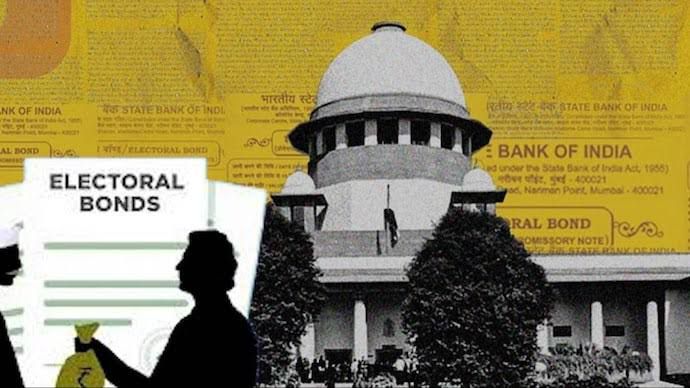
Author: Shalin Saurav, Lloyd school of law, noida
Corruption is the silent theft of trust, stealing not just wealth but the soul of a society. It grows in shadows where conscience sleeps and power forget its duty.
To the Point
The Electoral Bonds Scheme was announced in the 2017 Union Budget by then Finance Minister Arun Jaitley. It was implemented in January 2018 through amendments made to the Representation of the People Act, 1951, the Income Tax Act, 1961, the Companies Act, 2013 and the Foreign Contribution Regulation Act, 2010 (FCRA) – all via the Finance Act, 2017, which was passed as a Money Bill. In India, a money bill is a type of legislation that relates to the appropriation of money from the Consolidated Fund of India, which is the main fund of the government. Money bills can only be introduced in the Lok Sabha and only with the recommendation of the President. After a money bill is passed by the Lok Sabha, it is transmitted to the Rajya Sabha for consideration. The Rajya Sabha has limited powers with regard to money bills and can only make recommendations and cannot reject or amend the bill.
The scheme allowed any Indian citizen or company incorporated in India to purchase electoral bonds from designated branches of the State Bank of India (SBI) and donate them to political parties. There bonds could then be encashed by the eligible political party within 15 days of issuance.
Use of Legal Jargons
Since its inception, the electoral bonds scheme faced a slew of legal challenges. NGOs like Association for Democratic Reforms (ADR), Common Cause, and individuals such as former Election Commissioner S.Y. Quraishi approached the Supreme Court seeking a declaration that the scheme was unconstitutional.
Violation of Article 19(1)(a): Petitioner s argued that the scheme violated the right to know, a part of the freedom of speech and expression, which includes the right of voters to know the source of political funding.
Violation of Free and Fair Elections: By allowing unlimited and anonymous donations, especially from corporates and foreign entities (after FCRA amendments), the scheme titled the playing field unfairly in favor of the ruling party.
Violation of Articles 14 and 324: The scheme allegedly discriminated between political parties and compromised the autonomy of the Election Commission of India (ECI)
Abuse of Money Bill Provision: The amendments were passed as a Money Bill under Article 110, bypassing Rajya Sabha scrutiny. Petitioners argued this was a colorable exercise of legislative power and a misuse of parliamentary procedure.
Colorable Legislation: When the legislature enacts a law under one pretense but with a different hidden objective.
Quid Pro Quo: A Latin term meaning “this for that”, used to indicate a reciprocal arrangement, often used in corruption cases to suggest favor in exchange for donations.
Policy Capture: When public policies are influenced heavily by a few powerful interest groups, often to the detriment of public interest.
Chilling Effect: A discouraging effect on legitimate expression or behaviour due to fear of legal or governmental action.
Electoral Trust: Entities set up to route donations to political parties. Before electoral bonds, this was a more regulated form of political donations.
Transparency v. Anonymity: A legal balancing test between the right of donors to remain private and the public’s right to know.
The Proof
Anonymity was the scheme’s core feature – donors were not disclosed to the public. The Companies Act amendment removed the requirement for companies to reveal political donations in their annual reports. This allowed even shell companies or newly incorporated firms to donate crores of rupees with no accountability. It created an impact that voters had no way of knowing who funding parties was and why, undermining electoral integrity.
After the Supreme Court’s 2024 verdict, SBI was ordered to reveal all bond purchaser and receiver details. Data showed that more than Rs. 12,000 crore worth bonds were sold between 2018-2024. The BJP alone received more than 52% of total bond donations. Several companies that donated large sums were awarded big government contracts, licenses, and tenders shortly after. This raised red flags of policy manipulation, favoritism, and a quid pro quo arrangement – a hall mark of institutionalized corruption.
Amendments to the Companies Act allowed even loss-making or recently incorporated companies to make unlimited donations. Many such firms were found to be paper entities that made multi-core donations but had little to no operational activity. This was a strong indication that black money was being laundered into politics under a legal cover.
Though the scheme was claimed to be anonymous, SBI recorded KYC data of all bond purchasers. Critics alleged that this backend information was accessible to the ruling government, which could intimidate corporates or reward them for donating. This chilling effect led most donations to flow towards the ruling party – showing the misuse of state machinery for political gains.
Investigations by independent journalists and platform like The Reporters collective found that companies donating large amounts to the ruling party were rewarded with contracts, mining licenses, or regulatory reliefs. In some case, donations were made just days before or after key policy decisions that benefited the donor. This establishes a clear pattern of donations being exchanged for favorable treatment.
Abstract
In the world’s largest democracy, the sanctity of elections rests on transparency, accountability, and a level playing field. Yet, the Electoral Bonds Scheme, introduced under the pretext of reforming political funding, emerged as a brazen attempt to institutionalize opacity. Marketed as a “clean money” initiative, in fact operated like a legalized bribe mechanism, enabling corporates to secretly funnel crores into the coffers of political parties – predominantly the ruling one, without any public scrutiny. By obliterating the voter’s right to know, shielding donors from closure, and allowing unchecked corporate influence on policy, electoral bonds transformed Indian elections into a pay-to-play affair (Chanda Do, Dhanda Lo), where access and favors were quietly auctioned behind closed doors. Far from curbing corruption, the scheme entrenched it – threatening the very soul of democratic governance.
Case Laws
Case Title: Association for Democratic Reforms (ADR) and others v. Union of India
The Constitution Bench comprising of 5 judges authored by former Chief Justice D.Y Chandrachud and other judges Justices Sanjiv Khanna, B.R Gavai, J.B Pardiwala, and Manoj Misra had made a verdict unanimous – Electoral Bonds Scheme declared unconstitutional. Key rulings of the Supreme Court:
The Court struck down the Electoral Bonds Scheme, 2018, as a violative of Article 19(1)(a) of the constitution. It held that voters have a fundamental right to know the source of funding of political parties, and the anonymity allowed by the scheme infringes this right. “Political funding in a democracy must be transparent to ensure free and fair elections. Secrecy serves no legitimate state interest in this context.
The amendments brought by the Finance Act, 2017 (passed as a money bill) were also declared unconstitutional. Held that these amendments diluted transparency, enabled corporate capture, and compromised electoral integrity.
The court emphasized that free and fair elections are a basic feature of the constitution. The asymmetry of information created by electoral bonds, where only the ruling party (via SBI) could access donor data, disrupted the level playing field. “The opacity promoted by the electoral bond scheme distorts political competition and violates the democratic ideal”.
Electoral bonds scheme is struck down with immediate effect. SBI was directed to disclose details of all electoral bonds purchased and redeemed since 2018. Share buyer details, recipient parties, and bond amounts with the Election Commission of India (ECI). ECI was ordered to publish the entire data on its website by March 13, 2024. Any unredeemed bonds in possession of political parties must be returned to SBI for refund.
Conclusion
While the Electoral Bonds Scheme was framed as measure to cleanse political funding, the reality revealed through court proceedings, data disclosures, and investigative journalism proved otherwise. It legalized opacity, enabled corporate capture of democracy, and undermined public trust in electoral fairness. By striking it down, the Supreme Court didn’t just declare the scheme unconstitutional – it indirectly acknowledged that it had become a systematic medium for corruption in Indian politics.
Frequently Asked Questions (FAQs)
Which constitutional rights were violated by the scheme?
Article 19(1)(a), Freedom of speech and expression, which includes the right to know the source of political funding. Free and fair elections, which are part of the basic structure of the constitution, were also undermined.
What was revealed after the court ordered disclosure?
Over Rs. 12,000 crores worth of bonds were sold between 2018 and 2024. The BJP alone receive over 52% of total bond donations. Many companies that donated large sums were later found to have received government contracts, licenses, or benefits.
What does this mean for citizens?
The judgement empowers voters by restoring their right to make informed choices. It send a clear message that democracy cannot survive in the darkness, and political finance