Author: Samidha Ramdas Chaudhari, Dr. Babasaheb Ambedkar Memorial College of Law Dhule
To the Point
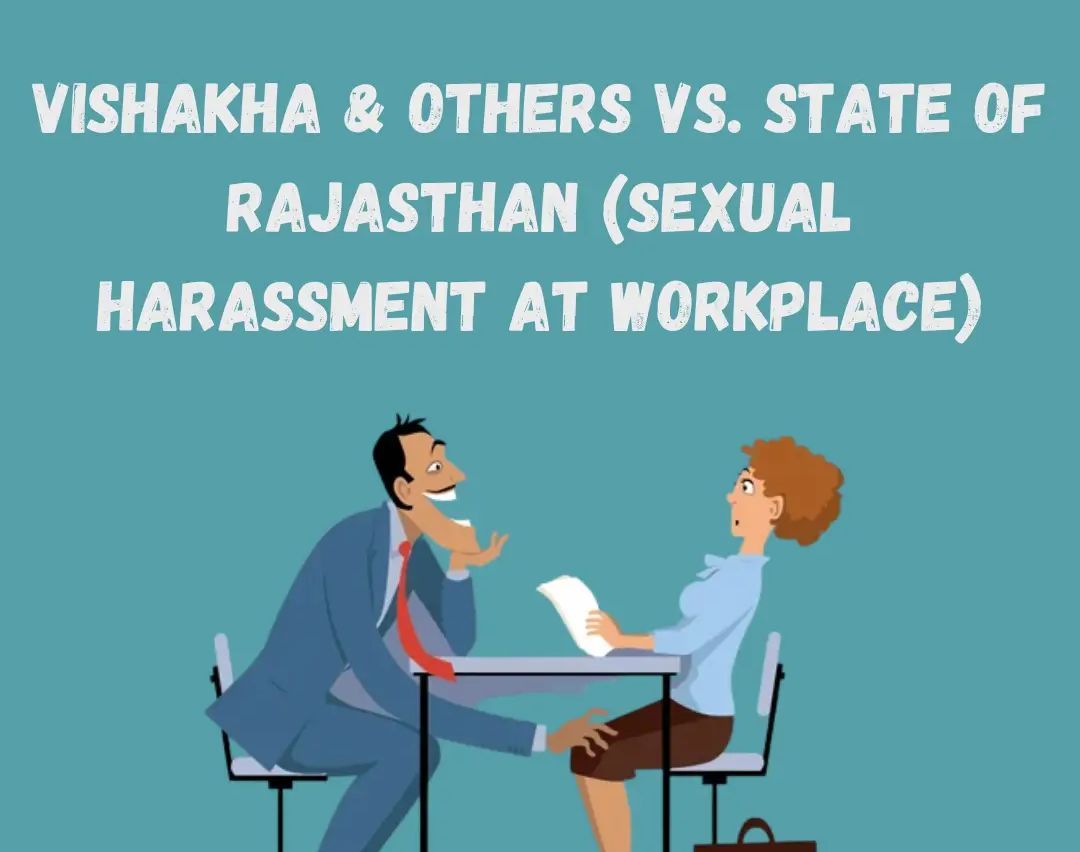
Due to the positive changes taking place in the society, India is leading in many things today. Equality between men and women has been established. Women are making a name for themselves in many fields, but are women really safe? This serious question still remains the same. Even though positive changes are taking place in India, many horrific incidents are happening every day after these changes. On the one hand, women are respected, on the other hand, the same women are atrocities, rapes and harassment are committed against them. Women are unsafe in this safe India. Those women who have to go out for work are physically and mentally harassed at the workplace, which violates the fundamental rights of women and the Indian Constitution.
Abstract
Such a historic case of violation of women’s dignity and fundamental rights.
Visakha and others vs. State of Rajasthan and others.
This case started with the case of Bhawari Devi.
Originally, Bhavari Devi was campaigning against education, dowry and child marriage. As part of her work, her parents arranged the marriage of a young girl. Some big people were involved in it and did not allow this child marriage to be stopped. And some of them gang-raped Bhavari Devi. This incident made it clear how unsafe a working woman is at work or what dangers a working woman can face or the bad consequences of sexual harassment. Bhavari Devi filed this case in the trial court but the Hon. Court acquitted the accused due to lack of evidence. But some women, who were upset with such a decision of the court and a group of women led by Naina Kapoor, filed a Public Interest Litigation (PIL) against the State of Rajasthan in the Hon. Supreme Court under Article 32 of the Constitution of India. This petition was filed to bring forward the issue of atrocities and sexual harassment against women at work.
Use of legal jargon
The case of Visakha vs. State of Rajasthan was filed in the Supreme Court as a Public Interest Litigation. Some of the major laws discussed in this case before the Hon’ble Supreme Court and emphasis was laid on them are as follows –
Constitution of India
Article 14 (Right to Equality) – This law provides that all citizens of India are granted the right to equality before the law. In which no one can deny the protection of the law to citizens. The concept of equal protection of the law is taken from the American Constitution. Article 14 indicates that the same law will be applied to everyone.
Article 15 (Prohibition of Discrimination):- This article provides that it is the duty of the state not to discriminate among citizens on the basis of certain factors such as religion, race, caste, sex, place of birth. It is also provided that no citizen shall be discriminated against on the basis of religion, race, caste, sex, place of birth in the matter of entering public places.
Article 19(1)(g) (Right to carry on any profession):- According to this article, every citizen has the right to carry on any profession or trade, but it is subject to certain restrictions. The freedom to carry on any profession, public morality and order have been imposed on this right, subject to reasonable restrictions.
Article 21 (Freedom of person and life):- According to this article, every citizen has the right to life, that is, the freedom to live life, which includes the right to education, freedom of movement, etc.
Article 32 :- Every citizen has the right to approach the Supreme Court for enforcement if their fundamental rights are denied, and the Supreme Court is also bound to hear such petitions.
Convention on the Elimination of All Forms of Discrimination Against Women 1979 (Article 11)- It is stated that the state should take appropriate measures regarding the safety of women, as well as taking appropriate measures regarding discrimination against women and sexual harassment at the workplace.
The Proof :- Bhavari Devi, a woman from Bhateri village in Rajasthan, has been working in a development project implemented by the Rajasthan state for the welfare of women since 1985. In 1987, a woman was raped in a village adjacent to the village where Bhavari Devi lives, so Bhavari Devi raised this issue for the safety of women. For this, she also got the support of the members of her village. In 1992, she raised another issue on the government’s campaign against child marriage run by the Rajasthan government, but this time the villagers did not support her in this campaign. The villagers knew that child marriage was illegal and opposed the campaign. When Bhavari Devi came to know that Ramkaran Gujjar in the neighboring village was planning to get their young daughter married, she tried to convince Ramkaran Gujjar’s family, but her efforts were in vain.
Finally, on May 5, 1992, the marriage was stopped with the help of the police. Due to this, the villagers took revenge on Bhavari Devi. On September 22, 1992, Ramsukh Gujar, Gyarasa Gujar, Ramkaran Gujar, Badri Gujar, and Shravan Sharma first attacked Bhavari Devi’s husband and then brutally raped Bhavari Devi. When Bhavari Devi tried to get justice, she was criticized, but in the face of all this, Bhavari Devi succeeded in filing a complaint. After that, she went to the trial court, but with the help of MLA Dhanraj Meena, the accused were acquitted. Due to this acquittal, a public interest litigation was filed by many women activists and organizations to seek justice.
The verdict of this case was given in 1997, when the Supreme Court gave a historic judgment issuing some guidelines to deal with sexual harassment. In that judgment, the court had said that until a law is enacted to remedy complaints of sexual harassment, the “Visakha Guidelines” would be implemented. The guidelines laid down by the court are as follows –
To prevent such acts, to take appropriate steps by the concerned institutions to prosecute them.
The definition of sexual harassment is given further, which states that it includes not only physical contact but also verbal or gestural, showing of images, whether direct or implied.
Provision should be made for taking preventive steps against any employee to avoid such accidents and they will be applicable to private or government employees.
A strong mechanism should be set up to handle such cases. Proper planning of work of employees should be done. Ensuring that there is no unsafe environment for women at the workplace.
Awareness of the rights of female employees in this regard should be created in particular by prominently notifying the guidelines (and appropriate legislation when enacted on the subject) in suitable manner.
As regards private employers steps should be taken to include the aforesaid prohibitions in the standing orders under the Industrial Employment (Standing Orders) Act, 1946.
Appropriate work conditions should be provided in respect of work, leisure, health and hygiene to further ensure that there is no hostile environment towards women at work places and no employee woman should have reasonable grounds to believe that she is disadvantaged in connection with her employment.
Case Law
Union of India vs. Dilip paul 6 November 2023 -Sexual harassment of women at the workplace violates their sense of dignity and right to earn a living with dignity and is against their fundamental rights and their basic human rights.
The International Convention on the Elimination of all forms of Discrimination Against Women (CEDAW) adopted in 1979 at Beijing also recognized the right of women to equality at the work place and it states that women shall not be subjected to sexual harassment at work places; as such harassment vitiates the working environment.
Women In Cinema Collective vs State Of Kerala on 17 March, 2022 – Issue a writ of mandamus or any other writ, order or direction declaring that the Respondent Associations are legally obliged to constitute a complaints committee against sexual harassment for its members in accordance with the guidelines laid down by the Honourable Supreme Court in Vishaka v. State of Rajasthan reported in (1997) 6 SCC 241 and the Sexual Harassment of Women at Workplace (Prevention, Prohibition and Redressal) Act, 2013 and comply with the various guidelines and the provisions of Act 14 of 2013 for prevention of sexual harassment at work places in letter and spirit.
Conclusion
This case turned out to be an important turning point for women’s safety. The guidelines given by the Supreme Court in the verdict of this case are the solution to keep women safe at work. This decision has become an important and historic case till . Indian judiciary implemented the Sexual Harassment of Women at Work Act in 2013 for the safety of women. The latest example of how women are still unsafe at work despite the introduction of such a law is the Kolkata rape case. No matter how many laws are implemented, women are still unsafe. Therefore, the best measures should be taken to reduce sexual harassment at work and regular publicity should be spread to prevent them from becoming victims of sexual harassment. Similarly, awareness raising programs should be started. Programs should be organized to give confidence and motivation to women so that such acts of sexual harassment can be curbed.
FAQS
Where was the first case filed in this case?
Answer- Bhavari Devi and her husband filed a case in a trial court in a district in Rajasthan, but with the help of MLA Dhanraj Meena, the accused were acquitted.
Under which law was this case filed?
Answer – Article 14, Article 15, Article 19(1)(g), Article 21 and the crucial article i.e. Article 32 of the Constitution of India.
Which law was implemented after the Supreme Court issued guidelines in this matter?
Answer -The Indian judiciary implemented the Sexual Harassment of Women at Work Act in 2013 for the safety of women.