Author: Anica Fayaz, Kashmir Law College Affiliated with Kashmir University
ABSTRACT
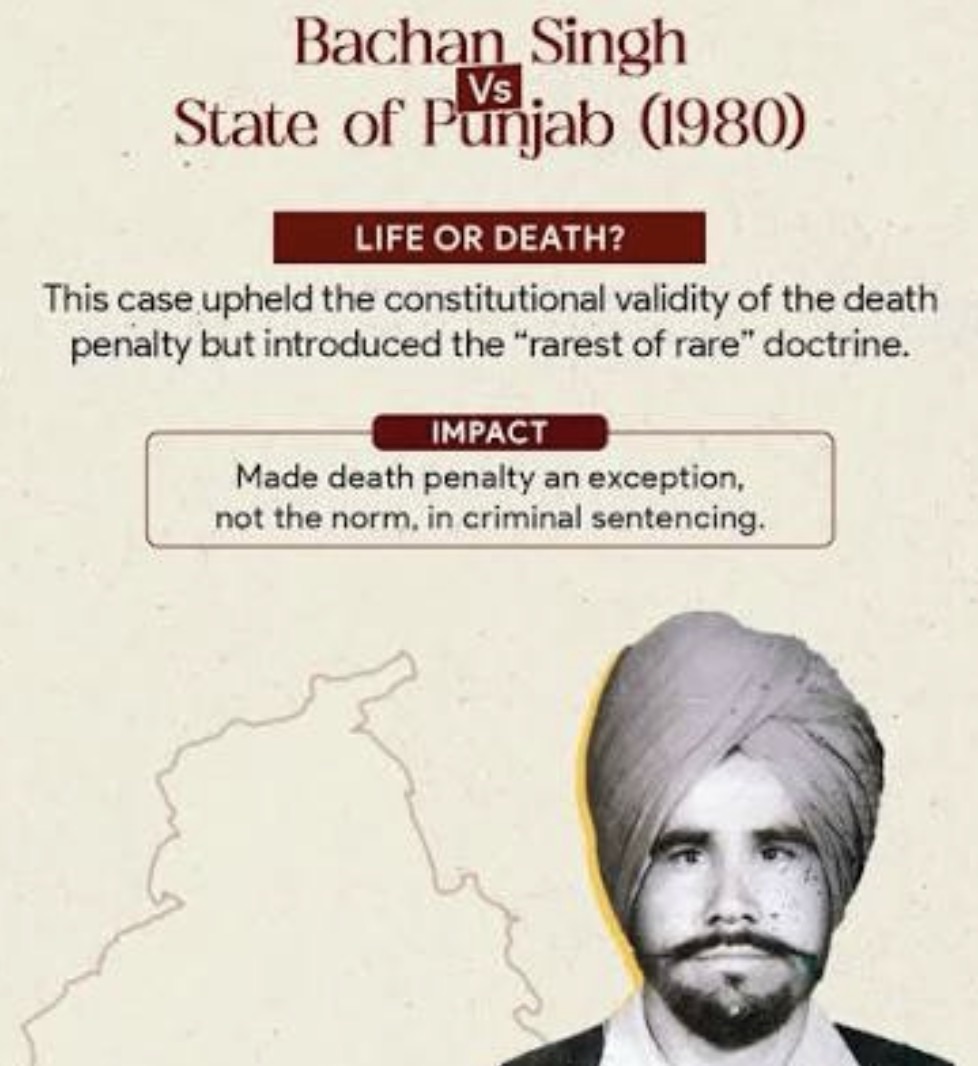
Bachan Singh was accused of attempting multiple murders, including those of his wife. The Trial Court found him guilty of murder and sentenced him to death. The sentence was subsequently confirmed by the HighCourt. Aggrieved by this decision, Bachan Singhapproached the Supreme Court by way of appeal,challenging both his conviction and the constitutional validity of the death penalty. Before the Supreme Court, the appellant questioned the constitutional validity of the death penalty prescribed under Section 302 of the Indian Penal Code (IPC) and the sentencing procedure contained in Section 354(3) of the Code of Criminal Procedure (CrPC), 1973. He said that these provisionsinfringed upon the fundamental rights guaranteed underthe Constitution of India. The constitutional validity ofcapital punishment was challenged on the ground that it violated Articles 14, 19, and 21 of the Constitution. The petitioner argued that the death penalty is arbitrary and unreasonable, and that it deprives an individual of life and personal liberty, thereby interfering with the protection guaranteed under Article 21. The Supreme Court, after examining the constitutional challenges raised by the petitioner, upheld the validity of the death penalty. However, the Court recognised that capital punishment should not be imposed as a matter of routine. In its landmark judgment in Bachan Singh v. State ofPunjab, the Court evolved the “Rarest of Rare” doctrine, holding that the death penalty may be awarded only in exceptional cases where life imprisonment is unquestionably inadequate and the alternative option is foreclosed. The judgment marked a significant development in Indian criminal jurisprudence as it established clear constitutional limitations on the exercise of judicial discretion in death penalty cases.
Introduction:
Capital punishment, also known as the death penalty and formerly called judicial homicide. It is also known as death penalty. This punishment is sentenced on heinous offences such as rape, murder, treason etc. The debate surrounding the death penalty has existed for decades,with supporters arguing that it acts as a deterrent tocrime and opponents claiming that it violates the fundamental right to life. However in India, the capital punishment is challenged by several cases, one of them is Bachan Singh’s case. Section 302 of IPC and sub-section of 354 of CrPC,1973 which was challenged by the appellant in the Supreme Court stating that it infringed the rights which were provided by theConstitution of India. It was mainly challenged becauseof the Article 14,19 and 21 of the Indian Constitution. These appeals were rejected by the Supreme Court, sentenced to death penalty and it was considered as ‘rarest of rare’ doctrine.
The constitutional debate surrounding capitalpunishment primarily concerns whether the death penalty is compatible with the fundamental rights guaranteed under the Constitution of India.
Opponents of the capital punishment argues that it violates the Article 21, Right to life and personal liberty which is provided by Indian Constitution. They say it deprives an individual permanently from this right. However the supporters argues that the death penalty serves as a deterrent against heinous crimes and reflects society’s demand for justice in exceptionally gravecases. According to this view, the punishment is constitutional so long as it is imposed through a fair, just, and reasonable legal process.
Main Analysis:
Facts of the case:
The Supreme Court, by majority decision was rendered by a majority of 4-1. The Court held that Article 21permits deprivation of life provided it occurs accordingto a fair, just, and reasonable legal procedure. Therefore, capital punishment was not inherently unconstitutional. However, the Court recognized the seriousness and irreversible nature of the punishment. To prevent arbitrary use, it established the “rarest of rare” doctrine.According to this principle, the death penalty should be imposed only in exceptional circumstances where life imprisonment would be inadequate. that it does not violate Article 21’s right to life if passed through a fair procedure. However, to prevent arbitrary executions, theCourt established the “rarest of rare cases” doctrine, making life imprisonment the standard rule and capital punishment a strictly regulated exception. Under this framework, sentencing judges must provide “special reasons” by evaluating a balanced list of aggravating circumstances ensuring the death penalty is only used when the alternative option of life imprisonment is unquestionably foreclosed.
Bachan Singh, the petitioner who have previously been convicted for the murder of his wife under Section 302of IPC and served his 14 years in prison. He wasreleased after serving his sentence and was resided in his cousin’s house i.e., Hukum Singh.
However, his cousin’s wife and kids were not in favourof his living in the house and opposed his decision. Bachan Singh, the petitioner who have previously been convicted for the murder of his wife under Section 302 of IPC and served his 14 years in prison. He was released after serving his sentence and was resided in his cousin’s house i.e., Hukum Singh. However, his cousin’s wife and kids were not in favour of his living in the house and opposed his decision. Later a tragedy happened on a horrible night where Vidya Bai was awaken by some noise and saw that her sister, Beeran Bai, getting hit by the appellant, Bachan Singh, by means of an axe.
Vidya Bai bravely stepped in order to stop this horrific assault. She tried to grab the axe from his hand, but it pierced her viciously, which resulted in cutting her ear and face and rendering her senseless. Others were awakened from their sleep by the disturbance, and it was not ignored. The sharp screams woke up the two sleepers i.e., Diwan Singh and Gulab Singh, who told others what had happened. When they arrived to the site quickly, they observed something horrible. Desa Bai, the victim of Bachan Singh, remained upright, holding the bloody axe in his hands. Diwan Singh and Gulab made an immediate attempt to apprehend Bachan Singh in order to stop any further injuries. Bachan Singh had to makethe painful choice to drop the axe and run when he realised he was surrounded and could be captured. Despite the seriousness of the situation, they chased Bachan Singh in an effort to bring him to justice. But they were unsuccessful as he managed to avoid them. Bachan Singh was thus convicted for the murder of Veeran Bai, Durga Bai and Desa Singh by the Session Court under the Section of 302[2] of IPC.
Issue before the court:
Issue 1: Whether the death penalty violates Articles 14,19, and 21 of the Constitution of India?
This issue concerned whether capital punishment is compatible with the fundamental rights guaranteed under the Constitution. The petitioner argued that the death penalty is arbitrary and discriminatory, thereby violatingArticle 14 (Right to Equality). It was also said that the punishment places unreasonable restrictions on personal liberty under Article 19 and deprives a person of life and personal liberty under Article 21.
Therefore, the Court had to determine whether capitalpunishment is constitutionally permissible.
Issue 2: Whether Section 302 of the Indian Penal Code isconstitutional?
Section 302 IPC prescribes death or life imprisonment as punishment for the offence of murder. The petitioner challenged the validity of this provision on the ground that it authorises the State to take away a person’s life.The Court was required to examine whether Section 302 IPC is consistent with the constitutional guarantees of equality,
liberty, and life, and whether the provision could besustained under the Constitution of India.
Arguments of the parties:
Petitioner:
The petitioner argued that the death penalty was unconstitutional because it permanently deprived anindividual of the right to life guaranteed under Article21. It was further argued that the punishment wasarbitrary and inconsistent. The petitioner contended that life imprisonment was a sufficient punishment and that capital punishment served no legitimate constitutional purpose.
The State argued that the Constitution itself permits deprivation of life through a valid legal procedure. It maintained that the death penalty was necessary for exceptionally heinous offences and served the interestsof justice and public safety. .
Ratio Decidendi and Significance:
The ratio decidendi of Bachan Singh v. State of Punjab (1980) is that the death penalty is constitutionally valid and does not violate Articles 14, 19, and 21 of the Constitution of India, it is imposed through a fair, just, and reasonable procedure established by law. The Supreme Court held that capital punishment should not be a routine sentence and must be reserved only for the “Rarest of Rare” cases where the alternative punishment of life imprisonment is inadequate.
The significance of the judgment lies in the establishment of the “Rarest of Rare” doctrine, which guides courts in deciding whether a death sentence should be imposed. This decision introduced importantsafeguards against the arbitrary use of the death penalty and ensured greater judicial control in sentencing. The judgment continues to serve as the foundation of death penalty jurisprudence in India and remains one of the most influential decisions in Indian constitutional and criminal law.
The central principle established in Bachan Singh is that life imprisonment is the normal rule and death penalty is an exception reserved for the rarest of rare cases. Thejudgment significantly influenced Indian criminaljurisprudence by restricting the use of capital punishment. It introduced a human rights-oriented approach to sentencing and required courts to evaluate individual circumstances before imposing the penalty. Even today, every death sentence awarded in India is examined through the principles laid down in this case.
Conclusion:
Bachan Singh v. State of Punjab (1980) remains one of the most significant judgments in Indian constitutional and criminal jurisprudence. The Supreme Court upheldthe constitutional validity of the death penalty whilerecognising that the right to life under Article 21. By introducing the “Rarest of Rare” doctrine, the Court ensured that capital punishment would be imposed only in exceptional cases where life imprisonment is considered inadequate.
The judgment struck a balance between the protection of individual rights and the interests of society. It acknowledged the need to punish heinous crimes while simultaneously safeguarding against the arbitrary and excessive use of the death penalty. The decision alsoestablished important sentencing principles by requiring courts to consider both facts and better facts of a case before they can order an execution before imposing capital punishment.
Even today, the principles laid down in Bachan Singhcontinue to guide Indian courts in death penalty cases.The judgment serves as a landmark precedent that reflects the judiciary’s effort to balance justice, fairness,human dignity, and constitutional values within the criminal justice system.
Frequently Asked Questions (FAQs):
Q1. What was the main issue in Bachan Singh v. Stateof Punjab?
The main issue before the Supreme Court was whetherthe death penalty prescribed under Section 302 of the Indian Penal Code violated the fundamental rights guaranteed under Articles 14, 19, and 21 of the Constitution of India.
Q2. What is the “Rarest of Rare” doctrine?
The “Rarest of Rare” doctrine is a sentencing principleestablished by the Supreme Court in Bachan Singh v. State of Punjab. According to this doctrine, the death penalty should be imposed only in exceptional cases where life imprisonment is inadequate and the circumstances of the crime are extremely grave.
Q3. Why did Bachan Singh challenge the deathpenalty?
Bachan Singh argued that the death penalty wasarbitrary, unreasonable, and violative of the fundamental rights guaranteed under the Constitution. He contended that capital punishment deprived a person of life and personal liberty under Article 21.
Q4. What was the Supreme Court’s decision in thecase?
The Supreme Court upheld the constitutional validity ofthe death penalty by a
majority decision. However, it ruled that capitalpunishment should be awarded only in the “Rarest of Rare” cases and not as a routine punishment.
Q5. Why is Bachan Singh v. State of Punjabconsidered a landmark judgment? The case is considered a landmark judgment because it established the “Rarest of Rare” doctrine and laid down important safeguards against the arbitrary use of the death penalty. It continues to guide courts in deciding capital punishment cases in India.