Author: Sairab Sayed, GJ Advani Law Council, Mumbai
To the point
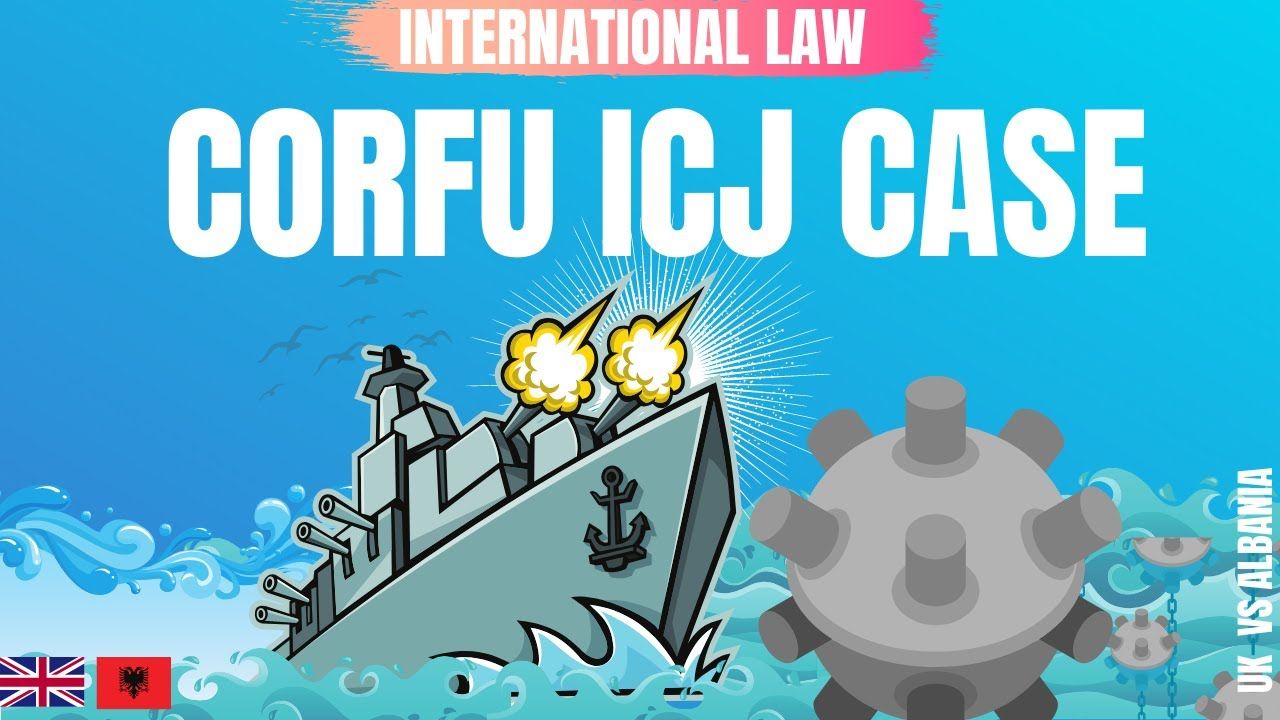
The corfu channel case was a result of accidents that passed in the corfu channel Albania in 1946 it was a narrow water way under the face of water mines were set up and this information was n’t given to the British vessel that was navigating through the area as a result of which they struck these mines and caused explosion and damage of life and property, this case was one of the public transnational law case that was heard intimately Following the incidents, the United Kingdom originally brought the issue to the United Nations Security Council, which recommended referral of the case to the International Court of Justice( ICJ). he United Kingdom originally brought the issue to the United Nations Security Council, which recommended referral of the case to the International Court of Justice( ICJ). The UK also filed a claim with the ICJ, asserting that Albania bore responsibility for the incident under transnational law and seeking compensation the Albanian government opposed this claim, asserting that the british vessel violated Albanian territorial sovereignty by carrying out operations in the corfu channel without previous permission from the Albanian Government. The UK also filed a claim with the ICJ, asserting that Albania bore responsibility for the incident under transnational law and seeking compensation the Albanian government opposed this
claim, asserting that the british vessel violated Albanian territorial sovereignty by carrying out operations in the corfu channel without previous permission from the Albanian Government.
Use of legal jargons
The ICJ verified its governance to hear the Corfu Channel case, interpreting Albania’s July 2 communication as a wordless acceptance of the Court’s governance. The UnitedKingdom consequently submitted an operation which, after an expostulation to its admissibility had been raised by Albania, was the subject of a Judgment, dated March 25th, 1948, in which the court declared that it held governance. .Although Albania’s communication was kindly circular, the Court reasoned that it met the conditions for establishing governance. The ICJ underlined that the acceptance of its governance by a party does n’t bear a rigid, formalistic approach; rather, concurrence to governance could be inferred, as in this case. The Court set up that no procedural irregularities warranted redundancy of the case.
The proof
In the present case both substantiation of the Albanian Government’s station( its intention to keep a close watch on its territorial waters, its kick against the passage of the British line but not the laying of mines, its failure to notify shipping of the actuality of mines) and the fact that mine- laying would have been visible to a normal lookout on the Albanian seacoast, lead the Court to conclude that the laying of the minefield could n’t have been fulfilled without the knowledge of Albania. The Court also considers Albania’s scores in light of
this knowledge The scores performing for Albania from this knowledge are n’t disputed between the Parties. Counsel for the Albanian Government expressly honored that( restatement) “ if Albania had been informed of the operation before the incidents of October 22nd, and in time to advise the British vessels and shipping ingeneral of the actuality of mines in theCorfu Channel, her responsibility would be involved.The scores peremptory upon the Albanian authorities comported in notifying, for the benefit of shipping in general, the actuality of a minefield in Albanian territorial waters and in advising the approaching British warships of the imminent peril to which the minefield exposed them. similar scores are grounded, not on the Hague Convention of 1907, No. VTII, which is applicable in time of war, but on certain general and well-recognised principles, videlicet abecedarian considerations of humanity, indeed more exacting in peace than in war the principle of the freedom of maritime communication; and every State’s obligation not to allow deliberately its home to be used for acts contrary to the rights of other States.In fact, Albania neither notified the actuality of the minefield, nor advised the British warships of the peril they were approaching.
Abstract
Corfu Channel Case, ICJ Rep. 1949 This case involved incidents where British warships struck mines in the Corfu Channel, leading to controversies over Albania’s responsibility. TheICJ held that Albania was responsible for not notifying other countries of the mines’ presence, emphasizing the obligation of countries to not deliberately allow their home to be used for acts contrary to the rights of other countries. The case underlined principles of innocent passage and the duties of littoral countries
regarding nautical safety.
Case laws
1). The Halcyon Isle( 1981) AC 221
Data The case involved contending claims between the holder of a maritime lien for necessities( inventories handed to a boat) and the mortgagee of the vessel. The issue was whether the precedence of the claims should be determined by the law of the forum( Singapore) or the law of the country where the lien arose( United States).Decision The Privy Council held that the question of precedence between maritime liens should be determined by the law of the forum( lex fori) rather than the law of the place where the lien arose).Applicability This case is pivotal in transnational maritime law as it addresses the complex issue of conflict of laws in maritime liens. It has crucial counteraccusations for how different authorities handle violations of maritime rules and regulations it is a requirement to have authorities to implement the laws relating to international waters
2) The Achilleas( 2008) UKHL 48
Data The boon of the vessel Achilleas returned the boat late, causing the possessors to miss the coming duty.The request rates had fallen dramatically, performing in a significant loss for the possessors on their follow-on duty.Decision The House of Lords held that the boon were n’t liable for the possessors’ loss of gains on the follow-on duty. They introduced the conception of “ supposition of responsibility, ” meaning that a party in breach is only liable for losses that they can be assumed to have accepted responsibility for at the time of contract conformation
3) Enrica Lexie case (Italy v. India )
The Enrica Lexie case is about a shooting in international waters ,This incident took place in 2012 in 15th February’s two Indian fisherman aboard the st Anthony were killed by Italians ship oil tanker called enrica Lexie later on they were intercepted and detained by the Indian government this matter was discussed in special international courts Both marines were released . Meanwhile, an independent United Nations court was charged to resolve the jurisdictional conflict.[2] That was following a European Parliament resolution of January 2015, stating that no charge was filled against the Italians while being in detention with the Indian government and this is a serious breach of human rights
Conclusion
The transnational court of justice held Albania responsible internationally for mine explosions, and directing the albanian government to pay the UK compensation, while also confirm in the right of innocent passage for warships
FAQS
1) Why is this case known as corfu channel case?
It’s called the corfu channel case because the incident took place in the corfu raceway of Albania
2) Who had the right of innocent passage in this case?
The UK warships had the right of innocent passage in transnational waters
3) Who was held liable for damages?
The Albania government was held Liable for damages since it did n’t inform the UK warships about deep water mines
4) What was the judgement passed by ICJ?
The transnational court of justice held Albania government shamefaced and directed them to pay compensation to uk warships