
Author: Anish Tandi, Centurion University, Bhubaneswar
LinkedIn Profile: www.linkedin.com/in/anish-tandi-668a7b2a1
ABSTRACT
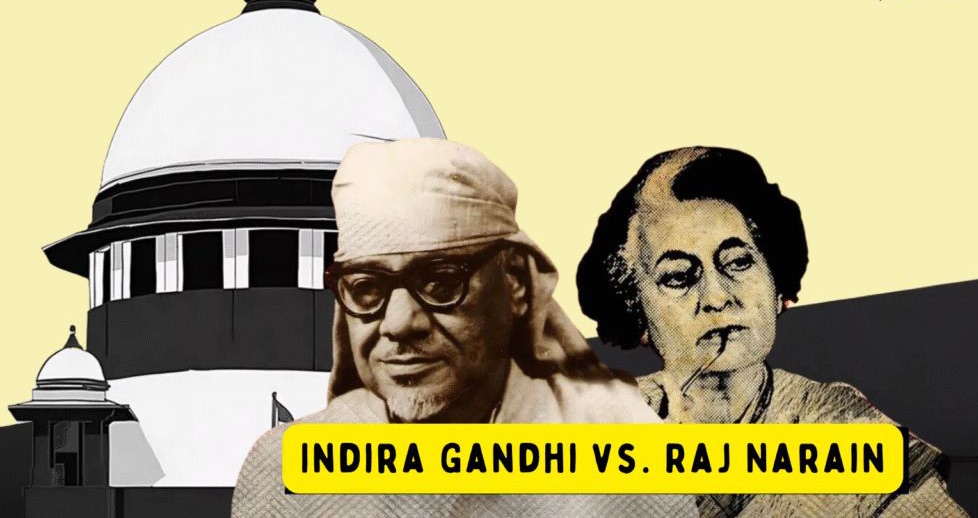
The Case of Indira Nehru Gandhi v. Raj Narain (1975) is considered a constitutional turning point in Indian jurisprudence. The case originated out of a post-election battle in the 1971 Lok Sabha polls, where the Allahabad High Court in an election petition empowered under the Representation of the people Act, 1951 unseated the then Prime Minister for Corrupt practices. Subsequently, the government amended the constitution with the Thirty-ninth Constitutional Amendment to immunize the Prime Minister and Speaker from Courts. In response, the Supreme Court of India in a unanimous decision on 7th November, 1975, held the clause
(4) of Article 329-A as inconsistent with the basic structure of the constitution. This paper discusses the case extensively, analyzing the fact matrix, constitution crisis and the supremacy of the basic structure of the Constitution and the Supreme Court’s decision in that regard. The Judgment whether ordained to disprove the theory that even constitutional amendments couldn’t destroy the free and fair elections, rule pf law, judicial review and fundamental features of democracy.
TO THE POINT
The 1971 General Elections to the 5th Lok Sabha were held in March 1971. Smt. Indira Nehru Gandhi contested from the Rae Bareli (Uttar Pradesh) constituency and defeated her nearest rival, Shri Raj Narain, by a margin of over 1,10,000 votes. Displeased with the election of Gandhi, Raj Narain preferred an election petition before the Allahabad High Court on 24th April, 1971, on the grounds of: misuse of government machinery and use of gazetted officers for furthering her election prospects.
On 12th June 1975, then Justice Jagmohan Lal Sinha of the Allahabad High Court pronounced a judgement which would revolutionize Indian political history and her political future. The Court observed that the appellant election was obtained with the help of Yashpal, a gazetted officer, for furtherance of his election prospects rendered him liable for corrupt practices under Section 123(7) of the Representation of the People Act, 1951 and declared her election void and disqualified her from contesting election proceedings of six years.
The High Court, also stayed for twenty days the operation of its judgment. As a result, the appellant filed a petition in the Supreme Court. However, before the petition was heard, the Government took unprecedented legislative measures namely, the constitution (Thirty-ninth Amendment) Act, 1975. On August 10, 1975, it passed an act with insertion of Article 329-A in the constitution, one shall be the effect that, clause (4) that states that No law made by parliament relating to an election petition shall apply to the election of the Prime Minister or the Speaker and any order of a Court declaring an election of the Prime Minister or the Speaker to be void “shall be and shall be deemed always do have been void and of no force or effect.”
The main question before the Supreme Court was the constitutionality of clause (4) of the Article 329-A. The Court held, by margin 4:1 (with the chief Justice Raye dissenting), that the clause was unconstitutional on the ground that it was contrary to the basic features of the constitution. Thus, the Court reaffirmed the doctrines of the Supremacy of the judiciary and of democracy.
USE OF LEGAL JARGON
Constitutional attack on Article 329-A (4) was based on the basic structure doctrine formulated in Kesavananda Bharati v. State of Kerala (1973). The respondent contended that the amendment altered the democratic structure of the Constitution as it brought about immunity of a specific election form the scrutiny of courts which was a violation of tenet of free and fair elections, a vital premise of democracy and part of the basic structure of the Constitution.
In his dissent, Justice Khanna held that Article 329-A (4) offended the rule of law and the doctrine of separation of powers. He noted that the provision did away with the forum for challenging election without providing an alternative extinguishing the right and remedy which forms part of the principles underlying procedural due process. The Court held the law to be arbitrary within the meaning of Article 14 because there was no rational classification between the election of the Prime Minister and the election of a regular Member of Parliament.
Justice Mathew, in passing some of the most trenchant remarks, described the challenged provision as a legislative decision a bill of attainder in fact, though not in form. The Court held that the amending body, which had in exercise of the Constitution, no jurisdiction-though in exercise of the jurisdiction, it had no power to exercise that power to exercise that power, unless and until the law was first enacted providing for the manner in which such consequential amendments were to be made. By obdurately pronouncing invalid an election of an individual, in the absence of an adjudication, the amended Act was an instance of exercise of irresponsible despotic discretion and was, therefore governed solely by considerations of political expediency.
Another ground the Court relied upon was equality before the law as provided in Article 14. The amendment established an arbitrary classification, even between the Prime Minister and other elected representatives, by rendering the then incumbent election proof. Such a class legislation broke down the fundamental guarantee of equal protection.
The Court was equally categorical in the matter of Parliamentary sovereignty versus constitutional supremacy. Parliament has power to amend the constitutional under Article 368 and the power is not an unlimited one which can be used to destroy the nature of Constitutional, democracy, secularism, federalism and judicial review.
THE PROOF
The incontestable fact of the constitution crisis is that following the verdict of the Allahabad High Court, the subsequent chain of events was 26th June 1975 emergency is proclaimed under Article 352 of the Constitution. Fundamental rights are curbed the press is placed under severe censorship. A total number of 1,00,000 political opponents were sent to imprisonments for an indefinite period of 21 months under the Maintenance of Internal Security Act (MISA).
Remarkably, the thirty-ninth Amendment was passed so rapidly that it was introduced and came into force within days of the High Court judgement. Importantly, the Thirty-ninth Amendment was inserted in the Ninth Schedule (Entry 87) of the Constitution which was originally introduced to shield land reform statutes from judicial review. It was the first such occasion in which electoral laws were protected from constitutional review.
On the other hand, the record shows that at the same time the government also retrospectively amended the Representation of the People Act 1951, by way of the Election Laws (Amendment) Act, 1975 (Act 40 of 1975). The amendments amended the definition of “candidate” and various other provisions so as to validate the conduct that the High Court had found to be corrupt practices. The Supreme Court upheld the validity of this legislative innovation, while striking down the aforesaid nullification of the High Court decision.
The question of procedural irregularity in passing of the Thirty-ninth Amendment was also placed before the Court. It was argued that some members of the parliament were detained on 26th June 1975 and could not attend the House. The Court rejected this argument by observing that the validity of proceedings of the parliament cannot be open to collateral attack when such proceedings are within the internal own domain of the Houses of Parliament within the Articles 85 and 122.
CASE LAWS
1. Kesavananda Bharati Sripadagalavaru v. State of Kerala(1973) 4 SCC 225
The primary case that encapsulated the basic structure doctrine. The Supreme Court ruled that parliament may have wide powers to amend the Constitution as laid down in Article 368 but may not interfere with its basic structure or essential features. This doctrine was directly referred to in Indira Gandhi v. Raj Narian.
2. State of Rajasthan v. Balchand (1977) (in the context of stay proceedings)
On a separate occasion in a different case (June 14, 1975) dealing with a stay application. Justice Krishna Iyer, considered the nature if judicial discretion in granting stay of election judgement while pronouncing his judgement of the stay application of the present case. He observed that judicial power is a mobile and prospective as human power and courts must take a long stride to do complete justice.
3. Kanta Kathuria v. Manak Chand Surana (1969) 3 SCC 268
Cited in the judgement on the proposition that any finding of corrupt practices in election petitions must be proved beyond reasonable doubt since the other penalties in such cases are the very serious consequences of disqualification of candidates from contesting in an election for a period of six years.
4. R. v. Burah (1878) 3 App Cas 889
An English case was quoted by Justice Mathew in his opinion to illustrate the limits of legislative power. The accepted principles that “a legislative cannot create a legislative skeleton” and that a legislative cannot delegate basic functions, was then used to hold that the amendment body could not exercise judicial power while cloaked as amending power.
5. Anisminic Ltd. v. Foreign Compensation Commission(1969) 2 AC 147
Cited to make the point that an ouster clause an agreement to exclude judicial review does not preclude courts from inquiring into jurisdictional errors. The rule was applied to Article 329-A(2) which provided that “any order of the prescribed authority shall not be called in to question in any court.”
CONCLUSION
On 7th November 1975, the Supreme Court by a majority if 4:1, delivered its final judgement through separate opinions by (dissenting) chief Justice Ray and (Concurring in the decision) Court Justices Khanna, Mathew, Beg and Chandrachud. The Court held as under:
1. Clause (4) of Article 329-A of the constitution (introduced by the Thirty ninth Amendment) was declared void as unconstitutional as it abridged the basic structure of the constitution, among them the constituents of democracy, rule of law, impinged upon the judicial view.
2. It was held that the Election Laws (Amendment) Act, 1975 (Act 40 of 1975) was valid.
3. In the light of the amended election laws, the Supreme Court overruled the High Court on all the major findings. The Court reasoned that we cannot construe voluntary expenditure incurred by his friends and relations cannot be regarded as expenditure incurred by the appellant himself and upheld the appellant’s election petition whereas overruled the cross appeal of Raj Narain.
The Decision is without a doubt, the grand dictum on the basic structure principles. It showed us that judicial review is much more than an empty ritual with toothless bites. It is an active, real review of legislative power, even when employed in the service of amending the constitution. The irony here is that, even as the Court held Article 329A (4) ultra vires, it also upheld many findings of the Bombay High Court on grounds of merits, thus reaffirming the annulment of the election by the High Court.
The case lives in memory not only for the judgement on the Constitution but for what was around it. The emergency, announced only days after High Court decision, loomed large over proceedings. By invalidating the constitutional amendment that would have protected the Prime Minister from election challenge, the Supreme Court made its message clear: even the Prime Minister is to obey the Constitution.
FAQs
Q1. What was the primary allegation of corrupt practice against the appellant in the High Court?
The High Court found the appellant guilty of having obtained the help of a gazetted officer namely, Yashpal Kapur for the purpose of being able to better her election prospects, which was one of the offences enumerated under section 123(7) of the Representation of the people Act, 1951. It also held that she had held herself out as a candidate after the issue of the notification for the elections.
Q2. What did the Constitution (Thirty-ninth Amendment) Act, 1975 purport to do?
The Amendment inserted Article 329-A into the Constitution. Clause (4) declared that no election law shall apply to and in relation to the election of the Prime Minister or the Speaker and anu direction or order of any court or tribunal declaring such election to be void shall be and shall be deemed always to have been void and of no effect. It, in effect nullified the Allahabad High Court Judgement.
Q3. What is the basic structure doctrine, and how was it applied in this case?
The Basic structure doctrine is a doctrine that the parliament cannot amend the fundamental features of the Constitution, even by means of constitutional amendment. The supreme Court found that the deletion of Clause (4) of Article 329-A resulted in the destruction of the democratic features of the constitution, as it rendered judicial review of the Prime Minister’s election a thing of the past without providing an alternate forum. This is a breach of the basic structure.
Q4. What was the final outcome of the appeal?
While Article 329-A (4) was declared unconstitutional, valid was the Election Laws (Amendment) Act, 1975. Following the amended law, the Supreme Court overturned the decision of the High Court and maintained the election of the appellant to the Lok Sabha and dismiss his cross-appeal by Raj Narain.
Q5. Did this case lead to the Emergency of 1975?
The Emergency was declared on 26 June 1975 after only 14 days of the Allahabad High Court ruling and the Thirty-ninth Amendment was enacted during the Emergency, however the final ruling of the Supreme Court occurred during the Emergency, in November 1975, the case is seen to have played a significant part in the political crisis that precipitated the Emergency.
REFERENCES
• Supreme Court of India. (1975). Indira Nehru Gandhi v. Raj Narain, AIR 1975 SC 2299; 1975 Supp SCC 1; (1976) SCR 247.
• Supreme Court of India. (1973). Kesavananda Bharati v. State of Kerala, AIR 1973 SC 1461; (1973) 4 SCC 225.
• Constitution (Thirty-ninth Amendment) Act, section 2 (inserting Article 329-A).
• Representation of the People Act, 1951, No. 43 of 1951, Section 123 (7), 8A, 116A (India).
• Election Laws (Amendment) Act, 1975, No. of 1975 (India).
• Memon, Z. (2019, May 15). The Case that Shook India: Indira Gandhi vs Raj Narain. Courting The Law
• Akshayaa, M. (2018). Indira Gandhi v, Raj Narain – A Critique on the issue of Air Force dealt by the High Court of Allahabad. International Journal of Law Management & Humanities, 1(3).

