
Author : Saanya Singh, Bharati Vidyapeeth Institute Of Management And Research (BVIMR), New Delhi
Abstract
The enactment of the Bharatiya Nyaya Sanhita, 2023 (BNS) marked a significant legislative shift by replacing the Indian Penal Code, 1860. However, despite promises of reform and victim-centric justice, the continuance of the marital rape exception under Section 63, Exception 2 of the BNS reflects a substantive failure to realign criminal law with constitutional morality. This article critically examines the continuance of the marital rape exception in the post-BNS legal regime while doctrinally relying on judicial interpretations and constitutional challenges framed under the erstwhile Section 375 IPC. The paper argues that the exception violates Articles 14, 15, and 21 of the Constitution, undermines bodily autonomy, and creates an impermissible classification based solely on marital status. Through constitutional analysis, case law, and comparative jurisprudence, this article contends that the marital rape exception remains a constitutional blind spot even under the reformed criminal framework.
INTRODUCTION
The criminal law reform culminating in the Bharatiya Nyaya Sanhita, 2023 was presented as a departure from colonial morality and an advancement towards justice rooted in constitutional values. However, the retention of the marital rape exception, albeit structurally relocated, reflects legislative continuity rather than reform.
Historically, Exception 2 to Section 375 of the Indian Penal Code, 1860, excluded non-consensual sexual intercourse by a husband with his wife, if she is not under 15 years of age, from the offence of rape. While the IPC now stands repealed, the judicial discourse, constitutional challenges, and legal principles developed under Section 375 IPC remain doctrinally relevant for interpreting the constitutionality of analogous provisions under the BNS.
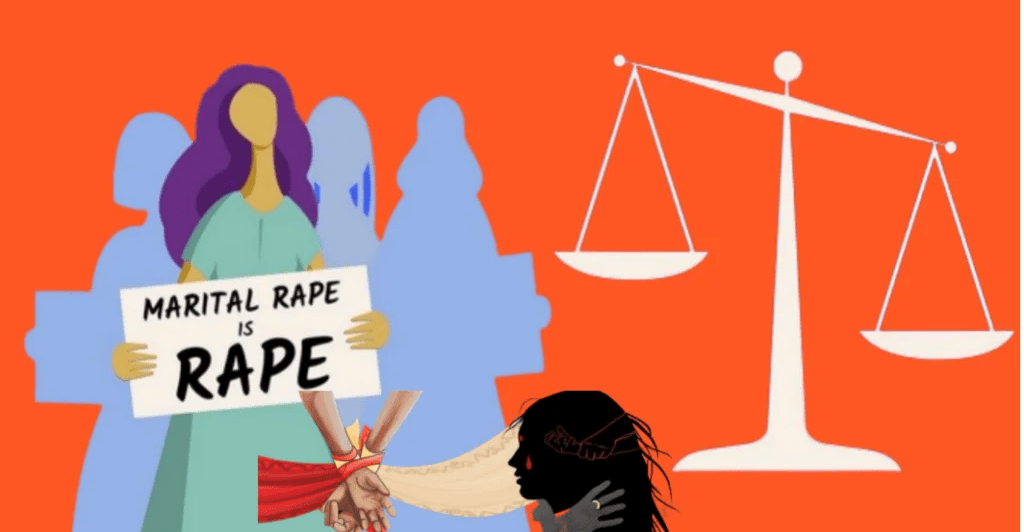
The central question persists: Can marriage operate as an irrevocable consent to sexual access, overriding a woman’s bodily autonomy?
LEGAL FRAMEWORK & THE MARITAL RAPE EXCEPTION
Under the IPC regime, rape was defined under Section 375, subject to Exception 2 which explicitly carved out marital intercourse from criminal liability. The Courts repeatedly acknowledged that this exception created a legal fiction of implied consent.
The BNS, 2023, while reorganising offences and modifying language, has not yet criminalised marital rape under Section 63, Exception 2, thereby preserving the same immunity in effect. Consequently, judicial precedents interpreting Section 375 IPC remain indispensable for constitutional scrutiny.
The legislative choice to retain the exception indicates:
Endorses marital privilege over individual autonomy
Undermines the concept of freely given and revocable consent
Perpetuates gender-based inequality under criminal law
Failure to align criminal law with evolving constitutional morality
CONSTITUTIONAL ANALYSIS: WHY THE EXCEPTION IS UNSUSTAINABLE
Article 14 – Arbitrary Classification
The marital rape exception creates an unreasonable classification between:
Married women, and
Unmarried women
Both categories are similarly situated with respect to bodily integrity and sexual autonomy. Denying married women protection from rape lacks any rational nexus with a legitimate state objective and fails the test of reasonable classification under Article 14.
Article 15 – Discrimination on Grounds of Sex and Marital Status
The exception operates exclusively to the detriment of women, granting immunity only to husbands, thereby discriminating on the basis of sex and marital status. It reinforces patriarchal assumptions that a wife is sexually subordinate, violating substantive gender equality. By insulating husbands from prosecution, Section 63, Exception 2 BNS reinforces patriarchal assumptions that a wife’s consent is subordinate to marital status.
Article 21 – Dignity, Privacy and Sexual Autonomy
Post Justice K.S. Puttaswamy v. Union of India, decisional autonomy, sexual privacy and bodily integrity are core components of Article 21 and are intrinsic to the right to life. Forced or non-consensual sexual intercourse within marriage squarely violates:
Sexual autonomy
Right to refuse consent
Right to live with dignity
Judicial interpretations of Section 375 IPC demonstrate that the exception directly negates these rights, a flaw now transplanted into the BNS through Section 63, Exception 2.
CONSTITUTIONAL ARGUMENTS AGAINST THE EXCEPTION
Violation of Fundamental Rights :
Article 14 – Equality Before Law
The marital rape exception creates an arbitrary and unreasonable classification between married and unmarried women, despite both being similarly situated with respect to bodily integrity and consent. Such exclusion lacks a rational nexus with any legitimate state objective and therefore violates the guarantee of equal protection of laws.
Article 15 – Prohibition of Discrimination
By granting immunity exclusively to husbands, the exception results in discrimination on the grounds of sex and marital status, reinforcing patriarchal hierarchies and denying married women substantive equality under the law.
Article 21 – Right to Life and Personal Liberty
The exception negates a woman’s right to bodily autonomy, decisional freedom, and dignity by legally sanctioning non-consensual sexual acts within marriage, thereby violating the expanded interpretation of Article 21 which includes sexual autonomy and privacy.
Comparative Jurisprudence & International Norms
Internationally, many jurisdictions, that is around 150 countries, have criminalised marital rape, viewing spousal immunity as a violation of human rights. International human rights instruments recognise marital rape as a violation of:
Personal liberty
Freedom from inhuman treatment
Gender equality
India remains among a shrinking group of countries where marital rape is not fully criminalised, signalling a discord with global human rights standards.
JUDICIAL PERSPECTIVE & CASE LAWS
Independent Thought v. Union of India (2017)
The Supreme Court read down Exception 2 to Section 375 IPC to criminalise marital rape of minor wives, holding that marriage cannot override bodily integrity. Though limited in scope, the judgment dismantled the doctrinal foundation of implied consent.
Karnataka High Court in X v. State of Karnataka (2022)
The Court refused to quash rape charges against a husband, observing that “rape is rape, irrespective of the marital status; rape does not lose its character merely because the perpetrator is a spouse.”. It expressly rejected the argument that marriage grants immunity for sexual violence. It emphasised that constitutional guarantees cannot be neutralised by marriage.
Delhi High Court Split Verdict in RIT Foundation v. Union of India (2022)
One judge declared the marital rape exception unconstitutional for violating Articles 14 and 21, while the other deferred reform to Parliament. This split underscored judicial discomfort with the exception’s constitutional validity.
Hrishikesh Sahoo v State of Karnataka (2022)
This case is a challenge to the Marital Rape Exception which has reached the Supreme Court to decide if the marital rape exception to Section 375 of the IPC violates the fundamental rights of married women. Previously, the Karnataka High Court reiterated the existing statutory position that:
Non-consensual sexual intercourse by a husband with his wife does not constitute rape under the prevailing criminal law framework, owing to the marital rape exception.
The Court declined to expand the scope of rape through judicial interpretation, observing that criminalisation of marital rape falls within the legislative domain.
Relief, if any, could only be sought under alternative provisions such as cruelty or domestic violence, not rape.
The Constitution of India is the paramount source of law in the country which guarantees equality before law and equal protection of laws. However, the criminal law framework has historically reflected a contradiction to this constitutional mandate by institutionalising discrimination against married women. While offences of rape are punishable under sections 375, 376, 376A, 376B, 376C, 376D, and 376D, and related provisions of the Indian Penal Code, but a husband is exempted from criminal liability of committing rape against his own wife due to the deeply entrenched and archaic presumption of marital authority. This exception perpetuates a regressive notion that subordinates women within marriage, thereby violating the right to equality. The refusal to recognise marital rape as an offence results in grave injustice to women who summon the courage to seek judicial redress for violations of their bodily autonomy and dignity. Such legal exclusion not only denies substantive justice but also inflicts profound psychological harm by invalidating the lived experiences of survivors.
The Constitution envisions marriage as a partnership of equals, grounded in mutual respect and autonomy. Given that the Indian Penal Code was enacted during colonial rule and since the British law has criminalised marital rape and 150 countries of the world have criminalised it aswell, then the question remains : “Why our country still has not criminalised marital rape as a crime?” The differential treatment accorded to women based solely on marital status remains unjustifiable in a constitutional democracy committed to equality and gender justice.
ALTERNATIVE REMEDIES: A LEGAL ILLUSION
Proponents of Section 63, Exception 2 (BNS) argue that remedies under Section 498A IPC (Cruelty) and Protection of Women from Domestic Violence Act, 2005 are sufficient. However, these provisions:
do not recognise rape as sexual violence per se,
treat forced sex as incidental cruelty, and
fail to reflect the gravity of rape as a crime
Thus, they offer only symbolic relief and cannot substitute criminalisation of marital rape.
CRITICAL ANALYSIS: WHY THE EXCEPTION IS A CONSTITUTIONAL BLIND SPOT?
The marital rape exception creates a paradox in which a woman’s non-consensual sexual suffering within marriage may amount to cruelty or domestic abuse under other sections but cannot be categorically prosecuted as rape. This bifurcation fails to safeguard sexual autonomy and reduces the severity of the harm inflicted.
Further, classifying marital rape as a “social” issue rather than a legal offence sidelines it from urgent judicial consideration, while societal stigma and patriarchal norms further silence victims.
The marital rape exception:
Converts marriage into a site of legal immunity
Subordinates consent to social institution
Treats sexual autonomy as conditional
The BNS, despite its reformist rhetoric, missed a historic opportunity to correct this injustice.
CONCLUSION
The marital rape exception in India constitutes a glaring constitutional blind spot. The retention of the marital rape exception in the Bharatiya Nyaya Sanhita, 2023 represents a constitutional failure disguised as legislative continuity. While the IPC has been repealed, its most regressive provision survives in spirit.
Judicial trends show a fractured approach, with some courts acknowledging the injustice of the exception and others upholding it. Judicial interpretations under Section 375 IPC unequivocally demonstrate that the exception violates Articles 14, 15, and 21. Marriage cannot be a licence for sexual domination, nor can the State abdicate its duty to protect bodily autonomy in the private sphere.
Criminalisation of marital rape is not just legal reform, it is a reaffirmation of the fundamental constitutional values of dignity and equality. The gap created by the exception cannot be effectively bridged by ancillary provisions; only recognition of marital rape as a punishable offence can fully protect the rights of married women.
FAQS
1. Is marital rape currently a crime in India?
No. The BNS retains the marital rape exception in effect.
2. Are there any ongoing challenges to this legal position?
Yes. Multiple petitions challenging the constitutional validity of the marital rape exception are pending before the Supreme Court.
3. Can a husband be prosecuted under other laws?
Yes. under cruelty or domestic violence laws, but not for rape.
4. Why does the government oppose criminalisation?
The government has argued that criminalisation might disrupt marital harmony and that existing legal avenues sufficiently address abuse.
5. Why rely on IPC jurisprudence after repeal?
Because constitutional challenges and judicial interpretations were developed under Section 375 IPC and remain doctrinally applicable.
6. What is the way forward?
Judicial invalidation or legislative repeal of Section 63, Exception 2 BNS.
REFERENCES
Statutes
Bharatiya Nyaya Sanhita, 2023
Indian Penal Code, 1860 (repealed)
Constitution of India, 1950
Protection of Women from Domestic Violence Act, 2005
Books
Kelkar, R.V., Criminal Law, Eastern Book Company, Latest Edition.
Pillai, K.N. Chandrasekharan, Rape: Law and Practice, LexisNexis.
Reports & Articles
Justice Verma Committee Report on Amendments to Criminal Law, 2013.
Law Commission of India, 172nd Report on Review of Rape Laws (2000).
Harshita Arora, Hrishikesh Sahoo Case: A Step Forward to Voicing Marital Rape, Indian Journal of Integrated Research in Law, Vol. II, Issue III (2022).
Flavia Agnes, Marital Rape: The Inconsistencies in the Indian Law, Economic and Political Weekly.
Amnesty International, Women’s Rights and Marital Rape Laws: A Global Perspective.
Online / News Sources
Supreme Court of India, judgments available at https://www.sci.gov.in
SCC Online Database at https://www.scconline.com
Privacy Law Library – Hrishikesh Sahoo v. State of Karnataka (2022) overview.
LiveLaw, “Delhi High Court Split Verdict on Marital Rape,” 2022.
The Hindu, “Marital Rape and Constitutional Morality,” editorial analysis.
Economic Times (Legal) – coverage of Supreme Court prioritising marital rape exception hearings.
Cases Cited
Independent Thought v. Union of India, (2017) 10 SCC 800.
X v. State of Karnataka, 2022 SCC OnLine Kar 1694.
RIT Foundation v. Union of India, 2022 SCC OnLine Del 2927.
Hrishikesh Sahoo v. State of Karnataka, 2024 SCC OnLine Kar ___.
Justice K.S. Puttaswamy (Retd.) v. Union of India, (2017) 10 SCC 1.
