Author: Siddhi Suresh Landge, B.A. LL.B., Late Parvatibai Jondhale Women’s Law College
🎯 To the Point
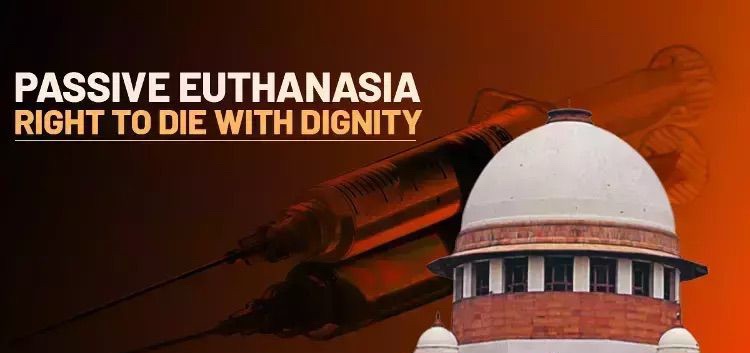
The Supreme Court in Harish Rana v. Union of India (2026) reaffirmed that the Right to Life under Article 21 of the Constitution includes the Right to Die with Dignity in limited circumstances. The Supreme Court allowed the discontinuation of medically assisted nutrition and hydration for a patient in an irreversible vegetative condition, contributing to the evolution of India’s legal approach to passive euthanasia.
⚖️ Use of Legal Jargon
The judgment engages deeply with constitutional doctrines such as proportionality, medical futility, best interest principle, and constitutional morality. The Court interpreted Article 21 expansively, holding that forced continuation of life support in irreversible medical conditions may violate dignity.
The Court relied on the framework established in Common Cause v. Union of India (2018) and clarified procedural safeguards relating to medical boards and judicial oversight. It reiterated that withdrawal of life-sustaining treatment does not constitute active termination of life but rather recognition of natural biological decline.
📌 The Proof
In the present matter, the patient had remained in a Permanent Vegetative State for more than a decade due to severe brain injury. Medical reports from independent boards confirmed that the condition was irreversible, with no possibility of neurological recovery.
The Court observed that continuing medical intervention in such cases only prolongs biological existence without restoring consciousness or quality of life. It held that dignity under Article 21 includes the right to be free from inhuman and degrading medical prolongation of suffering.
After evaluating medical evidence and consent of family members, the Court approved withdrawal of artificial nutritional support under strict safeguards. It also emphasized that such decisions must be supported by expert medical opinion and judicial scrutiny.
📖 Abstract
This article examines the constitutional and ethical dimensions of Harish Rana v. Union of India (2026). The judgment is significant as it operationalizes passive euthanasia principles in India and strengthens the legal recognition of dignity at the end of life.
It analyses how the Supreme Court balances individual autonomy with state interest in preserving life. It further highlights the evolving jurisprudence under Article 21 and its application in modern medical ethics.
⚖️Case Laws
The judgment draws its strength from multiple precedents:
1.Aruna Shanbaug v. Union of India (2011)
First recognition of passive euthanasia under strict supervision.
2. Common Cause v. Union of India (2018)
Declared Right to Die with Dignity as part of Article 21 and introduced living wills.
3. Gian Kaur v. State of Punjab (1996)
Earlier view that Right to Life does not include Right to Die.
4. Maneka Gandhi v. Union of India (1978)
The Supreme Court interpreted Article The decision significantly widened the scope of Article 21 by holding that any interference with personal liberty must be based on a procedure that is fair, just, and free from arbitrariness.
5. Harish Rana v. Union of India (2026)
Applied passive euthanasia framework to real-life medical condition and confirmed CANH withdrawal legality.
🧠Critical Analysis
This decision highlighted that the constitutional framework seeks to preserve human dignity alongside life, particularly in situations involving irreversible medical conditions. It strengthens the principle that constitutional rights must evolve with medical and technological advancement.
However, the decision also raises important concerns. One major issue is the absence of a clear statutory law governing euthanasia, which leaves courts to interpret complex ethical situations on a case-by-case basis. This may lead to inconsistent application in future cases.
Another concern is the emotional and ethical burden placed on families and medical professionals who must decide on end-of-life withdrawal. Despite safeguards, subjective interpretation of “best interests” remains a sensitive issue.
Nevertheless, the judgment ensures that decisions are not arbitrary by mandating medical board certification and judicial supervision.
🌐Contemporary Relevance
This ruling is highly relevant in modern times where advanced medical technology can artificially prolong life even in irreversible conditions. It raises important questions about human dignity in the age of artificial life support systems.
The judgment also contributes to ongoing debates on:
End-of-life medical ethics
Patient autonomy
Brain death and vegetative states
Right to dignity in healthcare
It aligns Indian jurisprudence with global human rights standards that recognize dignified death as part of personal liberty.
🧾Conclusion
In the matter of Harish Rana v. Union of India, the Supreme Court (2026) is a landmark in Indian constitutional law. It strengthens the interpretation of Article 21 by recognizing that dignity is not limited to living but extends to dying in humane conditions..
The judgment operationalizes passive euthanasia principles and ensures that unnecessary prolongation of life in medically futile situations is not forced upon patients. It reflects a humane, progressive, and rights-based constitutional approach.
At the same time, it highlights the urgent need for comprehensive legislation to regulate euthanasia in India in a structured and uniform manner.
❓FAQs
Q1. Why is this judgment considered a landmark decision?
It applied passive euthanasia principles in a real-life case. Thejudgment further affirmed that preserving human dignity in end-of-life situations is an important aspect of the protections guaranteed under Article 21 of the Constitution.
Q2. Does it allow active euthanasia?
No, only passive euthanasia under strict safeguards is permitted.
Q3. What constitutional provision is involved?
Article 21 – Constitutional Protection of Life, Personal Liberty, and Human Dignity
Q4. What medical condition was involved?
Permanent Vegetative State (PVS) with irreversible brain damage.
📚Reference
1. Harish Rana v. Union of India (2026), Judgment of the Supreme Court of India.
2. SCC Times – Supreme Court Allows First Passive Euthanasia
3. LiveLaw – Harish Rana v. Union of India (2026)
4. IJLLR Journal – Harish Rana v. Union of India: An Important Supreme Court Decision on End-of-Life Rights in India
5. Wikipedia – Harish Rana v. Union of India