Author: Tanu Rani Mahato, New Law College, Bharti Vidyapeeth
TO THE POINT
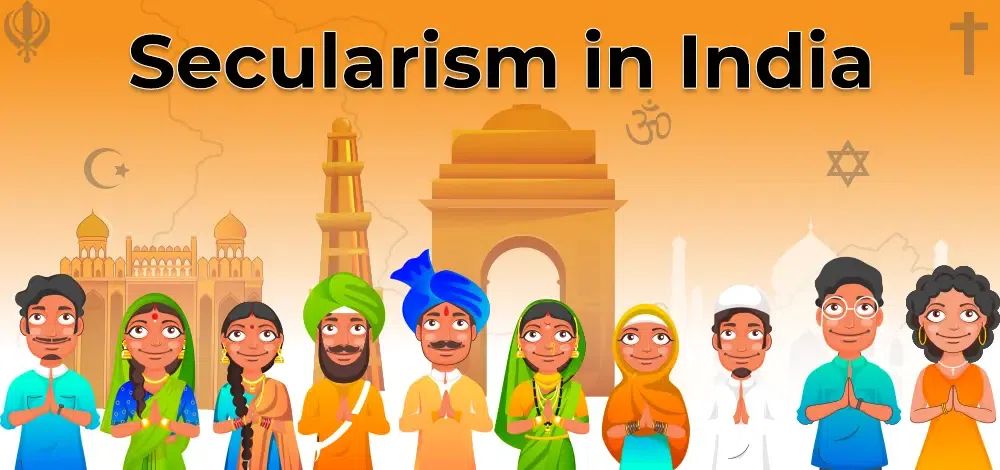
In 1976, the 42nd Amendment to the Indian Constitution introduced the term “secularism.” Secularism is the separation of church and state, which essentially means that the Indian government should not adhere to or support any one religion but should instead give equal weight to all of them. Secularism is crucial for a nation like India, which has more than five religions for protection. Based on India’s secularism, the preamble of the Indian Constitution guarantees the following fundamental rights: the freedom of conscience, the right to practice, and the right to profess. If someone violates these rights, it will be considered a crime and the offender may face legal repercussions.
ABSTRACT
Secularism is a foundational pillar of the Indian Constitution, reflecting the country’s commitment to religious neutrality and equality. It is not merely a political philosophy but a legally enforceable principle embedded in constitutional mandates. Unlike the Western notion of complete church-state separation, Indian secularism is inclusive, promoting tolerance, pluralism, and state intervention for reform. The legal landscape of Indian secularism is shaped by constitutional provisions, judicial pronouncements, and statutory mechanisms that ensure the coexistence of multiple faiths in a democratic framework.
USE OF LEGAL JARGON
Doctrine of Essential Religious Practices: Used by courts to determine whether a religious practice deserves constitutional protection.
Constitutional Morality: The judiciary’s evolving standard to assess conflicts between religious freedom and fundamental rights.
Public Order Exception: The state’s authority to intervene in religious matters to maintain law and order.
THE PROOF
Secularism in India is deeply rooted in its constitutional framework and has been reinforced through legislative, judicial, and state practices. The Preamble of the Indian Constitution explicitly defines the nation as a “sovereign, socialist, secular, democratic republic,” establishing secularism as a guiding principle of governance. This is further concretized through Articles 25 to 28, which guarantee every individual the freedom of conscience and the right to freely profess, practice, and propagate religion. These articles prohibit discrimination based on religion and ensure that the state does not endorse or financially support any particular faith, laying the foundation for a pluralistic society.
Additionally, Article 44 of the Directive Principles of State Policy calls for a Uniform Civil Code (UCC), envisioning a common set of secular personal laws applicable to all citizens, irrespective of religion, to promote equality and national integration. The judiciary has played an instrumental role in upholding and interpreting the secular character of the Constitution.
Through judicial activism, courts have intervened in cases like Shayara Bano v. Union of India (triple talaq) and Indian Young Lawyers Association v. State of Kerala (Sabarimala temple entry), illustrating how the judiciary balances religious freedom with constitutional rights and social reform. Interestingly, state practices sometimes reflect a form of contextual or accommodative secularism, where the state provides support for religious pilgrimages like the Haj or the Kumbh Mela, not to promote a particular religion but to facilitate cultural and administrative responsibilities. These acts, although debated, are often justified on grounds of preserving public order and managing large religious congregations. Together, these constitutional provisions, judicial interpretations, and administrative actions demonstrate that Indian secularism is not about the strict exclusion of religion from state affairs, but rather about ensuring religious harmony, equality, and justice within a democratic framework.
CASE LAWS
1.S.R. Bommai v. Union of India (1994)-It was held secularism to be part of the basic structure doctrine, making it non-amendable. Any anti-secular state action may lead to dismissal of the government.
2.Aruna Roy v. Union of India (2002)-Upheld the constitutional validity of introducing Vedic content in school curricula, emphasizing pluralistic secularism.
3.Indian Young Lawyers Association v. State of Kerala (Sabarimala Case, 2018)-Declared that barring women’s entry based on menstruation violated Articles 14, 15, and 25, reinforcing secular and gender-equal ethos.
4.Shayara Bano v. Union of India (2017)-Declared instant triple talaq unconstitutional, showing the judiciary’s willingness to reform religious practices inconsistent with fundamental rights.
CONCLUSION
Secularism in India is not a mere constitutional ideal but a living, evolving legal principle. It ensures state neutrality towards all religions while permitting proactive engagement when religious practices infringe upon constitutional guarantees. The Indian model of secularism is dynamic—it respects religious plurality yet subordinates religious norms to constitutional supremacy. The judiciary plays a vital role in upholding this balance, ensuring that secularism remains a bedrock of Indian democracy.
FAQS
Q1. Is secularism a part of the basic structure of the Constitution?
Yes. In S.R. Bommai v. Union of India, the Supreme Court held that secularism is a part of the Constitution’s basic structure, hence cannot be abrogated.
Q2. Can the state intervene in religious practices?
Yes. Under Article 25(1), the right to religious freedom is subject to public order, morality, and health, allowing state intervention.
Q3. Does secularism mean the State is anti-religion?
No. Indian secularism promotes equal respect for all religions and does not advocate irreligion or atheism.
Q4. Is Uniform Civil Code against secularism?
No. The UCC, under Article 44, seeks to ensure equality and justice in personal laws, thereby strengthening secularism.
Q5. Are religious institutions exempt from taxes?
Not entirely. While Article 26 grants religious denominations the right to manage affairs, these are subject to state regulation and taxation under applicable laws.