Author: Mahak Chatkele, Rabindranath Tagore University
LinkedIn Profile: https://www.linkedin.com/in/mahak-chatkele-19994a278?utm_source=share&utm_campaign=share_via&utm_content=profile&utm_medium=android_app
INTRODUCTION
The year was 1945. The world had just survived its second catastrophe in thirty years, and this time, it decided to build something fundamentally different. Not merely a treaty. Not just a handshake between governments. A promise written into institutional architecture : “never again”.
The United Nations was that promise.
But law, as history keeps reminding us, is rarely about justice alone. More often, it is about who gets to hold the pen. And the five nations who drafted the founding document of this new world order : the United States, the United Kingdom, France, Russia, and China : quietly ensured they would hold that pen permanently.
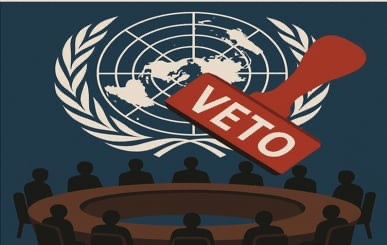
They called it the veto. One word. And with it, any single one of them can bring the entire Council to a standstill : no reasons required, no challenge permitted, no consequence attached.
Eighty years later, that word has been deployed over three hundred times. It has frozen action while populations were massacred. It has blocked condemnations while borders were violated. It has watched humanitarian disasters unfold from a conference room in New York and done nothing, because legally, nothing was required.
This is not the system breaking down. This is the system doing exactly what it was designed to do.
The veto was never built to protect the world’s most vulnerable. It was built to protect the world’s most powerful : from each other, and from accountability.
TO THE POINT
After two world wars in the span of three decades, the nations of the world arrived at a shared determination: this must not happen again. From that determination came the United Nations — an institution designed to make collective security possible and individual aggression answerable.
At its centre sits the Security Council, the body charged with translating that aspiration into action. Five nations were placed at its head, all victors of the Second World War, and each was given something no other member received: the power to say no, alone, without justification, and without appeal.
That power means a single permanent member can paralyse the Council on any substantive question. The other 193 member states have no mechanism to override, challenge, or even demand an explanation for that decision.
Since 1945, this power has been exercised over three hundred times. Genocides proceeded. Civilian populations were bombed. A nation invaded its neighbour and then used its own seat at the table to prevent the Council from even acknowledging the violation.
The Council was designed to make never again a reality. Instead, it became the mechanism through which again kept happening : legally, procedurally, and without consequence.
USE OF LEGAL JARGON
The Security Council draws its authority from the UN Charter of 1945. Article 24 confers upon it primary responsibility for maintaining international peace and security on behalf of all member states. Article 27(3) institutionalises the veto by requiring that all decisions on substantive matters receive the affirmative votes of all five permanent members, granting each an absolute power of unilateral obstruction.
Article 2(4) prohibits the threat or use of force against the territorial integrity of any state. It is among the most foundational norms in international law, and the veto has repeatedly shielded direct violations of this very provision.
The Responsibility to Protect, unanimously adopted at the 2005 World Summit, established that sovereignty cannot shield governments committing mass atrocities against their own populations, and that the international community carries an obligation to respond. Yet its application has remained entirely subject to P5 political interests. It was invoked in Libya. It was vetoed into silence in Syria.
Article 94 of the UN Charter renders ICJ judgments legally binding on member states. However, enforcement of those judgments runs through the Security Council : meaning any permanent member facing an adverse ruling, or choosing to shield an ally from one, may simply veto enforcement proceedings. The legal obligation exists in text. The mechanism to give it force does not.
This is what the jurist John Austin described as the vanishing point of jurisprudence : the place where legal obligation dissolves into political preference. The veto is precisely where that dissolution occurs.
THE PROOF
The consequences of the veto are not confined to academic debate. They are recorded in death tolls, displacement figures, and the names of places the world failed to protect.
Syria : Between 2011 and 2023, the Syrian civil war claimed over 500,000 lives. The Assad government deployed chemical weapons against its own civilian population, constituting a direct violation of international humanitarian law. The Security Council attempted to respond on multiple occasions. Russia and China together blocked over 17 resolutions. Every attempt at accountability was extinguished at the veto. The perpetrators remained in power. The Council remained in session.
Palestine : Since 1972, the United States has exercised its veto over 45 times on resolutions relating to the Israeli-Palestinian conflict. As recently as 2024, a ceasefire resolution commanding the support of an overwhelming majority of the international community was blocked by a single American vote. The collective will of 193 nations, extinguished by one.
Rwanda, 1994 : In the spring of 1994, approximately 800,000 Rwandan Tutsis were killed over the course of 100 days. UN forces were present on the ground. General Romeo Dallaire personally warned the Security Council of the planned genocide weeks before it began. No authorisation to act was granted. Political considerations took precedence over 800,000 lives. The Council did not fail to act through oversight. It made a choice.
Ukraine, 2022 : On 24 February 2022, Russia launched a full-scale invasion of Ukraine in open violation of Article 2(4) of the UN Charter. The Security Council convened. A resolution condemning the invasion was tabled. Russia vetoed it. The state committing the violation used its permanent seat to eliminate its own legal consequences. The architecture of accountability collapsed in a single vote.
Eight decades of evidence arrive at one conclusion. The veto has never protected the vulnerable. Without exception, it has protected the powerful.
ABSTRACT
When the United Nations Security Council was established in 1945, it was assigned the highest responsibility in international law : to maintain global peace and security. Central to its design was a mechanism granting five permanent members the individual power to block any Council resolution, irrespective of the position held by the remaining member states. That mechanism is the veto.
This article argues that the veto has not merely complicated the Security Council’s functioning : it has systematically hollowed out the foundational commitments of international law. The prohibition against the use of force under Article 2(4) of the UN Charter and the Responsibility to Protect doctrine adopted in 2005 have both been rendered conditional on P5 political will. Through an examination of the Council’s conduct across the Syrian civil war, the Palestinian conflict, the Rwandan genocide, and the Russian invasion of Ukraine : and drawing on the ICJ’s reasoning in Nicaragua v. United States (1986) and Ukraine v. Russia (2022) : this article contends that the veto has functioned as a legal shield for the powerful at the direct expense of the vulnerable.
The conclusion is uncomfortable but unavoidable. The veto does not represent international law’s failure. It represents its most unfiltered expression.
CASE LAWS
Nicaragua v. United States (1986) : The International Court of Justice determined that the United States had violated international law by covertly funding Contra rebels and orchestrating the mining of Nicaraguan ports. Washington disregarded the ruling entirely. When Nicaragua sought enforcement through the Security Council, the United States vetoed the attempt. A state had been adjudged guilty by the highest judicial authority in the world and walked away by blocking its own punishment. No case more starkly illustrates the practical unenforceability of international law against those who hold veto power.
Bosnia and Herzegovina v. Serbia (2007) : In the aftermath of Srebrenica, Bosnia brought genocide proceedings against Serbia before the ICJ. The Court found that Serbia had violated its obligation to prevent genocide. Enforcement, however, remained contingent on Security Council action : a body that powerful states and their political allies can effectively immobilise. The structural impossibility of accountability was made plain.
Ukraine v. Russia : Provisional Measures (2022) : Following Russia’s full-scale invasion, Ukraine initiated proceedings under the Genocide Convention. The ICJ issued provisional measures ordering Russia to halt military operations immediately. Russia disregarded the order without consequence. The court had ruled. The enforcement mechanism was paralysed by the very state it was meant to constrain.
UN Resolution 377 : Uniting for Peace (1950) , Designed as a procedural workaround when the Council is paralysed by veto, this resolution permits the General Assembly to convene emergency special sessions and recommend collective action. It was invoked in 2022, producing a 141-to-5 condemnation of Russia’s invasion of Ukraine. General Assembly resolutions, however, carry no binding legal force. The workaround exposed the depth of the problem without offering any means of resolving it.
CONCLUSION
The United Nations was built on a promise, and the veto was embedded into that promise from the very first day. Not as a safeguard for peace. As an escape route for the five most powerful states on earth.
Reform remains structurally impossible. Any amendment to the UN Charter requires ratification by all five permanent members. The P5 would veto any proposal that threatens the veto itself. Power, by design, perpetuates itself.
The veto did not break international law. It revealed international law for what it has always been at its core : a political order dressed in the language of universal obligation, where rules apply to everyone except those powerful enough to author them. A single state can initiate war, obstruct any response, and face no legal consequence. The institution built on the promise of never again became the very mechanism that made again not only possible but inevitable.
The never again the world was promised became the again and again the world was given.
Five states. One word. The world, watching.
FREQUENTLY ASKED QUESTIONS
Q1. What is the UN Security Council veto?
It is the exclusive power held by the five permanent members : the United States, the United Kingdom, France, Russia, and China — to block any Security Council resolution with a single negative vote, regardless of how many other nations support it.
Q2. Has the veto ever been successfully overridden?
Not directly. The Uniting for Peace mechanism allows the General Assembly to convene emergency sessions when the Council is paralysed, but resolutions passed in that forum carry no binding legal force and cannot compel any state to act.
Q3. What is R2P and why has it not worked?
The Responsibility to Protect is a doctrine unanimously adopted in 2005, establishing that state sovereignty cannot shield governments that commit mass atrocities against their own populations, and that the international community bears an obligation to respond. In practice, its application has been entirely determined by P5 political interests. It was invoked in Libya. It was vetoed into irrelevance in Syria.