Author: Aditya Kumar Singh, Dharma Samaj College, Aligarh, Uttar Pradesh
Abstract:
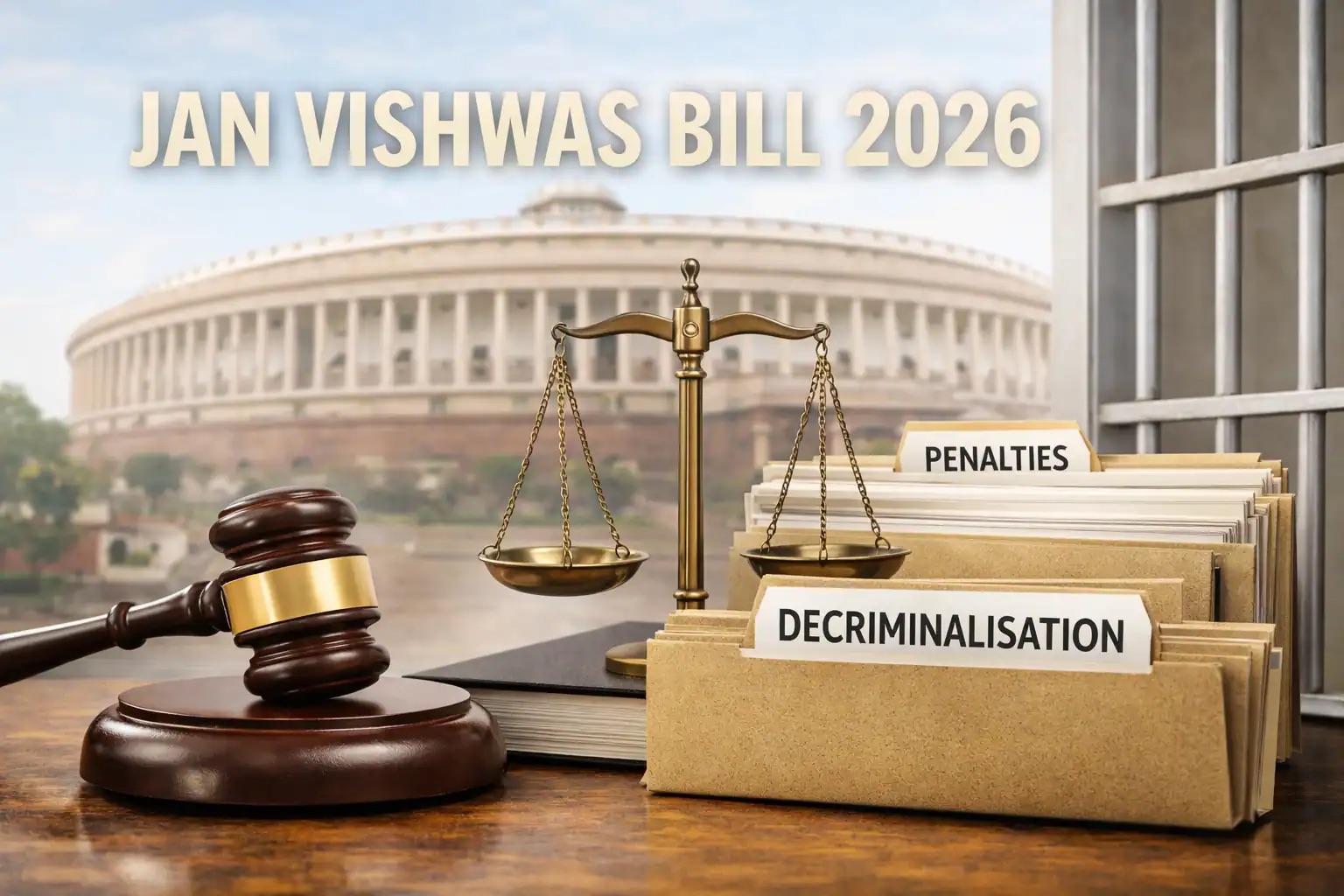
This article is all about how the Jan Vishwas Bill 2026 is changing old Indian laws. For a very long time, our legal system had rules that could send someone to jail for just making a tiny mistake in business paperwork or missing a date. This new bill changes that by removing jail time and replacing it with simple fines. In my opinion, this is a wonderful step because it stops regular people and small shopkeepers from facing heavy punishments for accidental errors, making everyday life much easier.
To The Point:
The main thing to understand about the Jan Vishwas Bill 2026 is that it wants to clean up our legal system. It focuses on two big goals: Ease of Living and Ease of Doing Business. Right now, there are many sections in different central laws where even a small typing mistake or a delay in giving a report can make you look like a criminal. This bill removes those scary prison sentences. Instead of treating innocent citizens like dangerous criminals, the government will now use small monetary fines or just give a warning notice to fix the mistake.
Use of Legal Jargon: Since I am a new law student, I want to explain the actual words used behind this bill in a very simple way. The first main concept is “Decriminalization.” This means taking away the ‘crime’ tag from an action, so the police cannot arrest you for it. The second concept is “Proportionality.” This is a basic rule of justice which says that the punishment must always fit the crime. If someone’s mistake is very small and unintentional, it is highly unfair to threaten them with a prison cell. Therefore, this bill respects this rule by replacing jail time with basic administrative penalties.
The Proof: We can easily see the practical benefits of this bill in the real world. For example, under laws like the Motor Vehicles Act or rules for small businesses, if a person forgets to renew a document on time, they used to face immediate court cases. Now, with these changes, they will first get an official ‘Improvement Notice’ from the authorities. This notice gives them a fair chance to correct their mistake within a few days without going to court. This practical shift is very important because it builds trust between the government and ordinary citizens and people do not have to live in constant fear of the law.
Case Laws: To understand this better, we can look at some old landmark judgments and also some very recent court cases from 2024 and 2025. All these cases show that our judges also think exactly like this bill:
1. Shreya Singhal v. Union of India (2015):
In this famous case, the Supreme Court cancelled a bad section of the IT Act because the police were using it to arrest innocent people for just posting their opinions online. The court said that a law should never be so wide that it starts punishing innocent behavior. This is exactly what the Jan Vishwas Bill is trying to fix.
2. State of Rajasthan v. Balchand (1977:
In this historical case, Justice Krishna Iyer said a beautiful line: “Bail is the rule, jail is the exception.” This means putting a human being in prison should always be the absolute last option, not the first reaction. Threatening someone with jail for a paperwork delay goes completely against this rule.
3. Registrar of Companies v. Shahi Exports (2025):
This is a very recent judgment where the Supreme Court was unhappy because criminal action was taken against a company just for submitting documents late. The court clearly ruled that procedural delays cannot be called a crime. Unless there is a real intention to cheat, only civil penalties should be used.
4. Sun Pharma Laboratories v. Union of India (2025):
Recently, the Delhi High Court handled a matter where someone tried to start a criminal case because of a minor printing error on a medicine pack. The High Court stopped the case and said there is a massive difference between a technical printing mistake and a real crime. A simple fine or warning is enough for such small slips.
5. M/s XYZ Logistics v. State of Maharashtra (2024):
In this recent business case, the Bombay High Court noted that Ease of Doing Business cannot happen if small traders are always scared of inspectors and prison. The court strongly agreed that solving minor rule breaks with simple fines instead of long court cases is the best way forward.
Conclusion:
In conclusion, the Jan Vishwas Bill 2026 is a highly necessary and positive change for India. It finally gets rid of the old British-era mindset that looked at every citizen with suspicion. Now, the system is moving toward a trust-based model. In my opinion, this bill is a great boon for startups and normal people. However, as a student, I feel its success will depend on whether the officers collect these fines honestly without harassing people. Also, it should be clear that this relief is only for honest mistakes; if someone commits a real fraud or hurts public health, they must be sent to jail immediately. Overall, this is a proud step for our country.
FAQs:
Q1. Does the Jan Vishwas Bill mean people can break any law safely?
Answer – Absolutely not. It does not forgive serious crimes, big frauds, or things that harm public safety. It only changes the punishment for minor, technical, and accidental paperwork mistakes from jail to small fines.
Q2. How will this new bill help our overloaded court system?
Answer – Since these small mistakes are no longer crimes, their cases will not go to the regular courts. Instead, special administrative officers will handle them in their offices. This will save a lot of time for our judges, allowing them to focus on serious cases like murder or big scams.
Q3. Why is this bill important for law students and internships? A
Answer – This bill shows us how practical law is evolving in India. It helps us understand that the purpose of the legal system is not just to punish people, but to create a fair, smooth, and balanced society for everyone.